

Three ash piles on a scorched road and a horse that turned left on its own. A citadel that was precisely what it needed to be. Lightbringer fit his hand as though it was made for it. Five became six. Meanwhile, something sinister moves.
The wolf mask had been comfortable.
They always were, at first. A new face carried a kind of freshness—the novelty of a different voice in his own ears, a different set of memories to sort through and file. Lance Ashcroft had been a well-organized man, which made the work easier. His history was tidy, his ambitions legible, his social connections mapped and maintained with efficiency. The man understood that influence was a garden requiring constant tending.
He had been useful. For a time.
He stood at the edge of the ballroom and watched the room with Lance Ashcroft’s eyes, through Lance Ashcroft’s face, wearing Lance Ashcroft’s patience—and felt the certainty of the evening arrive, cold and complete.
The girl was not going to yield.
He had known it before the masquerade. He had known it from the moment he watched her on the dance floor, before the masks came off. There was something in her that did not bend in the ways he needed. Not stubbornness, exactly. He had broken stubborn people before. It was something deeper.
The bloodline, of course. He understood that now. The immunity ran through her the way water runs through limestone, invisibly, shaping everything it touched. He could not drain her. He could not take her. And without that, all the elegant social machinery of a courtship—the careful words, the champagne, the manufactured intimacy of a garden bench at night—was precisely what it appeared to be.
Performance.
She had seen through it. Not because she was suspicious by nature, though she was. But because there was nothing in her that the performance could find purchase on any more than the draining could. He had offered her a door, and she had stood in front of it and told him, with perfect courtesy, exactly what kind of door it was.
What do I become, if I say yes?
He turned the champagne flute in Lance Ashcroft’s fingers—slowly, without thinking, a habit the man had carried and that he had absorbed. Four thousand years and he still caught himself doing things with borrowed hands that the original owners had done without knowing why.
The Ashcroft hands were familiar, in their way. He had worn them before—not these hands, not this man, but the great-grandfather’s. A baron, in those days, with a baron’s access and a baron’s usefulness. It had been the work of months to perfect the ducal seal—the practice forgeries, the careful repetition until the impression was indistinguishable from the original. The ring he had made himself. When the letter was finished and the Duke of Wentworth was hanged for a treason that had never occurred, he had burned what he no longer needed and moved on to the next face.
He had not thought about the forgeries in decades. A servant had pulled them from the fire before they were fully consumed—not out of loyalty to the Wentworths, but out of the oldest human instinct: leverage. The servant had imagined blackmail. But you don’t blackmail immortals.
He had drained the servant to death, prolonging his own life, searched the premises thoroughly, and found nothing. The documents had been hidden somewhere he could not locate, by a dead man who could no longer say where.
He had made a decision—one he had made many times across many centuries: if the thing resurfaced, he would handle it when it did. Most things did not resurface. People died, houses were sold, hiding places were lost to time. He had calculated the odds and moved on to the next face and the next century.
He had, apparently, miscalculated.
And yet here was the Wentworth girl, standing in a restored manor, wearing a restored title, the sharp intelligence behind the swan mask catching everything and giving nothing back. The documents had found their way to the queen. The Duke had been exonerated. The title was law.
It was an irritation. Not a wound—he did not suffer wounds, not in any sense that lasted—but a loose end he had thought he had accounted for. It did not matter now. The restoration was done, and the girl’s bloodline had made her beyond his reach in any case. What mattered was that the Ashcroft name had served him once, across a generation he had long since vacated, and was serving him again now in the great-grandson’s body. There was a tidiness to that which he appreciated, the way he appreciated all things that closed neatly upon themselves.
He had come to the masquerade with a plan. The plan had been Scarlet—the land, the name, the clean resolution of a complicated legal situation through a marriage that would have solved everything at once. The Wentworths had spent eighty years without the land. They were motivated. The girl was capable. It would have worked elegantly if she had been anyone other than who she was.
But she was who she was. And the land still needed acquiring. He was considering this—turning it over with the same unhurried patience he applied to every problem of duration, which was all of them—when he saw the unicorn.
The boy was seventeen, perhaps. Taller than Scarlet but with the same coloring, the same quality of attention in his eyes that the girl used to see through people and the boy apparently used to be charmed by them. He was dancing with a butterfly—a genuinely pretty creature in a gown of layered silk, her movements exactly as light as the wings she wore. They were laughing.
He watched them complete a turn.
The boy’s name was Charles. He had been at the dinner table. A younger son—the Viscountcy of the River, once the Wentworths had their land back, which was not yet but was the direction things were moving regardless of what happened to Scarlet. A younger son was not nothing. A younger son, properly positioned, was in fact quite a lot.
He watched Charles say something that made the butterfly laugh again.
The plan revised itself with the clean efficiency of something that had been waiting for its pieces to arrive. The land did not require Scarlet. The land required a Wentworth. Charles was a Wentworth. Charles was also seventeen, which meant he was at exactly the age when a man’s judgment is most thoroughly routed through his feelings, and his feelings were currently located somewhere in the vicinity of that butterfly’s smile.
The butterfly’s name was Isabelle. Lady Isabelle Marlow. He sorted through Lance Ashcroft’s social memory and found her there: minor gentry, Bravia, no complications. A gentle family. A small estate. A daughter known for her warmth and her genuine sweetness, both of which Charles Wentworth appeared to be in the process of discovering in real time.
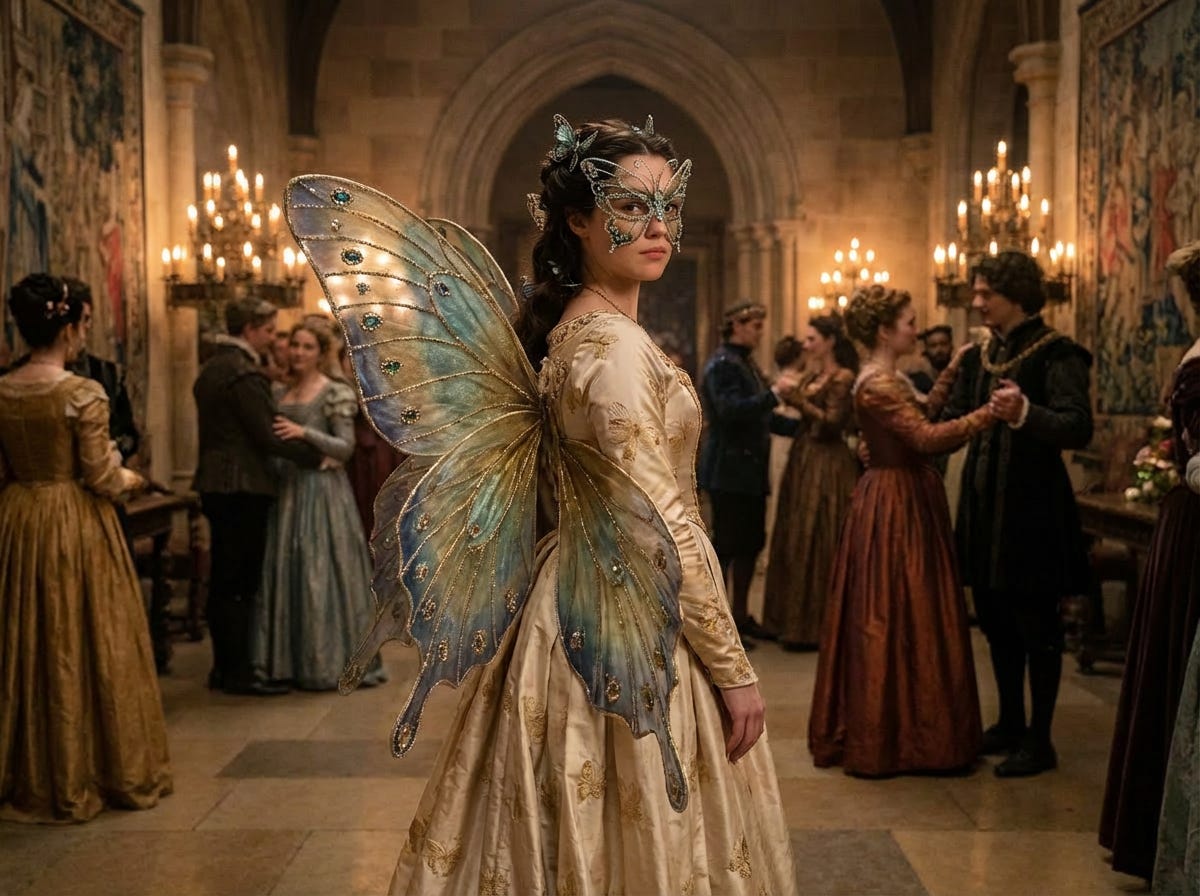
He watched her laugh.
No complications, he thought.
He set the champagne flute on a passing tray. There was no urgency. There never was. He had learned, across a very long life, that the worst mistakes were made by people in a hurry, and he had stopped being in a hurry sometime in the second millennium. Lance Ashcroft still had uses. The body was in good health. The social position remained intact.
And Isabelle Marlow was still entirely unaware of him.
Charles Wentworth had not intended to dance with anyone four times.
He had intended to be pleasant, and present, and not embarrass Scarlet, which were the three instructions his mother had given him and which he had resolved, with some sincerity, to follow. He had managed the first two. The third had become complicated approximately forty minutes into the evening, when a butterfly had asked him if he thought the peacock on the far side of the room was aware of how much he sounded like one.
He had laughed before he could stop himself. It was exactly the right thing to say.
Her name was Isabelle, which he did not learn until after the first dance, and then the second, and then after they had stood at the edge of the room for twenty minutes talking about everything and nothing with the ease that only comes when you are not yet afraid of the other person. She told him the peacock’s name was Lord Duvall and that she had been dreading his inevitable conversation all evening, and Charles had felt a warmth he did not entirely have a name for, which was the warmth of being genuinely liked by someone worth being liked by.
She was not trying to be interesting. She simply was. That was the thing about her—Isabelle Marlow seemed entirely unaware of her own quality, which made it more apparent rather than less. She had opinions. Not strong ones, but real ones, held gently and offered without an agenda. She disagreed with him twice during dinner, both times correctly, and apologized for neither.
He had traded seats with Scarlet to sit beside her, which had the secondary effect of moving Scarlet one seat closer to the owl. He had noticed the owl. He had also noticed how carefully Scarlet did not look at the owl, which amounted to the same thing. He would think about that later.
Right now there was Isabelle.
The dancing had resumed after dinner, and he had asked her a fourth time without quite planning to, and she had said yes without the pause that would have told him she was being polite. They moved through the last dance of the evening with the ease of two people who had already sorted out the basic questions and were simply enjoying the fact of being in the same place.
She was not Scarlet’s height—shorter, with the kind of face that arranged itself into warmth as its natural expression. When she laughed, which was often, something happened in her whole face that Charles could not have described if someone had asked him to. He was seventeen and the vocabulary for it had not yet arrived.
The music came to its end.
They stood in the middle of the floor while the room rearranged itself around them.
“I should find my mother,” Isabelle said, though she didn’t move immediately.
“I should find mine,” Charles said. “She’ll have opinions about the evening.”
“Do you dread that?”
“Surprisingly, no,” he said. “Her opinions are usually correct. It’s just that she delivers them before you’ve had time to arrive at them yourself, which takes some of the fun out of it.”
Isabelle considered this with what appeared to be genuine recognition. “Mine does the same thing. I used to find it irritating. Now I find it humorous. I know what she’s going to say before she says it.”
Charles was quiet for a moment.
“That’s a very grown-up way to feel about it,” he said.
She smiled. “I’m practicing.”
He thought about that on the carriage ride home, while Scarlet sat across from him and their mother said measured things about the evening that were actually less measured than they appeared. He thought about Isabelle’s face when she said I’m practicing—direct and a little amused, but sincere.
He told Scarlet, when their mother was speaking with the driver at the house, that Isabelle was precisely what her butterfly wings had promised.
Scarlet was quiet for a moment, and then nodded, with the expression she got when she had already decided something and was letting him arrive at it himself.
“She is a sweet girl,” Scarlet said.
This had caused him to smile, which he hid by turning his face to the side of the carriage.
Four weeks later, somewhere in the gardens of Marlow House, in the blue hour before the household rose, Lady Isabelle Marlow walked alone along the garden path she had walked every morning since she was a child.
The dew was still on the grass. The light had not yet decided what color it intended to be. She was thinking about a letter she had received the previous week—Charles Wentworth’s handwriting, careful and slightly too formal, which she had found endearing—and whether the reply she had drafted was too eager, and whether being too eager was actually a problem when the thing you were eager about was real.
It was he who had written that he wondered if he had become too fond of her for his own good, which had driven that very eagerness on her part. She thought the fondness was very good for both of them.
She felt the chill first. Just a chill, the kind the morning sometimes brought down from the hills. She drew her shawl tighter and walked on.
Then the isolation—a sudden, absolute quality to the quiet around her, as though the birds had stopped and the house behind her had moved very far away and the garden had become a room with no doors. She slowed her step. Something told her to turn back. She had no name for what she was feeling and no reason for it.
She did not turn back.
The presence found the door it had been looking for and entered without force, without pain, without any of the violence that might have made it comprehensible. It simply arrived. She felt a dimming—not of the light, which remained exactly as it was, but of herself, of the part of her that had been Isabelle since she was old enough to know she was Isabelle. It receded like a tide, slow and complete, until she was standing in her own body the way a stranger stands in a house whose furniture has all been moved.
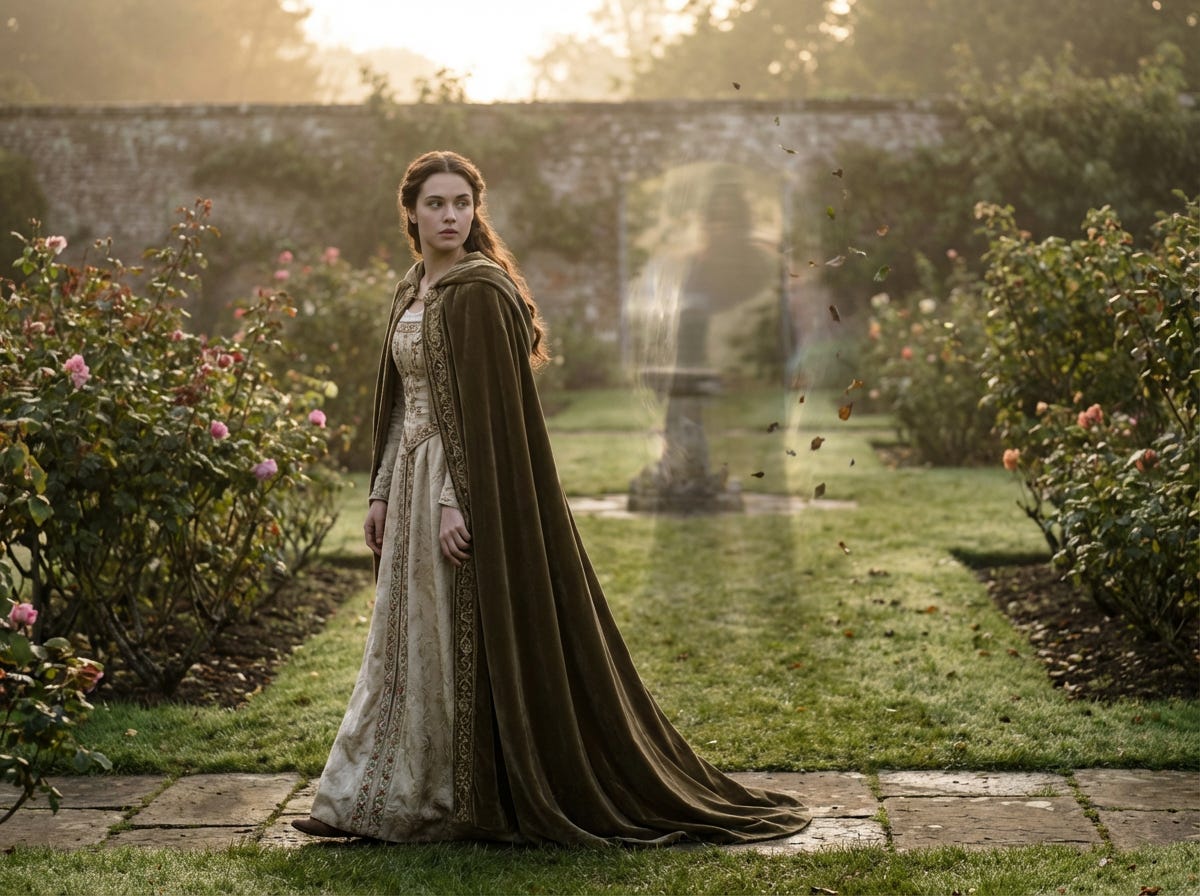
She paused at the window in the garden door, caught her reflection in the glass.
She did not see the invisible presence. She could not feel the malevolence. But it looked back at her from behind her own eyes, and smiled the slow smile of something that had just found a very comfortable place to live.
It looked at the reflection for a long moment.
When Charles Wentworth arrived for tea that afternoon, she was entirely herself—warm, gentle, direct, and real in all the ways he had come to rely on. She laughed at the right moments. She disagreed with him once, correctly, and did not apologize. She touched his hand when she said goodbye.
He noticed nothing.
He would not notice for a very long time.
And by then, it would be too late.
Stephen B. Anthony is the author of Transmigrant, an epic science fiction thriller, available on both Amazon and Audible. The first seven chapters are available on this website for free.
Oh nooo. It’s getting so much deeper and darker
You’re so good at building the romance that it’s all the more unnerving when things start to go sideways 😭