

Nine blades on nine rests. Five became six became seven became eight. A sword that had been rattling in its holder all day flew across the courtyard pommel first and landed in her outstretched hand. Welcome, Number Nine.
The vault opened when all nine stood before it.
No key. No mechanism they could see. Yselle had examined the doors twice already in the days before Scarlet arrived—running her small hands along the seams, tapping the stone, tilting her head as she did when she was listening to something just below hearing. She had found nothing. The doors had simply waited.
Now they swung inward without sound.
The room beyond was not large. Stone walls, a vaulted ceiling, a single window set so high and narrow it admitted a column of light no wider than a man’s hand. The light fell on a table, and on the table sat the archive. A single bound volume, its cover dark with age, set apart from everything else as though it had always known it would be opened last.
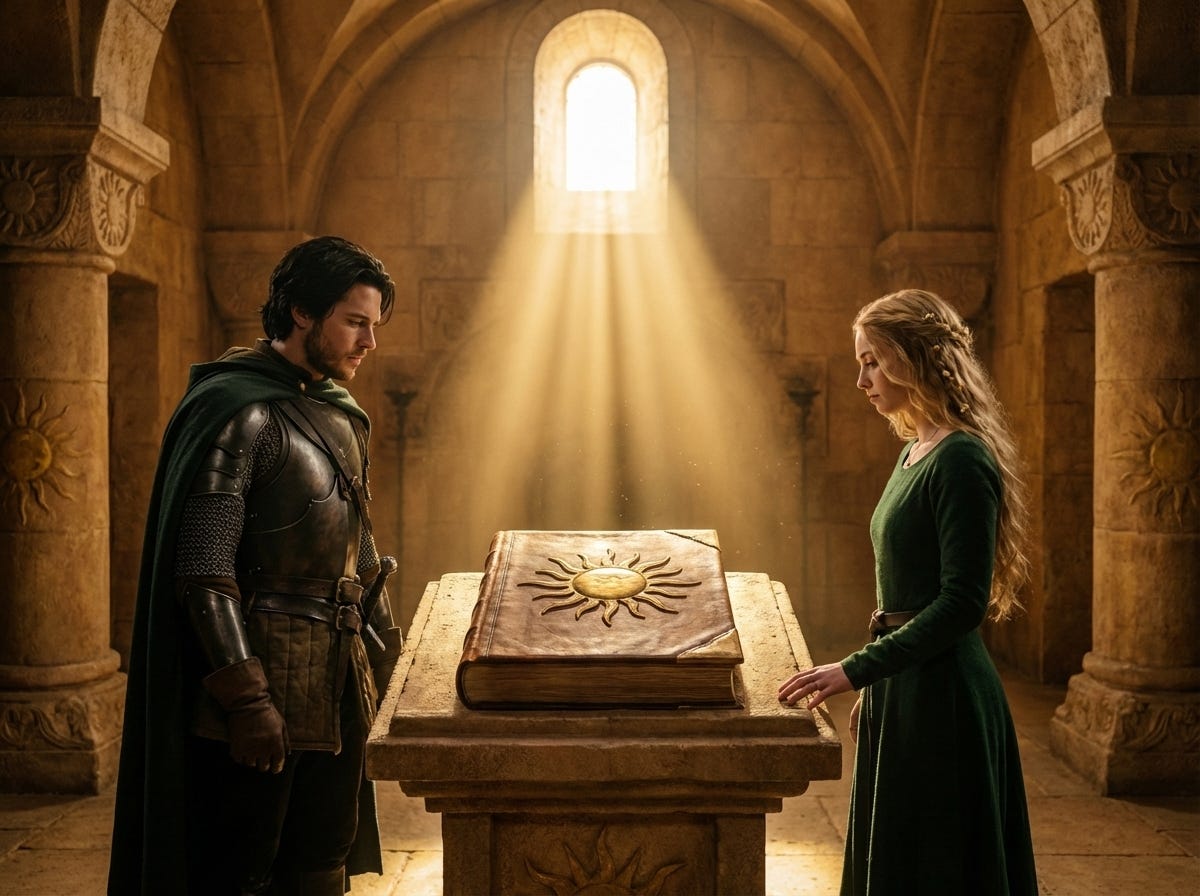
Scarlet was still holding Lifegiver. She hadn’t sheathed it since the gate. The pale light of the blade caught the column of sun and threw it softly across the table.
“Drogoth may be our most learned,” Philip said. “Why don’t we start with the text you brought from Drakkar?”
Drogoth nodded and read to them from the text.
It concerned itself with time. How one person lives one hundred years, but another only seventy, and what happens to the missing thirty years. What happens to the time normally allotted a person if that person is stillborn? What becomes of their lost years? Does it accumulate somewhere in the cosmos? Does Abba keep track of the balances of fate such as this?
The treatise continued in this vein, waxing philosophical about equities and inequities in life in all matters—not just time, but wealth, love, appreciation, kindness, and the negative things like anger, hatred, abuse, injustice. Is it Abba that tracks these balances, or does she not care? Does the afterlife adjust for these inequities experienced in life?
“It leaves ambiguous the identity of the pawn of the Imprisoned One, but then names nine justices called by Epherion to judge his evildoing,” Drogoth said.
“And we are the nine justices,” Yselle said. “And you are the chief justice, Lightbringer.”
Philip’s jaw set. He said nothing.
“My teachers suggest the text was apocryphal and probably not true, but so far it has turned out to be true,” Drogoth said.
“Let’s open the archive,” Philip said.
Drogoth nodded and opened the cover, gently. It was clear that he was used to old tomes of this nature.
The script was archaic in places but not unreadable—someone, at some point in the book’s long history, had made a careful copy in a cleaner hand, and it was this he followed. The first pages were history: the founding of the order, the making of the blades.
“On the world anvil!” Chenguer said. “So it does exist.”
“So it would seem,” Senna said.
“Doesn’t mean the worldtree doesn’t though,” Amira said. “I’ve always believed both myths carried some truth.”
Aldric spoke. “Some in Elindor think that both myths are simply metaphorical and that Epherion merely spoke and the world began, that he willed it and life sprang from the world, that he thought it and the Aelvaeni were the first to rise.”
Drogoth read aloud.
…that Shaetan, though bound beneath Elduros, had not ceased his corruptions, but had worked upon Abba and Solenne through the long darkness of his imprisonment, turning their compassion to his purpose as water turns stone. He overcame them slowly, and without their knowing.
And it is written that this compact (between three who ruled and one who was dying) was not a gift but a devouring. For the years stolen back from death carried with them no more than the shell of what had lived. The self that separates breath from mere wind, motion from mere water, was not returned. The soul kept by Solenne. The balance of years stolen from Abba and turned to extend, without end, their hollow existence.
What walked thereafter walked without it. Neither of the living nor of the dead, but the Unfinished. And over these the Usurper held dominion, being himself a man unmade by the same hunger, reduced from flesh to will alone, and that will bent entirely toward the purposes of the Imprisoned One.
For it is the belief of Shaetan (and here the author must tread carefully, for to write it plainly is to give it a dignity it has not earned) that the will of a creature is the source of all its suffering. That choice is not a gift but a wound. That if the choosing were taken away, what remained would know only peace.
This the author names a lie. But it is a lie that has the shape of mercy, and that is the most dangerous kind.
It is further written (though the author confesses uncertainty) that such a creature, lacking body, may move between the living as water moves between stones, and that those it inhabits are not destroyed but diminished, and that what is done through them is done against every faculty they possessed.
Whether this is true, the author cannot say. But the author has seen what they leave behind.
Silence settled over the vault.
“So something does, in fact, control those undead—those Unfinished,” Scarlet said.
“It seems to me that Ashcroft controlled them,” Philip said. “But he is now dead.”
“Was he possessed by this Usurper then?” Wardyn asked.
Scarlet said nothing for a moment.
She remembered the hollowness of Lance Ashcroft. The times when he did not know she was watching—when he stopped seeming real, stopped seeming human, until he became aware of her again and the mask of life returned to his features. She had told herself it was brooding. She had told herself it was his nature.
But then Ashcroft had proposed to her. Had he done so while controlled by this Usurper? Is that why it had never felt true? And if true—if the real Lance had remained hidden away somewhere in a mind commandeered by an ancient spirit—then what had he endured? What had been done through him against every faculty he possessed, as the archive put it, while he was still in there?
She sat with that for a long moment.
“Poor Lance,” she said, quietly.
“What do you mean?” Yselle asked.
“I think he was possessed,” Scarlet said. “I traveled with him during that time, and he was always trying to manipulate me. When he did not get what he wanted, Lance was no longer useful to the Usurper. That is why he died.”
“What did he want from you?” Philip asked.
Scarlet swallowed hard. She had avoided this subject with Philip up until this point. She thought about it for a moment—her goal to not hurt the one she loved.
“He wanted to resolve the dispute between our families.”
“How?” A beat, and then something shifted in Philip’s expression. “Oh. I suspect this means he had an alternative plan to the queen’s designs.”
Scarlet looked away, the directness of his understanding too precise in the moment.
“No,” he said. “It makes total sense if you think about it from the perspective of a Usurper. He just had no idea who he was up against.”
She looked back at him. His face held nothing but steadiness and a quiet, unperforming kindness.
Whatever she had felt for Philip—for Edmund—prior to that moment was no longer the largest version of itself.
Chenguer drew his sword—Constellation. “Somehow this is related to him. Somehow this is a map to the Usurper and his Unfinished.”
The others turned to him.
“I just need to figure it out,” he said.
“Do you mean you think you can find him—the Usurper?” Amira asked.
“Possibly,” he said. “But I don’t understand any points of reference or coordinates.”
“What do you see?” she asked.
“I see a web of interconnected nodes. I can pan around it and see them. I see where some of them are broken. I see that some of the web strands are stronger and some are weaker.”
“Can you travel through the nodes?” Scarlet asked. “Can you search through it?”
“I’ve been trying that, and sometimes I do hop from node to node in my vision, but I don’t know why or how that happens.”
“A way to find the Usurper would change everything,” Philip said. “Keep working on it.”
“I haven’t been able to think of anything else,” Chenguer said.
“What more is there in the archive?” Philip asked.
“The names of every knight are here,” Drogoth said.
“Is it true that a member of the Knights Celestial has to take a new name?” Scarlet asked.
“They are called a new name,” Philip said. “But they remain who they are in reality. I am still Edmund, though I am called Philip as a member of the Knights Celestial—and this is how everyone but you calls me.”
“Edmund?” Chenguer asked. He chuckled. “I’m going to remember that.”
“You do that, Wei Liang,” Philip said.
“How—how did you know my true name?” Chenguer asked.
“I know them all,” Philip said.
“How?”
“I just do.”
Chenguer nodded.
“So I’ll need to take a new name,” Scarlet said.
“The names of the nine justices are given here,” Drogoth said. “The nine who will be called by Epherion. Wardyn, your name is here.”
Wardyn studied the text. “I thought I was picking that name of my own free will.”
“Prophecy is strange that way,” Drogoth said.
“So you are all named there,” Scarlet said. “What is the ninth name?”
“Esmerelda Hale,” Drogoth said. “Apparently that’s your name in the order.”
Scarlet and Philip looked at each other.
The name had been written here for two thousand years. Before she was born. Before her parents were born. Before the Wentworth title was stripped and the family fell and she grew up in three rooms with a crack in the wall that let in the cold. Before any of it. The archive had known what her life would cost her, and it had written down what she would be called when she came out the other side.
Drogoth read:
She shall lay down the name her parents gave her and take up the name the order gives her, and in doing so she shall find that the name she lays down has not been lost, but merely held until she becomes ready to carry both.
“Ready to carry both?” Scarlet asked. “I wonder what that means?”
“We don’t give up our names,” Wardyn said. “I am still Haddagan, but I will no longer be Krang among my people.”
“We give up titles?” Scarlet asked.
“The calling is singular,” Amira said. “We forsake those ties for the greater good.”
Scarlet stared at the older woman. She understood what that meant. The Wentworth name. The name she had spent her whole life fighting to restore, had stood in a theater and asked sixteen hundred strangers to trust. She would now be asked to give it up in the hour of finally realizing her success. She would become something else. Something that had been waiting in a book on a table in a locked room since before her grandmother’s grandmother drew breath.
“May I read it?” Scarlet asked. “If it’s about me?”
Drogoth stood aside as she read the words.
Scarlet read them over twice, the inscription ending at the bottom of the right-hand page. When she let out a sigh, the page turned on its own. She hadn’t touched it. And then she read what the ninth was called to do.
She shall restore what is taken, return what is stolen, and in extremis she shall stand at the threshold of death and pull back what the darkness would keep. The cost shall be proportional. She shall not be spared it. She shall not ask to be.
She thought about Philip at the pool, the quill poison working through him, his eyes finding her face with the last strength he had. She thought about what she had felt move through her when she prayed—not her own strength, something older and larger that had used her hands as the nearest available instrument.
She had not known what it was then. Now she did.
She closed the book carefully.
Around her, the others were moving—Chenguer had found something in a secondary document that he was showing to Drogoth, Wardyn stood before a carved relief on the far wall with his arms folded, Senna and Aldric were reading together over a second table. The vault was full of quiet industry, the nine finally understanding what they had been summoned to understand.
Scarlet stood at the table with her hand resting on the closed cover of the book and said nothing.
The sword was warm in her other hand. The column of light had shifted slightly as the sun moved, and it fell on her now instead of the table.
She didn’t move out of it.
“We are to war against the Usurper, a creature of spirit and shadow, and defeat his minion to prevent them from taking more lives—more years—from the people,” she said.
“I think that about sums it up,” Chenguer said.
“That was—is—the purpose of the Knights Celestial,” Philip said. “Epherion established us to defeat the pawn of the Imprisoned One.”
“But what is the Usurper’s purpose?” Amira asked.
“And,” Aldric added, “what were the terms of the bargain that he made? The vault said he was once a man.”
Stephen B. Anthony is the author of Transmigrant, an epic science fiction thriller, available on both Amazon and Audible.
Loving where this is going!
Oof, it’s getting intense again!