

Scarlet and Krang Hadagan have reached a peace accord through fire pit diplomacy and horse meat. Fifty thousand acres of borderland where Urukesh and human will learn to be neighbors. On to Faerlong Dell…
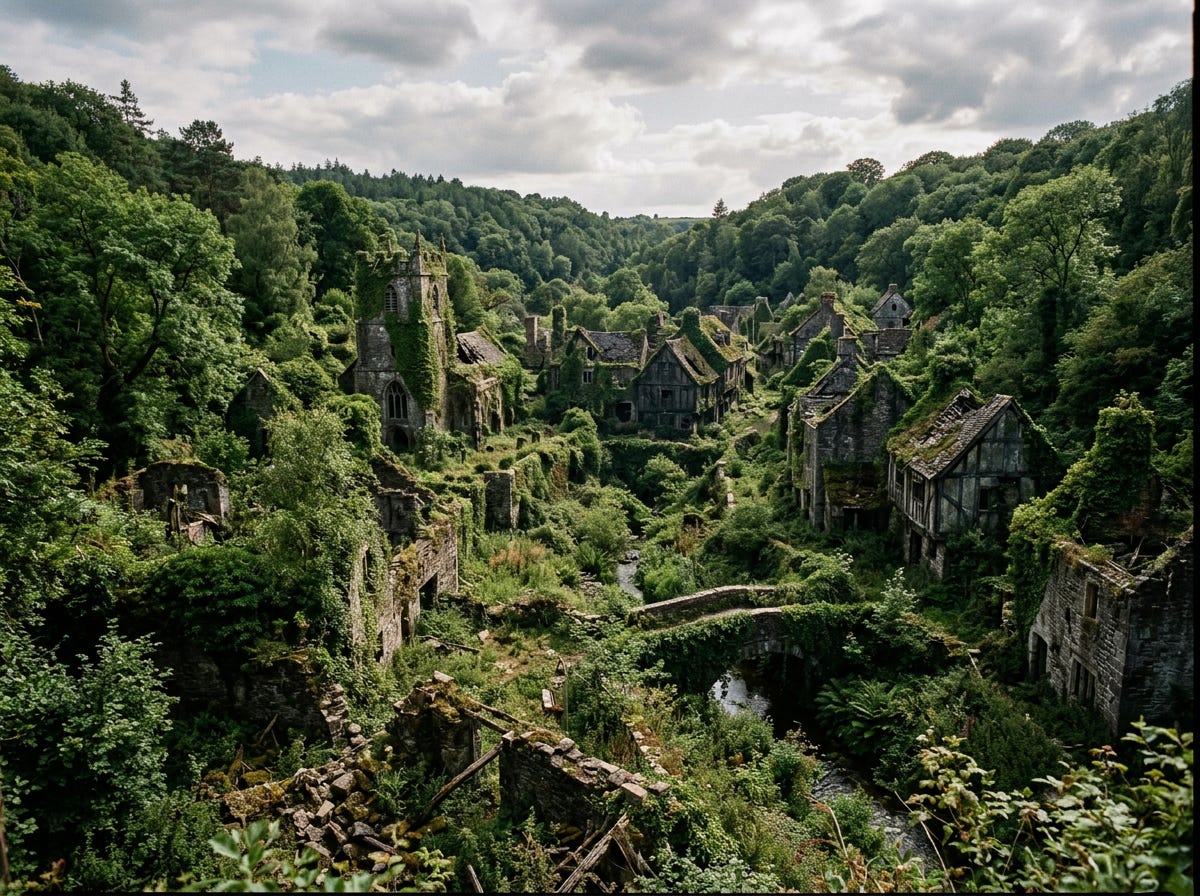
The road into Faerlong Dell had not been a road for some years. Grass had taken the ruts, and the tree line on either side had crept inward, branches meeting overhead in places, making a tunnel of green-gold light that the horses moved through without complaint.
Scarlet and Philip rode at the front, the armor of the Knights Celestial catching what light filtered through the canopy. Among her people she was still Scarlet, and they called her so, and she answered.
Nobody else spoke.
The village revealed itself slowly. A roofline through the leaves. Then a garden wall, still standing, with something that had been roses gone entirely to cane and thorn. A well with a wooden cover warped off its hinges. Doorways standing open to the weather, and inside them the dark and the smell of damp and the beginning of moss.
But the bones were good. Anyone who had ever kept a house could see it. The stone was sound. The walls stood plumb. War and occupation, not rot or fire, had driven people out.
A bird moved in the eaves of the nearest house and then was gone.
Scarlet did not dismount immediately. She sat her horse and took in the whole of it—the quiet street and the untended green and the long grass bending in the slight wind—and felt it settle in her. It was her land, but it needed work.
“Listen,” Philip said.
She stilled and tilted her head.
The sound of a hammer nailing something came to her ears.
“Someone’s already here,” he said.
They rode on further and found people. Not many—just enough to suggest a slow remigration had already begun. A town that once held three or four thousand people was now home to fewer than two dozen, all of them two generations removed from the original owners.
A man on a ladder, shoring up a stone wall in a house with no roof, caught the movement of the column and climbed down quickly, stepping out into the overgrown street to meet them.
“Fine morning, lords and ladies,” he said. “We weren’t expecting a wagon train.”
Scarlet and Philip both dismounted, as did others with them.
“Fine morning to you, too,” Scarlet said. “I am Scarlet Wentworth. What might your name be?”
“Lady—Wentworth? Returned? Begging your pardon, I’m Moses Miller.”
“This is your family home?”
“Aye. Belonged to my grandfather Abner Miller. But it’s in worse shape than I feared. Roof completely gone, two walls in a state of disrepair, floorboards rotted. It’ll take me seasons to complete it.”
“We’re here to help,” Scarlet said. “I have with me two thousand of our fellow countrymen and women who intend to settle here temporarily. I am no construction expert, but we have people of that skillset among us, and I think we begin by working on individual homes. We’ll start with yours if you would like the help.”
“Absolutely,” Moses said. “If you’ve got a stonemason with you, I have some questions I’d like to pose.”
“I’ll see to it, my lady,” Travis said without being asked.
“Bertram, Marcus. Let’s spread out and find the people who are here in need of assistance. It’s not yet ten in the morning and we can get in many good hours of work to help these fine people get one home at a time ready for habitation.”
“Pardon, my lady,” Moses said. “But there is a crew working on the town hall as we speak. We could use some help there as well.”
“Excellent,” she said. “We’ll pitch in.” She paused. “I wonder if you might direct me to two women: Charlotte and Patty.”
“You’d be talking about the Thompson sisters what are restoring their family home, two streets east. They’ve got their brother David running them ragged.”
Charlotte and Patty came out of their rundown home when they saw the two knights approaching in gleaming white and gold armor. A man with a similar build and features—presumably their older brother—came with them, dripping with sweat. The trio were filthy from the work.
“Fine morning,” Charlotte said. “My lady, my lord.”
“I am no lord,” Philip said.
“Oh!” Patty said. “You’re Sir Philip Beckwith of the knights!”
Charlotte stepped closer, studying Scarlet’s face.
“My lady, haven’t I met you somewhere before?”
“Yes,” Scarlet said, dismounting. “At the Whitewater Inn, weeks back when you were on your trip to see the floating gardens of Stormrest.”
“Yes!” Patty said. “You’re Esme, if I remember right.”
“I’m sorry that I deceived you at the time,” she said. “I’m Scarlet Wentworth.”
“What—the Lady Wentworth?” Patty said.
“And we treated you so common,” Charlotte said, feeling abashed.
“You treated me as a person,” Scarlet said. “And that’s what I needed at that time.”
Patty turned briefly toward Philip, then back. “Told you the sights were worth seeing out at the garrison, my lady.”
“You did indeed. And you were right.” She almost blushed.
“What brings you here, my lady?” David asked.
“I have brought many people from Psalter’s Point. My company numbers north of two thousand. Come to settle here temporarily and help recover the town. Can I send some people your way to help with your home?”
David took a step back. “To—to help us?”
“Yes. We have carpenters, stonemasons, woodcutters, you name it. We’ve suddenly got a whole community here to help bring Faerlong Dell back to its former glory.”
“I could definitely use the help,” he said. “These two spend more time gossiping than working.”
Scarlet smiled. “I’ll send people your way.”
“Would you stay for some tea?” Charlotte offered. “My lady. Last we knew you were headed somewhere in the east. Would love to catch up.”
“Another time?” Scarlet asked. “There’s much to see to today and the sun is moving quickly.”
“Two thousand people?” David asked. “That’ll be an enormous help for the town.”
“Let me be the first to tell you,” Scarlet said, “that the war with the Urukesh is now over. We have signed a peace treaty. There will be no more hostilities and, if you meet an Uruk traveling, they are to be left unmolested.”
“Peace?” David asked. “What, in my lifetime? Is that really true?”
“It is,” Philip said. “Lady Wentworth met with the Uruk leaders yesterday, drew new territory lines, and put an end to it. The Urukesh were ready for it to end as well. So yes, it is finally behind us.”
“That calls for a celebration!” David said. “I’ll be one moment.”
“Any excuse to get out his whiskey,” Charlotte said under her breath.
And that’s exactly what he did.
The remainder of the day saw Scarlet and Philip moving from home to home—about fifteen of them—offering assistance from the skilled crafters formerly of Psalter’s Point. It was gladly accepted by the resettlers, who carried fatigue and in some cases despair over what they had found in Faerlong Dell.
The streets had been cleared first, because they had to be. Two thousand people needed to move, and the overgrowth and debris wouldn’t permit it. Teams had gone through with scythes and axes and bare hands, pulling the long grass back from the cobblestones, dragging aside the fallen timber and the broken tile and the years of accumulated windfall. The cobbles themselves were mostly intact beneath it all, which drew more than one remark.
The broken tiles had not been wasted. Someone—nobody was quite sure who had started it—had begun sorting them into piles, loading them into carts, and depositing them in sorted fashion near the river bank. The piles had grown throughout the day as more people understood what they were for. By midafternoon there was enough crushed grog to begin mixing the first clay, and three long trench-cuts had been opened in the riverbank where the clay ran good and deep. Children too small for heavier work had been given the job of gathering broken tiles, fetching water, or treading the mixed clay with their feet. The latter job had been met with enthusiasm.
Moses Miller’s house had a rough thatch over its frame before noon. It wasn’t pretty, and Moses had said so, and been roundly ignored. Two stonemasons had looked at his walls, argued briefly with each other about the better approach, and reached a consensus by midafternoon. The sound of chiseling had not stopped since.
The town hall had required more hands and got them. Its roof frame was largely intact, but the tiles were in a state of disrepair. A crew had spent the day clearing the interior, relaying the fallen rafters, and beginning the slow work of salvaging tiles that had come off whole. Perhaps a third of them had. The rest would wait for one of the six clamp kilns that were nearing completion by dinnertime.
Twelve homes had been assessed. Four had been deemed sound enough to sleep in that night with minimal work. The other eight were projects, some of them long ones, but none of them hopeless.
And the cook fires. That was perhaps the thing that changed the feel of the place more than anything else. Smoke rising from dozens of chimneys that had not drawn in a generation, the smell of food moving through streets that had smelled only of damp and abandonment that same morning. People sat on stoops that weren’t theirs yet and ate together and the sound of conversation filled the gaps between the houses.
David Thompson had shared his whiskey more broadly than perhaps he intended, and nobody had complained, except David Thompson, who ended the evening with no whiskey.
The undead came before midnight.
Stephen B. Anthony is the author of Transmigrant, an epic science fiction thriller, available on both Amazon and Audible.
Love the details of the rebuilding. What a cliffhanger 😭
THAT LAST SENTENCE NO