

Last Chapter: Cold storage and the truth about Philip said simply while holding a lamb leg. A study that smells of pipe smoke and the story of the boy from the fireplace. The real signet on the desk where it always belonged.
“My lord,” Philip asked, as he knocked on the doorframe of the study door. “Do you have a moment?”
“Come in, Philip,” he said, “and close the door.”
Philip did as asked and crossed to the desk, but he waited to be invited to sit.
The duke didn’t offer. They stood on opposite sides of the mahogany desk.
“So you’ve spent some time with my daughter?”
“I have, sir.”
“Do you think you can handle her?”
Philip paused. “Any man that would make such a claim would be unworthy of her, sir.”
“Quite right,” Caspian said. “Let’s sit.”
“Thank you, sir,” Philip said. He waited for the duke to sit and then sat across from him.
The afternoon light came through the curtains at a low angle, laying a stripe of gold across the desk between them.
The duke steepled his fingers, placed his jaw on his thumbs, and regarded the young man. At last, he said, “I wonder if I’ve done myself a disservice a dozen years back.”
“How so, my lord?”
“Scarlet has informed me that you are the very same street urchin who I told her to stay away from when she was ten years old, give or take.”
Philip thought about that for a moment. Started to say something, then stopped. A beat later he spoke. “I wasn’t quite a street urchin,” he said. “But I suppose I can see why someone might think that, and I wouldn’t blame anyone for thinking it. But, in fact, I was a working child. I began working when I was eight and I have worked ever since.”
“A working child?”
“I delivered baked goods. In fact, that’s how I met Scarlet. But she was called Esme at the time.”
“Esme—” Caspian whispered. A brief smile flashed on his face. “You know, I thought I was the only one who used that nickname.”
“That’s what she called herself when we met,” Philip said.
“Did she?” He drummed his fingers on his desk. “That’s interesting.”
“But what disservice have you done yourself in those days?”
The duke smiled. “I warned her off of you.”
“How was that a disservice to you?”
“If I’d have let it go, she might have gotten tired of you on her own. Instead, she had this idealized memory of you—a memory against which no other man could ever measure.”
Philip kept his expression steady. “You’ll forgive me, sir, if I don’t take that as negatively as you might.”
“A fair point,” Caspian said, nodding. “There’d be no reason for you to be unhappy about being the standard for her. But I should like to think her father ought to be the standard.”
“We might not be that dissimilar, sir.”
“I can’t tell if you’re slick or sincere, young man.”
“No one has ever accused me of being slick, sir. It’s not really my nature, nor I think, yours. But let me answer you directly so there’s no mistake. I am absolutely, one hundred percent sincere about your daughter. I beg you to never think otherwise.”
“Let’s say I don’t doubt your sincerity then, Philip. Let’s then go to intentions.”
“I intend to love your daughter until the day I die.”
“As will I. So will many people. Indeed, it’s nearly impossible to know her without loving her.”
“The difference is that I make her happy. Would you want a man who was annoyed by her insatiable drive, or one who is inspired by it? Would you want someone who saw her flaws, or someone who saw them as beauty spots? I have held an idealized version of her for fifteen years, my lord. And having found her—I find the reality exceeds it.”
Caspian nodded. “Do you like her?”
“Yes, sir. She makes me laugh. She frustrates me sometimes if I’m being honest, but she has this way of making you forget that because she’s just so intent on what she’s trying to accomplish. I can’t help but admire her.”
“Tell me about it,” he said wistfully. He cleared his throat. “Now the hard part.”
“Sir?”
“The Knights Celestial. You recognize what you’re asking her to give up?”
“I have nothing to do with that, sir. That is something between her and Epherion. I won’t interfere with her calling and I won’t pretend it’s for me to decide.”
“You would not dissuade her?”
“If I had my way, I would have her stay somewhere safe and leave that kind of thing to me. But then I’d be asking her to be someone she’s not, and I can never do that.”
The duke opened the bottom right drawer of his desk and produced a bottle of whiskey and two glasses. He poured two before putting the bottle away.
“Very well,” Caspian said. “You may ask.”
“My lord. I seek your blessing to ask Scarlet to be my wife through all of our days.”
“She is my most precious jewel.”
“Mine too,” Philip said.
Caspian slid the second glass across the desk. Philip picked it up.
“To good women everywhere,” the duke said. “To Scarlet.”
“Hear. Hear,” Philip said.
They downed their glasses.
Isabelle arrived via carriage around three in the afternoon. She was greeted by Charles who had been waiting impatiently for her.
He gave her his hand.
She took it and stepped down.
“Good afternoon, my love,” he said. He hugged her.
She hugged back. Her arms were there. The warmth was not. Disappointed all over again, he led her into the drawing room where the family sat, accompanied by several people she did not know. The fire had been lit against the chill, and the room smelled of woodsmoke and the cut flowers Elise had arranged that morning.
Charles introduced each of them to Isabelle. She curtsied to each, saying a kind word or observation, unique to each individual.
“I’ve saved you some petit fours,” Scarlet said, winking.
“What was that?” Isabelle asked.
“Petit fours,” Scarlet said, eyebrow raised. “You told me at Christine’s they were your favorite dessert.”
“Yes, indeed,” Isabelle said. “Thank you for remembering.”
She took just one.
Scarlet noted it. The girl certainly didn’t seem in need to watch her weight. If anything, she looked more scrawny than she had at the masquerade. She wondered, briefly, if the girl had become sickly and this was why Charles was seeing her differently.
“Are you well, dear?” she asked Isabelle.
“Quite well, thank you,” Isabelle said.
“Is my brother treating you well?”
“Perfectly,” she said. “He’s always a gentleman.”
The petit four remained untouched as she held it in a napkin on her lap.
Charles took in the napkin and then met Scarlet’s eyes briefly. He gave her a very slight shrug of his shoulders. He’d been observing. That was Charles in a nutshell.
Cook had chosen lamb for dinner, which no one was unhappy about except Wardyn. “We don’t eat goat or lamb,” he said.
“But you eat horse,” Scarlet said.
“Horse is delicious,” he said. “I find lamb and goat distasteful.”
Charles took in the curved horns and filed that away.
“I’d be happy with more of that ham from earlier,” Wardyn said.
Chenguer arrived with Christine just as Cook was bringing the first course out, which saved them both from missing anything important and saved Elise from having to hold the table. Christine embraced Scarlet with both arms and held on longer than was strictly necessary, which Scarlet didn’t mind at all.
They found seats. The table filled. The wine went round. The candles had burned down an inch since the first course. Outside, the wind had come up, and somewhere in the house a shutter was tapping irregularly against its frame.
The sickness idea wouldn’t leave Scarlet as she kept watch on Isabelle throughout dinner. At the masquerade dinner, she had been lively, to the point of annoyance in Scarlet’s mind, about how delicious everything was. She’d commented on the herb-crusted Corvaire hens, the garlic potatoes, and the Drakkaran wine, not to mention the petit fours for afters. But today, she was eating mechanically. She called the food delicious when Scarlet asked, but gone was the delight the girl had once had for flavors.
Scarlet had heard of sicknesses that caused loss of appetite and taste, and she decided to mention it to Isabelle.
“If you’re not feeling well, our house doctor is a very capable man. I can send him to your room after dinner.”
“Thank you, but no,” Isabelle said. “I’m perfectly fine. I’m just not that hungry. I ate so much at teatime.”
Except she hadn’t even eaten the one petit four she had taken. Scarlet let it go after that, but saw Charles register their exchange. She turned her attention to Christine who was talking about having a second party.
“I keep thinking about the masquerade,” she said, to no one in particular. “How strange it was to spend an entire evening with people and not know who any of them were.”
“Stranger still,” Chenguer said, “to know exactly who someone was, and have no way to say so.”
Christine turned to him. “Did you know? Even then?”
“I knew enough,” he said.
Elise, who had been there for the story of the jade pendant, smiled and said nothing.
“I think that’s the thing about masks,” Scarlet said. “They’re meant to hide you. But sometimes they do the opposite. Sometimes you see a person more clearly when everything else is stripped away.”
“The owl,” Philip said quietly, beside her.
“The owl,” she agreed. She didn’t look at him, but her hand found his under the table. “I thought—here is someone I recognize. And I didn’t know his name. Didn’t know his face. Didn’t know a single thing about him that I could have told you the next morning. And yet I knew him.”
Someone reached for the wine. A chair shifted. The candles guttered briefly as the shutter knocked again outside.
“That’s sweet,” Elise said. “Did you think the same thing, Sir Philip?”
“We were ten years old, playing in abandoned buildings, with different names entirely. And yet—something was still there.”
“You didn’t recognize each other at all?” Drogoth asked.
“We were so different then. Plus we had different names completely.”
“Remarkable,” Wardyn said. “Clearly you were meant to find each other. You knew each other at some higher level.”
“I suppose what frightens me,” Scarlet continued, her voice still easy, still conversational, “is the reverse. Thinking you know someone. Being quite certain of it. And then realizing the person in front of you is not who you thought at all. That what you knew was only the surface, carefully arranged.”
She reached for her wine.
Isabelle had gone very still.
Charles noticed. His sister’s eyes were on her glass, her expression thoughtful and distant, as though she were talking about something that had happened a long time ago.
Which she was.
Isabelle’s jaw hardened.
Charles noticed that too.
Scarlet was awake, but she could not have said why. There was no sound, no premonition. Just a restlessness that had come over her in the small hours, a vague sense of the world being slightly wrong that she had learned, since Helios, not to dismiss.
She was already watching the door when it opened. She had heard the soft footsteps, deliberate, the kind that meant to be quiet. She had her hand on the lamp before the figure stepped into the doorway.
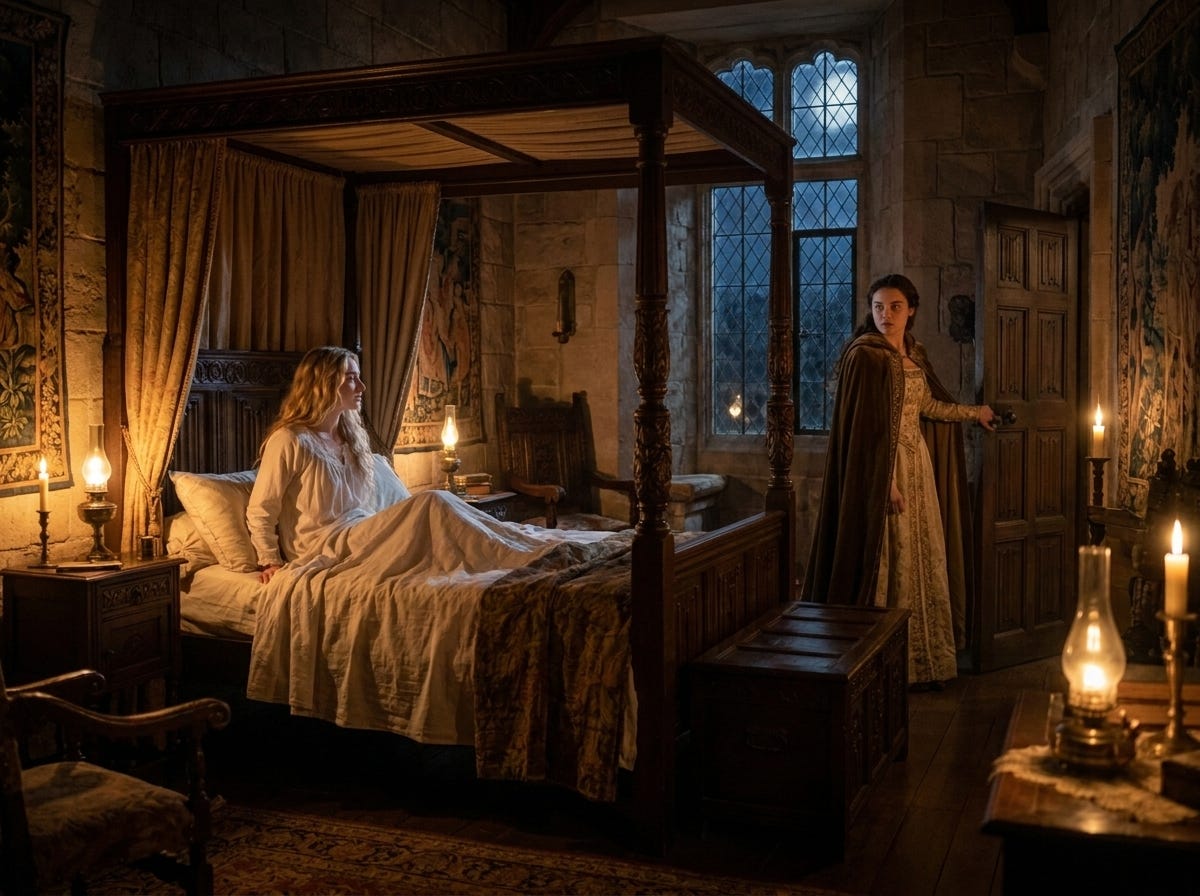
Isabelle.
She was in her nightdress, her dark hair loose, her face pale and composed, arranged into an expression that was almost Isabelle’s but not quite. The lamp threw her shadow long across the floorboards as she stepped inside, making her appear taller than she really was.
“Forgive me for intruding,” Isabelle said.
“Lady Isabelle,” Scarlet said. “What is wrong?”
She crossed to Scarlet. “Something you said at dinner got me thinking—”
“About what?” Scarlet asked. “Do you think you might be ill after all?”
“You’re really quite clever, aren’t you?” Isabelle said.
The voice was Isabelle’s. The cadence was not.
“What do you mean?”
“Compulsion is useless.” Her hands were at her sides. “Shadow to no avail. Charms ineffective. Seduction pointless.”
Scarlet set the lamp on the side table and rose to sit at the edge of the bed, reaching her hand to Isabelle’s shoulder, comforting her. “What are you talking about?”
Scarlet’s eyes dropped, briefly—to Isabelle’s right hand, which had moved to the fold of her nightdress.
“One thing always works,” Isabelle said.
“Works?”
“Steel always works,” Isabelle said.
Somewhere outside, the shutter fell silent.
The dagger caught the lamplight as it came up—and Scarlet’s arms crossed in front of her, training and instinct moving faster than thought. Not fast enough. Isabelle was faster than she should have been, and the blade came through the crossed guard and pierced her left breast before Scarlet could pull back.
She heard herself make a sound she had never made before.
Stephen B. Anthony is the author of Transmigrant, an epic science fiction thriller, available on both Amazon and Audible.
WHAT
Ahhhh!!! Nooo Scarlet!!!!! (Loved the nuances with the masquerade conversation)