

Chenguer was in the dark watching two threads from one person, saying nothing because uncertainty announced prematurely does more damage than silence. Wardyn’s blade has sundered the connection between Isabelle and the Usurper, freeing her from its clutches. Scarlet has been mostly healed. But now, something is stirring. All of them.
It didn’t begin everywhere at once. It began in specific places.
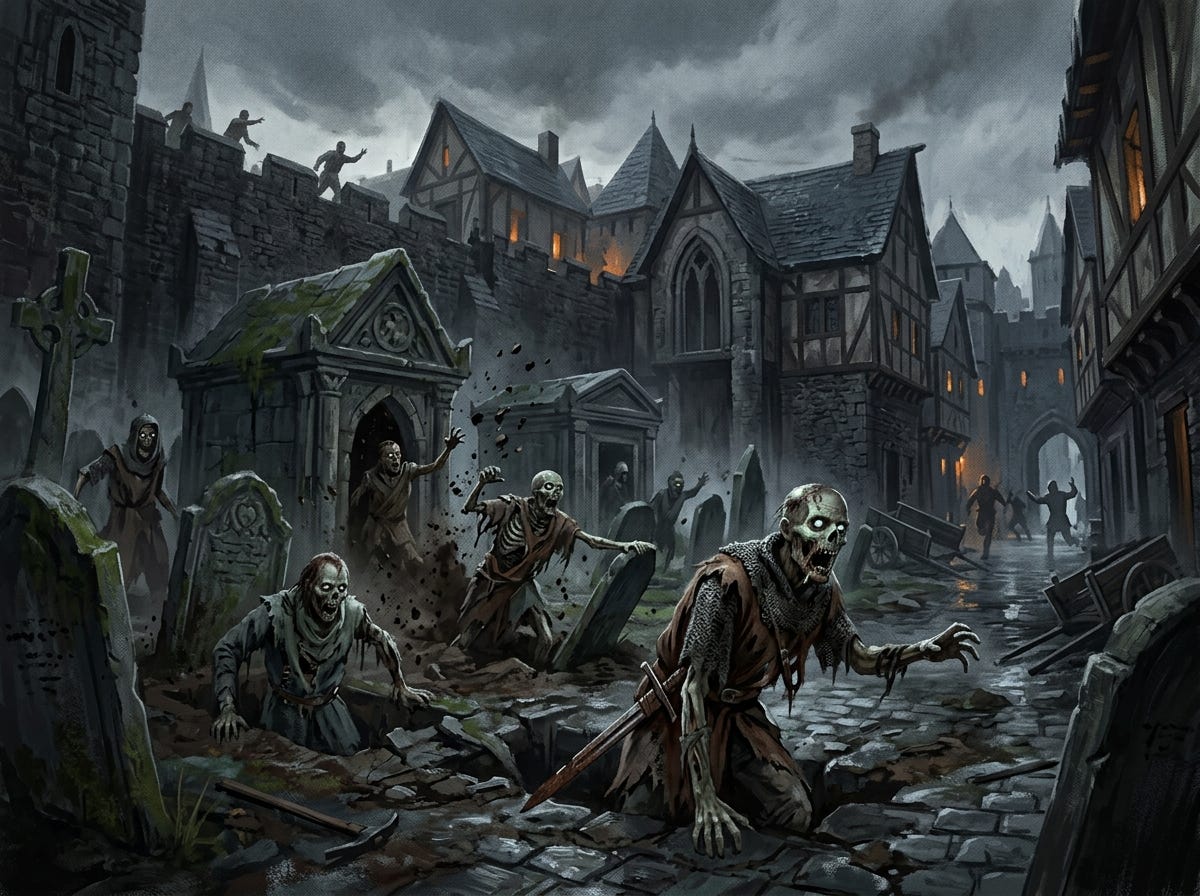
The war memorial grounds east of the river, where soldiers from five border campaigns lay buried. The overflow graves outside the south wall from the last Urukesh push, six years back. The unmarked section behind the harbor that everyone in the harbor district had learned to walk past quickly at night.
These were the concentrations of untimely dead, and these were what moved first. The graves didn’t erupt. They opened slowly, and somehow that was worse.
A woman on her way to the harbor at dawn stopped at the gate of the memorial grounds and watched the nearest stone shift and tilt. She stood there longer than she should have, trying to make sense of what she was seeing, and then she ran. Later she would remember that she hadn’t screamed. She wouldn’t understand why.
In the streets nearest the memorial grounds, doors began closing. A carter left his horse in the middle of the road and walked away from it quickly. Two boys who had been throwing stones at a gutter rat stopped throwing and stood very still. The sound of the city changed. It did not stop, but it changed.
A night watchman on his last round before dawn heard something beneath the cobblestones—a slow, grinding pressure, stone against stone—and stopped walking. He stood over it for a long moment, lantern held low, and then he blew the lantern out and did not move again for a very long time.
It was not a siege from without. It was a rising from within.
Philip sent two riders west before the city had fully understood what was happening. A hard ride to Faerlong Dell. Further still to the garrison. Wardyn wrote a note in the time it took Philip to saddle, sealed it, handed it over without a word.
Winterhaven had been the first thing hit. The castle sat nearest to the largest concentration of graves, and the dead had moved outward from where they rose without preference or strategy. Philip learned this from a guard who had gotten out. He did not go to see for himself. There was nothing to be done there, and the city needed him where he was.
The city stretched out below. Smoke rising from four separate fires being used as barriers. The smell of burned corpses drifting on the cold air. In the streets Philip could see his own people moving, learning the patterns, getting better. They had not broken. That was the first thing he looked for every time he came back to this roof, and every time so far it had still been true.
He sat beside Chenguer.
“There are fewer than there were,” Chenguer said.
“We’ve been fighting all night.”
“Outside.” Chenguer turned his head east. “Something is coming from the east. Something they feel.”
Philip looked at the road. It would be empty until tomorrow, if the rider had gotten through, if help had come at all.
He stayed on the roof.
Then Chenguer stood.
“Philip.”
Christine’s thread, moving fast away from Kestrelmont. The flow of auburn hair visible below—on horseback, heading toward Wyndmere.
“Go,” Philip said.
Scarlet worked.
The keep’s great hall had become a triage room in the first hour. People simply brought the injured to the largest interior space and began laying them on the long tables, and by the time Scarlet understood what was happening there were eleven people in various states of depletion, and the city guards who had carried them in were already going back out.
She started at the left end of the first table and worked right.
The theft of years left its evidence clearly. The face was the most obvious sign—a person drained of a decade looked a decade older, which in the young looked like sudden cruel aging and in those already old looked like collapse, the last reserve of vitality gone in an instant. But it was the hands she had learned to read first. The way they lay when a person had no strength to move them. The texture of the skin.
She did not let herself think about how quickly she had learned to read it.
The third was a boy, perhaps sixteen, a house guard’s apprentice by his jacket. Someone had carried him in over one shoulder and set him down without gentleness because there had been no time for gentleness. He had been drained past the point of consciousness. She worked through him slowly, and when she straightened he was breathing steadily, though he would not wake for hours.
By the seventh she could feel the wound in her chest again. She had worked through worse. She worked through this.
By the eleventh—a guard who had been drained on the south wall and carried in unconscious—she could feel it clearly. She sealed him and straightened and held her hand over her chest for a moment, breathing.
The cost shall be proportional. She shall not be spared it.
She moved to the next table.
Wyndmere was two miles from the keep. Chenguer rode hard, took the long way around the memorial grounds, and kept his eyes on her thread the whole way.
Then it flared—almost too bright to look at—and contracted back to faint.
The gates stood open, which was wrong. He came through at a canter and pulled up hard.
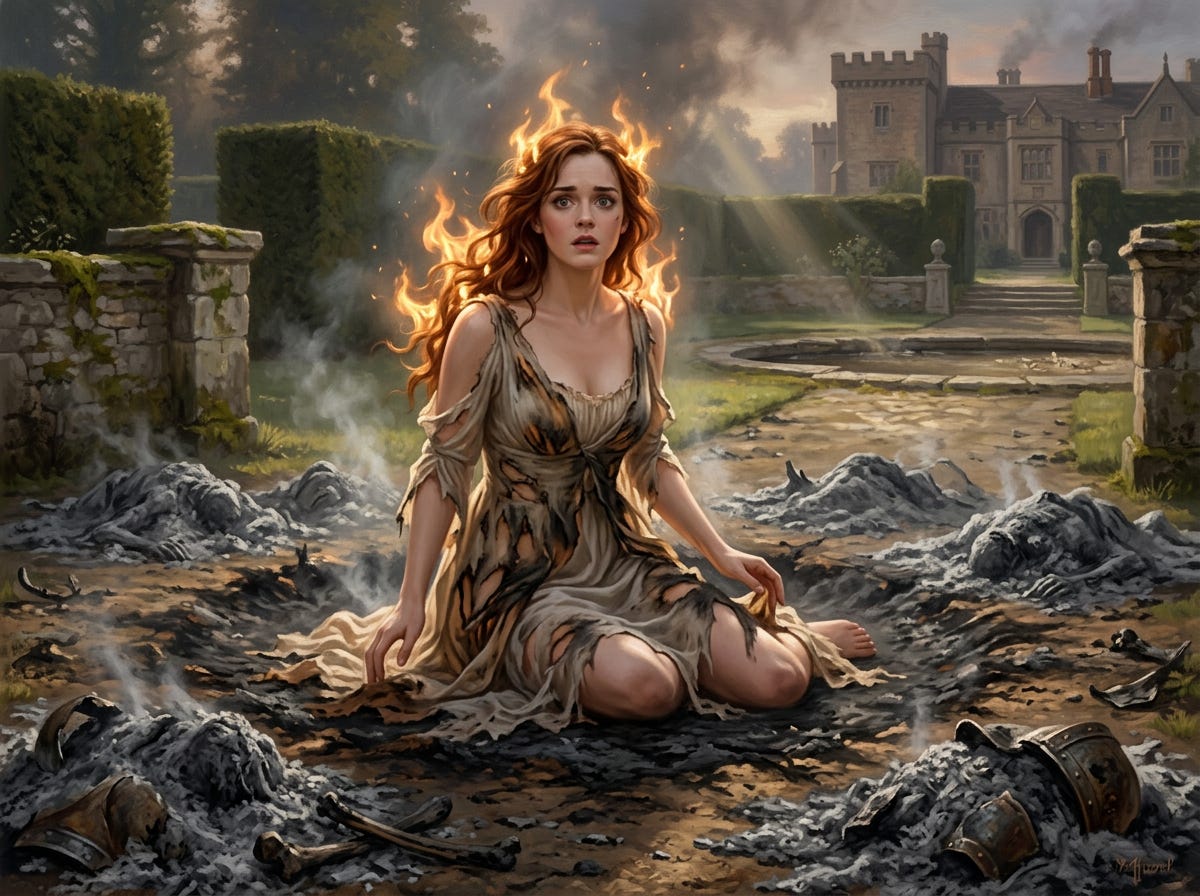
The Unfinished that had gotten through were shapes on the cobblestones, burned black at a heat that left nothing behind. The guards—nearly forty, scattered where they’d held the line—had not burned. They had been taken before the fire came.
Christine was sitting in the center of the courtyard with her knees drawn up and her arms around them. Barely dressed, what remained of her clothing ash at the edges. Flames still moving in her auburn hair. Her body untouched.
He dismounted and crossed to her.
“Chen,” she said.
“I’m here.”
“I don’t—” She stopped. Started again. “I don’t know what happened.”
The scorch patterns radiated outward from where she sat. The inner face of the Wyndmere walls was darkened as if something very hot had moved across the stone and then stopped. He sat down beside her and put his arm around her and she leaned into him and took a slow breath.
“They came through the gates,” she said, after a while. “There were so many of them. The staff were already inside, the doors were barred, I was in the courtyard when they—I couldn’t get to the door in time.” A pause. “I remember being frightened. And then heat, from inside me, and then it was this.”
She looked at her hands. Unburned.
“You’re not hurt,” he said.
“I know. I should be.”
He thought about six years of small things. A summer evening when the candles on the table had burned twice as high when she laughed, and she hadn’t noticed. The time the fireplace had roared in a room with no draft, and she had been the one standing nearest. The warmth she always carried.
He held her tighter.
She looked at the east wing, at the scorched stone, at her hands. “I want to go inside,” she said.
He stood and brought her to her feet. She leaned against him a moment, then straightened.
He picked her up because the cobblestones were hot and she had nothing on her feet, and carried her through the Wyndmere doors. She put her head against his shoulder.
“I burned my clothes,” she said.
“You did.”
“All of them?”
“Most of them.”
She was quiet for a moment. “That’s going to be a problem.”
“I’ll find you something,” he said.
The doors opened and servants rushed out. They wrapped Christine in a blanket.
“There hasn’t been a human fire shaper since Dorrin,” he said. “Three hundred years.”
“I know.”
Philip was on the east wall before dawn on the second day.
He had not slept. The east wall was where he had chosen to spend the last hours of the night, watching the road. The city behind him was still fighting. He could hear it. He did not turn around.
The column came with the first light. The sound reached him before the torches did—a column of riders on the eastern road, a low building thunder across the cold air—and then the line of orange fire cresting the hill above the east gate, already moving at full gallop when they cleared the ridge.
The gate captain had the sense to open rather than challenge. The lead riders came through at a pace that scattered the Unfinished clustered at the base of the wall in every direction, hooves finding whatever they found, torches swinging out to the left and right. Philip had ordered burning oil poured from the wall walk an hour before, and the Unfinished had withdrawn from it. It had opened a lane wide enough for the column to come through.
A few undead came through with them anyway, but it was over in less than three minutes.
Philip stood at the east wall and watched the riders wheel and reform below. A full column of riders who had ridden through the night because a rider had reached them and they had not waited to be asked twice. Along the south wall, fighters who had been holding the same doors since yesterday were being relieved for the first time. He could see them stepping back from their positions, some of them sitting down where they stood, one man simply leaning his forehead against the stone of the wall and staying there. The undead did not need to sleep. His people did, and now they could.
Yselle landed on the keep roof before the column had finished coming through—she had flown the perimeter and come ahead of the others. Amira, Senna, and Aldric rode in through the north gate an hour later.
All nine Sunblades were now inside the city. Philip had not let himself think about what that meant until it was true.
On the third day, more came from the northeast—Urukesh and Aelvaeni together, moving in formation, coming fast. They arrived without ceremony and went straight to work.
For the first time since the Rising, the outside force was caught between two pressures.
Chenguer watched it happen in the web. The outside threads, which had been diffuse and steady and patient for three days, changed. Something moved through the network—a ripple, a pressure—the threads pulling, clusters that had been holding position beginning to compress.
“They feel it,” he said.
“What do they feel?” Wardyn asked.
“Uncertainty,” Chenguer said. He watched a moment longer. “They’ve never been uncertain before.”
“I thought they didn’t think.”
“I’m not talking about their uncertainty. I’m talking about his.”
Philip looked east, toward the road where the column was still coming through.
That evening he noticed something different at the south gate. Christine was on the keep roof with the Fire Aelvaeni’s senior shaper—he didn’t know what passed between them and didn’t ask. What he saw the following morning was Christine clearing an approach three times the width of anything she had managed before, the fire moving in controlled sheets, precise at the edges, the Unfinished retreating in a straight line rather than dispersing in every direction. It was not the courtyard at Wyndmere. That had been something happening to her. This was something she was doing. She stood above the gate afterward with her hands still warm and said nothing to anyone.
On the night of the fifth day, Senna heard shouting from the old quarter.
Then she felt the ground move under her feet.
She reached for Sunflare.
The cobblestones cracked.
Stephen B. Anthony is the author of Transmigrant, an epic science fiction thriller, available on both Amazon and Audible.
Scarlet better be ok!
I’m so glad Christine is ok! How neat that she’s something, too