

A House of Lords has selected a new royal line. The Duke has become the king. Scarlet has become a princess and the heir apparent. But Philip has gone in pursuit of the Usurper, and she has stayed behind.
Frostfall brought one of the worst winters in record, with snow that never fell below three feet on the ground until the third week of Mysts and even then it remained unseasonably cold until The Festival of First Seed, marking the beginning of Plantings.
By then, Stormrest had mostly returned to normal aside from the ongoing work of reconstructing buildings. Children carried seedlings too and fro, gifting them to friends, neighbors, and strangers alike. By the end of the day, each family had a collection of a very wide variety of seedlings with which to begin their new gardens.
By the Season of bloom, seven weeks later, there would be surprises in every garden—something mislabeled or misspoken at the time of the exchange on the Festival of First Seed. It was part of the joy of the festival that lasted through Harvest.
Scarlet found Charles in the east wing of Kestrelmont, where he had converted what had once been a conservatory into something closer to a command post. Maps covered the long table. Letters were stacked and sorted. Two clerks moved quietly around him, and he did not look up when she entered.
“The Harwick grain stores,” she said.
“Arranged.” He made a note. “Three weeks ago.”
She looked at the table. The letters. The stacks organized by urgency and region in a system she hadn’t taught him and wouldn’t have thought of herself.
“The disputed boundary at Crestfall—”
“Referred to the county magistrate pending the king’s review. The reply is in the second stack, left side.”
She stood there for a moment.
Charles looked up.
“You’re very good at this,” she said.
He considered that. “Someone has to be.”
It was not a rebuke. It was simply true, and he knew it, and now so did she.
She walked back from Charle’s command post looking about the family home. The home she had come to at fourteen years old, after living the first part of her life in relative squalor. It was familiar to her. Every room. Every doorframe. Every ceiling molding. The bannister running up the stairs from the first to the second floor—the one she used to slide down when nobody was around to scold her.
Charles was the observant one. The one who sat back and watched things. The one who knew how to handle people and delicate situations with poise and attention. Details were his thing. Managing an estate was his thing. Perhaps, she wondered, if managing a whole nation was his thing.
Her skill set was action. Winning the land. Accomplishing what others thought impossible. But it wasn’t about managing it afterwards. She could, of course, but she took very little joy in it, whereas Charles was in his element.
He was more motivated now as well—the sort of thing that happens when you’ve found the one you want to be with, proposed, given her a ring you designed yourself, and had a wedding planned coincide with Harvest.
She was happy for Charles and Isabelle.
But she was unhappy by herself.
Her mother was in the small garden off the south corridor, the one that caught the afternoon light. She was not doing anything in particular — sitting with her hands in her lap, which was unusual for Elise.
Scarlet sat beside her.
For a while neither of them spoke.
“Talk to me,” Elise said at last.
“Mama. I miss him.”
“I know, dear,” she said, patting her daughter’s hand.
“I don’t know what to do with myself,” Scarlet said. “Charles has all the things done that father wanted. He’s better at it than me anyway. I just don’t know what I’m doing these days.”
“It’s natural to feel a little melancholy after an adventure on the road, when you’re cooped up in an estate doing the necessary work to make the estate run.”
“It’s not just that, Mama.”
“What do you mean, dear?”
“I am well loved,” she said. “Father adores me. Charles does in his own way. And I know you love me, Mama.”
“But?”
“Philip needs me, Mama.”
“What?” Elise said, staring at her daughter. “What did you say?”
“I love him. I want him. And I know he loves me too. But it’s more than that. I’m not needed here. I’m wanted, but not needed. Philip needs me.”
Elise smiled, a bittersweet smile. “You have found the important thing,” she said.
“What do you mean, Mama?”
“Before it was ‘I love him. I want him.’ It was all about what was good for you. All about what you wanted. And that’s important. It really is. But mature love is about the other person. It’s about what does his heart need. And now you know, Scarlet. Now you know.”
Scarlet dropped her head on her mother’s lap, and her mother played with her curls.
“I have to be where I am needed,” she said at last.
“Yes, you do,” Elise agreed.
“And Charles will be better at this than me.”
“Yes,” her mother said simply.
They said nothing as Scarlet rested on her mother.
After a few minutes, she looked up to see silent tears falling from her mother’s eyes.
“Mama?”
Her mother smiled down at her. “Love is a beautiful thing,” she said.
Scarlet wept.
After Scarlet left, Elise went to her side table and produced a sheet of paper, an envelope, and a pen. She sat down to write.
Lady Christine, she wrote.
When she was done, she called the butler, who then brought in a guard.
“Ride with this to Wyndmere. Deliver it only to the hands of the Lady Christine LaPointe. Do you understand?”
“Yes, my lady.”
Elise looked out the window into the garden, tears forming at her eyes again, but a slight smile graced her face.
Scarlet’s father was at his desk. The real Wentworth signet sat among his papers where it always did now, as though it had always belonged there, as though the eighty years of its absence had been a minor administrative error finally corrected.
He looked up when she came in and read her face before she said a word.
She told him anyway.
When she finished he was quiet for a long moment. He looked at the signet. Then he picked it up and turned it in his fingers the way she had seen him do a hundred times — not fidgeting, just thinking.
“You’re certain,” he said. It wasn’t a question.
“Yes, father. I am certain.”
The king called for a scribe and dictated to him, checking with Scarlet from time to time. She nodded in agreement.
When it was done, the document sat on his desk. He held a quill in his hand, looking across the desk at his only daughter.
“Promise me one thing,” he said.
“Anything, daddy.”
“Find a temple. Be joined there. Under the light of Epherion.”
“I promise.”
He nodded, and then slowly signed his name to the bottom of the document.
He opened his desk and produced a red stick of wax. Holding it in one hand, he held the flame of a candled to the end and let the wax drip onto the paper, forming a circular blot below his signature.
He picked up his signet ring—the real one—and pressed it to the melted wax, holding it there for several seconds.
He spun the page around for her to look at and then he handed her the quill.
She underlined the word abdicate, and then signed her name at the bottom of the page below where a scribe had written her name in fine calligraphy.
She looked up at him. He looked older than he had before the winter. They all did.
“Daddy—”
“Go,” he said. Not unkindly. “Before I change my mind.”
She kissed his cheek and left him standing by his desk.
He sat in his chair, opened his bottom drawer, and poured himself a whiskey.
She packed light. Everything she needed fit into two bags and a bedroll. She had done it enough times now that her hands knew the order without asking her.
She found her mother in the corridor.
“Don’t make me cry,” Scarlet said.
“I won’t,” Elise said. She straightened Scarlet’s collar. Smoothed it. Left her hands there a moment. “Go.”
She kissed her brother in his study, and he held her for a long time, crying with her, despite her pleas that he not do so.
Scarlet Wentworth, princess of Bravia, but no longer heir to the throne, left by the south gate, heading south toward Thyl and, perhaps beyond.
She had done no further than a half mile when she heard a horse coming behind her at a gallop.
She pulled on the reins slightly.
“Whoa,” she said to Thistledown, who slowed to a walk. Then she turned to see who was following her.
She saw the flowing auburn hair first.
Christine pulled up beside her.
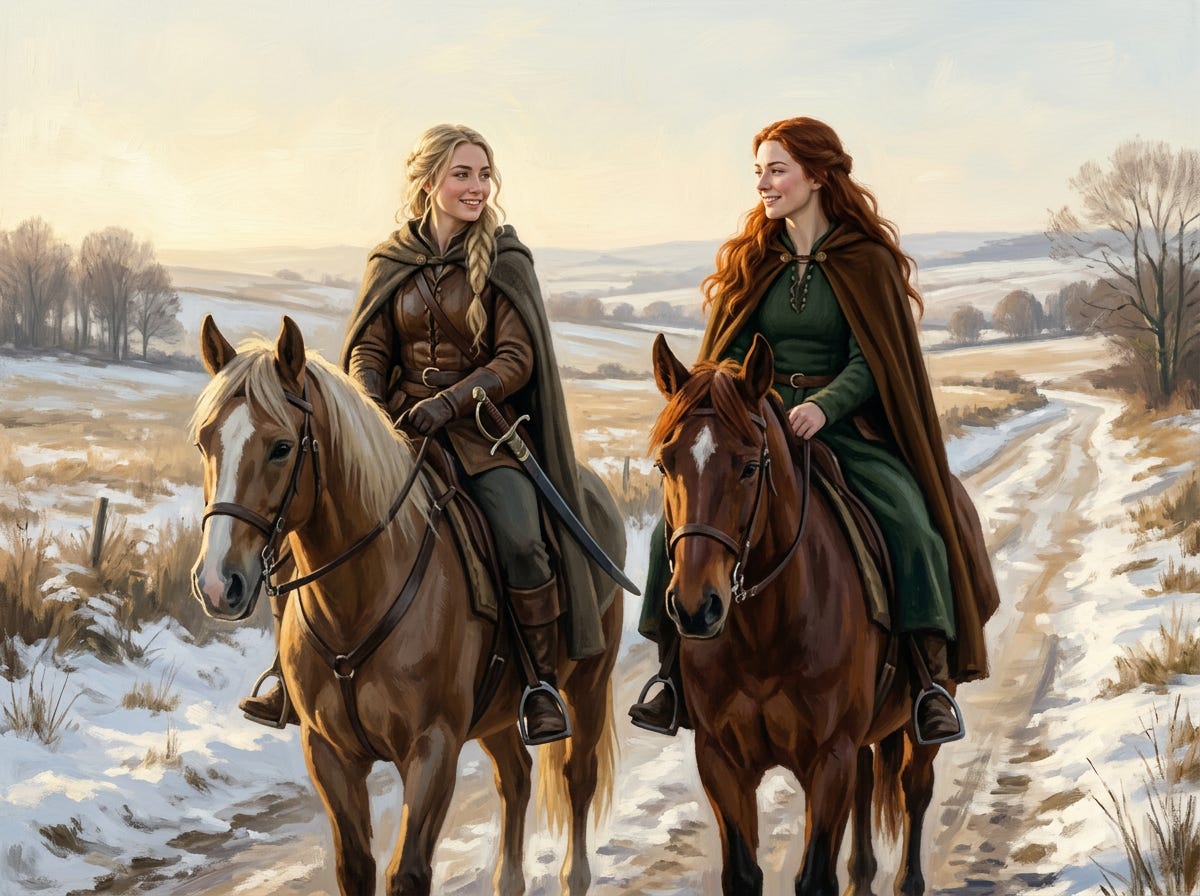
Scarlet looked at her, wide-eyed.
Christine smiled. “You didn’t think I would let you go alone, did you?”
“You want to come with me?” Scarlet asked.
“Hard telling what trouble they’ll get up to without us,” Christine said, looking at the road ahead.
Scarlet nodded. “Do you think you could call me Esmerelda from now on?”
Christine grinned at her. “Absolutely, your highness.”
“Just Esmerelda.”
Christine nodded. “Shall we?”
Esmerelda Hale reached for her friend and squeezed her hand.
Then, she looked at the road ahead.
“I’m coming, Edmund,” she said.
Stephen B. Anthony is the author of Transmigrant, an epic science fiction thriller, available on both Amazon and Audible.
I looove the scene between Scarlet & her mom where they’re talking about need vs. want. Beautiful lesson about love. Also excellent ending for this story
Drogoth 😢 But oh I’m glad it’s over!