

This story takes place in the world of Vael.
Edmund twirled the ring.
It was too big for his finger, so twirling it had become a habit since the afternoon he’d pulled the loose brick from the fireplace, reached into the dark, and felt something cold and smooth—metal that the world had forgotten. He’d kept the secret for three days. Three days of twirling. Three days of waiting for Esme.
She usually came with a surprise. He hoped it was hermits again. But today he had his own surprise for her.
“Edmund?” she called, her voice distant. “Are you in here?”
He chuckled slightly, but otherwise remained silent.
Then she was closer. “Edmund?”
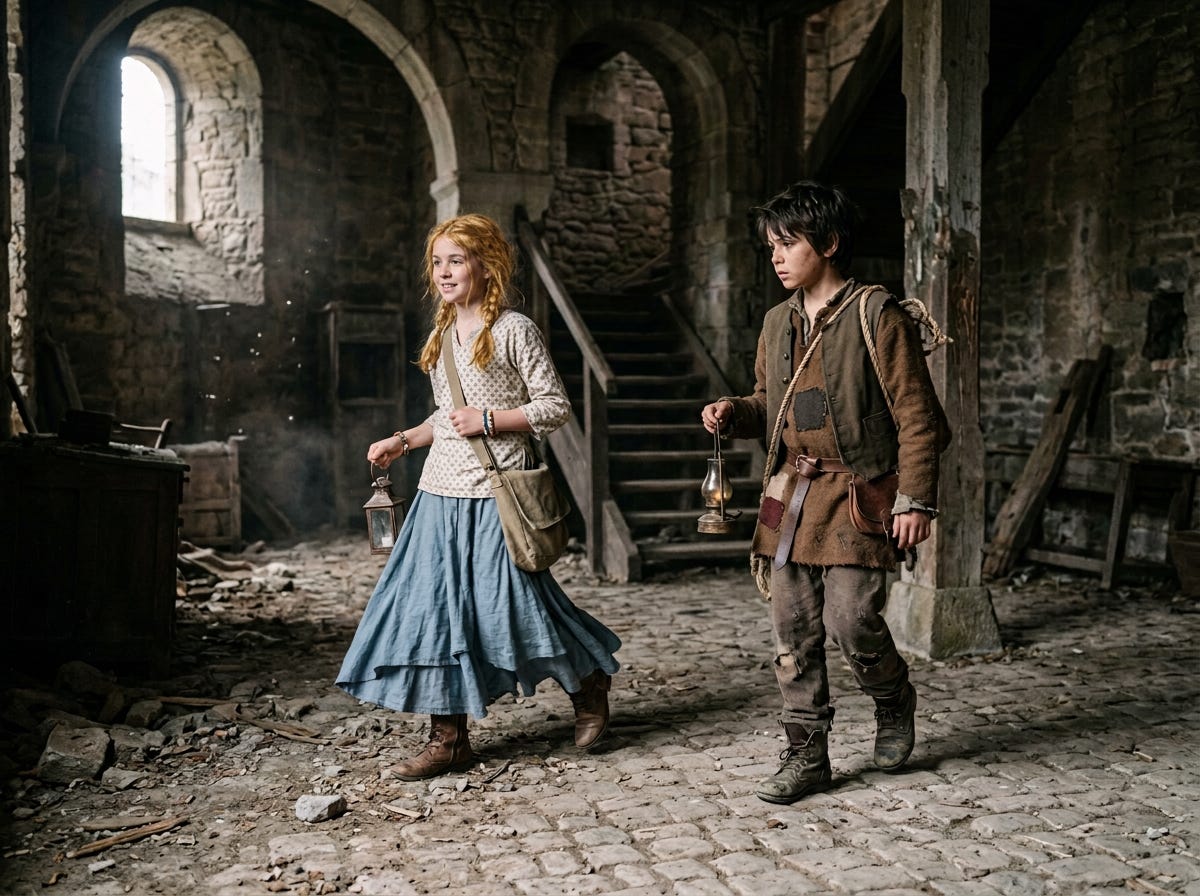
Years ago, fire had burned the stable and the whole upper floor was gone, leaving only the common areas in the bottom floor. Now it was abandoned, which made it a perfect place to play. Where the loft had been, the sky showed through charred beams, and pigeons that had made their home up there came and went as they pleased. The floor was packed dirt gone hard as stone, and the smell of old ash never quite left. The light came in sideways through gaps in the boards, laying itself down in pale stripes across the ground.
He crept deeper into the shadows of the old fireplace and held his breath when he heard her first footstep—the soft scuff of her shoe on the old stone floor, then another, then the whisper of her skirts. He pressed himself against the cold brick and waited.
He saw her skirts first, swirling in that mysterious way that girls’ skirts do. The light from the broken wall boards caught the hem first, then her hands, then her face, her long eyelashes, and her pretty green eyes. She’d be in the room with him in a moment and it made him feel strange.
He knew the point of the game was to not be found, but he absolutely wanted her to find him. As he waited, breath held, he wondered if she secretly wanted him to find her when it was her turn to hide.
“Aha!” she shouted, stepping into the room. “Got you!”
“Esme!” he shouted back. “No fair! Did you hear me?”
“Ha! Smelled you. When’s the last time you bathed?”
“You’re just smelling the flowers!” He handed her a bouquet of daisies he’d been holding so long the stems had gone soft. “I didn’t see you for the festival, but I saved them.”
“Thank you, Edmund,” she said, smiling. She smelled them, inhaling deeply, and then began weaving them into her blonde hair.
Edmund watched her fingers work in her curls. He glanced down at his own hand and found his fingers moving with hers.
When she was finished, she showed off her hair. “How do they look?”
“They look nice. But it’ll be easy to find you with your hair full of flowers.”
She stopped and looked at him twirling the ring on his finger.
“What have you got there?”
“It’s mine!” he said, hiding his hand behind his back, while pressing the ring with his thumb so it wouldn’t slip.
“Bakers’ boys don’t own rings,” Esme said. “Where’d you get it?”
“I won it in a game of dice,” Edmund insisted.
Esme squared her shoulders, her fists on her hips, and pouted. “Tell me the truth, Edmund.”
“Oh, alright. If you must know, I found a treasure hidden behind a loose brick in this fireplace. I wanted you to see it.”
“A treasure? Are ya gonna show me?” she asked, her eyes bright.
Edmund turned to the fireplace and pulled the loose brick away, revealing a dark cubby behind.
“I found it in here. There’s some papers too,” he said. “I know you like words and stuff, so I thought you might like the papers to practice with.”
He pulled out a bundle of individual sheets and handed them to her. “Here’s your share of the treasure.”
Esme looked at the pages, one by one, and Edmund watched her face. She went quiet, her brow drawing together slightly, her lips parting as though she meant to say something and then thought better of it.
“They’re burned,” she said at last.
“Yep, someone lit them on fire, but it didn’t take I guess.”
He watched her as she studied the pages, but their content didn’t matter to Edmund, who couldn’t read a word. What mattered to him was how her eyelashes moved.
“Show me the ring,” she commanded.
He obeyed, handing it to her.
“It’s brass, I think,” she said. “It has a funny design on the top.”
“It’s my ring of invisibility,” Edmund explained. “With it on, you won’t be able to find me at all.”
“But you just had it on and I still found you!”
“Only because you heard me laugh,” he said.
“You’re silly.”
“It’s your turn to hide. But you don’t get the ring. That’s mine.”
“I gotta go home anyway,” she said. “Papa doesn’t want me playing in the abandoned buildings.”
“Aww. Okay,” he said, frowning.
She turned to leave, skirts swirling, and then spun back to him.
“Thank you, Edmund,” she said, clutching her papers.
She tried to kiss his cheek, but he turned his head, and her innocent kiss landed on his mouth. An accident, a coincidence. And yet somehow it mattered. They stared at each other.
Edmund swallowed.
“Oh!” Esme said.
And then, gathering her skirts, she ran from the building, leaving Edmund to touch his lips and wonder what just happened.
He stood there a long moment. Then he turned and replaced the brick, sealing up the empty cubby. The ring was still on his finger, turning slowly.
He felt the opposite of invisible.
The room was one of three that Esme and her parents occupied on the upper floor of a building that leaned slightly eastward, as if an old man had grown tired of standing straight. The landlord called it lodgings. Esme’s mother called it sufficient. Esme called it home.
The plaster walls held the memory of better colors—something that might once have been cream or pale yellow, now the indefinite grey of things that have given up. A crack ran from the single window to the ceiling like a river on a map, and in winter the wind found it without fail. They had stuffed it with wool twice, and it remained cold.
The floor was bare board, unpainted as long as anyone could remember. The one thing it wasn’t was dirty, because her mother swept it every morning without exception—not for cleanliness, Esme had come to understand, but for dignity. You swept the floor because you were the kind of people who swept floors. You did not become the floor.
There was a table, scarred and uneven, shimmed with a folded piece of leather that was itself beginning to wear through. Three stools. A shelf holding what remained of their cookware. A straw mattress in the corner where her parents slept. Esme’s own sleeping place was a pallet rolled out each night and put away each morning, which gave the room the illusion of space it didn’t actually have.
Charles sat on the floor near the window, pushing a wooden peg back and forth across the boards in a groove he had worn himself over many months of exactly this. He made no noise while he played, just the small steady scrape of the peg, and he did not look up.
The fireplace was the room’s only generosity. It was large enough for actual cooking, which meant they didn’t have to pay for use of a communal kitchen. In winter they lived around it. In summer it made the room insufferable by midday.
On the shelf above the fireplace sat three objects with no practical purpose whatsoever.
A small piece of carved stone that had once been part of something larger.
A piece of ribbon, deep blue, faded but still recognizably blue, folded by her mother into a precise rectangle.
And a drawing, made by someone with real skill, of a house Esme had never seen. Towers. A gate. Trees along a wall.
She had asked about these things once, when she was very small. Her mother had said those are ours in a tone that ended the conversation.
Esme had learned to read that tone the way she was learning to read everything else. Carefully. Without letting on how much she understood.
“Papa,” Esme asked. “What does the name Wentworth come from?”
He looked up from his book. Something crossed his face—not surprise exactly, but a kind of careful stillness. “Where did you hear that name?”
“I’ve heard you say it before. Both you and Mama. But I wondered where it came from.”
“Why do you ask?”
“Just some papers my friend Edmund found. The name Wentworth is on them.”
“What papers?”
“Just some papers that seem like someone was practicing writing a letter,” she said. “I’ve been using them to learn some new words. What does consideration mean? Also, what does binding testament mean?”
“Let me see,” he said, crossing the room.
Esme handed them to her father.
He stood a moment, looking at the first page. “They were in a fire,” he said.
“That’s how they were when we found them.”
He sat down at the small table without another word. Esme watched him read. He was a quiet man by nature—she had never seen him rattled—but by the third sentence his hands had begun to tremble. She went perfectly still, watching him. His eyes moved down the page, then stopped. He set the page flat on the table with both hands, as though it might otherwise rise.
“Where did you get these?” he asked.
Esme shrugged. She really didn’t want to tell her father they had been playing in the old abandoned buildings again. He’d warned her to stay away from them, saying they were dangerous places.
“Esme?”
“Edmund found them stuck in a secret hiding place in an old chimney. Along with a ring.”
Her father looked up. “A ring?” His voice had the same trembling quality as his hands. “Does he still have it?”
“I think so,” she said.
“Where does this Edmund live?”
“I don’t know,” Esme said. “We play sometimes, is all.”
“Take me there,” he said.
“Papa—”
“Take me there.” Stern, but not unkind. He was already folding the papers carefully, as if they were something that mattered, as if they had always mattered. Esme hesitated, then nodded slowly.
She looked once at the shelf above the fireplace—the stone, the ribbon, the house she’d never seen—and then followed her father out the door.
Stephen B. Anthony is the author of Transmigrant, an epic science fiction thriller, available on both Amazon and Audible.
I’m riveted already. Your descriptions of young love are so spot on. Can’t wait to read more.
really opens the story, and strokes your curiosity