

Scarlet and Benedict found two dead Aelvani at the root of a fallen oak, wearing worn gold rings, their provisions still fresh. Two bandits chose the wrong travelers and paid the price.
The morning was cold enough to see breath, which Philip found useful. Cold sorted men quickly. You could tell who had learned to move, and who was still arguing with his own body. It showed in the shoulders. Some hunched against the air. Others understood that warmth came from motion, not resistance.
He walked the line with his hands clasped behind his back.
Twenty men, two ranks, blades drawn, holding the guard he had set. Most were acceptable. Three were good. One—Corporal Dast, two months in the field—was letting his elbow drift again.
“Dast.”
“Sir.”
“Where is your elbow?”
A beat. Dast dropped his eyes without moving his head, then brought them back up. “Drifting, sir.”
“It is. Why does that matter?”
A shorter beat this time. Philip drew and snapped the flat of his blade against the inside of the boy’s arm.
“Opens my inside line, sir.”
“It does. Fix it.”
He moved on.
Chenguer stood off to the left, watching the men Philip wasn’t. Between them, they covered the line. Neither had ever felt the need to say so.
Philip finished his pass and turned back to the formation.
That was when he noticed the pheasant.
It had taken up a position at the far left of the front rank, roughly where a man of middling height might stand, if that man were, for some reason, a pheasant. Its chest was forward, head erect—more than could be said for Dast. The morning light caught its plumage with an iridescence that outperformed anything else in the canyon.
Philip looked at it. It did not look back, which was either indifference or discipline. Philip looked at Chenguer, who was finding something very interesting to study on the middle distance.
“Brigadier,” Philip said.
The pheasant declined to respond, which was consistent with its record.
“Carry on,” Philip said to the formation, and not to the pheasant.
He resumed the drill. Advance, guard, disengage, reset. Again. Again. The kind of repetition that turned thought into habit and habit into survival. The pheasant held its place. Once, it took a single step left, neatly restoring its alignment with the rank. Philip chose not to investigate.
Corporal Maren—who had introduced the animal to garrison life two months prior and now bore the look of a man who regretted his own initiative—stared straight ahead with studied innocence.
They ran another twenty minutes. Philip corrected two grips, one footfall, and Dast’s elbow, again.
“Dast. We are attempting to remain alive.”
“Yes, sir.”
He corrected it and did not make the mistake again throughout the drill session.
The pheasant, by the standard of stillness alone, ranked in the upper half of the formation.
When Philip finally called the stand-down, it walked off without dismissal, which was either insubordination or comprehension. Philip decided he did not require the distinction.
Chenguer came up beside him.
“The men’s morale is good this morning,” he said.
“It is,” Philip said.
The watch called down from the wall.
“Riders at the approach, Sir Philip. Five. Colors are Ashcroft.”
Philip turned toward the gate and waited for the young baron to arrive.
Ashcroft had his men hold formation twenty paces off before closing on Philip. Five men on good horses, well-armed, sitting erect. One of them had a boot marked with three parallel gouges across the toe, deep and old—the kind left by something with serious claws. They had seen action, or something had. What gave Philip a moment’s pause was how perfectly still they sat. Not the ease of experienced riders, who shift and settle without thinking, negotiating the small movements of a horse at rest. These men sat as though the horses beneath them were furniture. As though nothing moved them because nothing needed to.
He filed it away without knowing why.
Ashcroft dismounted. They were nearly the same height, though Philip held a slight advantage. Ashcroft more lithe, Philip thicker in the shoulders. Ashcroft wore his fair hair long. Philip kept his dark curls short.
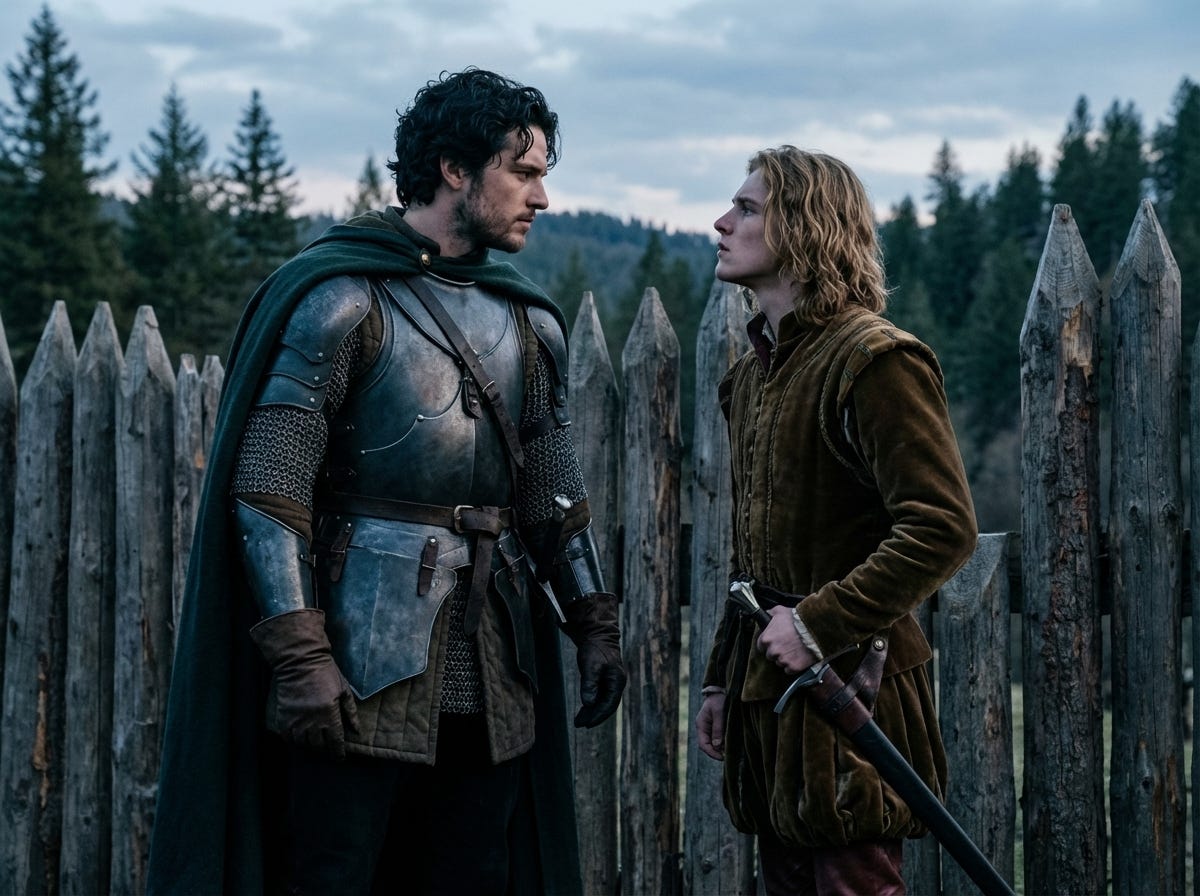
“Beckwith,” he said.
“My lord Ashcroft, to what do I owe the pleasure?”
“I have been led to understand that Lady Scarlet Wentworth passed through this palisade just over one week ago, heading east. Is this true?”
“It is indeed, my lord.”
“You let a noble woman go wandering in Urukesh territory alone?”
“I’ve done nothing of the kind, Lord Ashcroft. She went with her swordmaster, Sir Benedict.”
“Just the two of them? You allowed that?”
“Allowed? The Lady Wentworth is not under my charge or command. I did not let her do anything, nor did she need my permission.”
Ashcroft eyed him coolly.
“Not under your charge or command. True. But you might have given her men for protection.”
“I could not spare them, Lord Ashcroft, nor did she want them.”
“Your actions were unwise.”
“That remains to be seen, Lord Ashcroft. What is your concern with Miss Wentworth?”
“Only that she will be my future bride if I have anything to say about it.”
“Thankfully,” Philip said, “she is the only one with anything to say about it, and believe me, Baron, she has much to say about such things.”
Ashcroft smirked. He mounted his horse, which took two steps, and then turned back.
“The queen may have something to say about it as well, Beckwith. I’d bear that in mind.”
“I keep everything in mind, Baron,” Philip said.
“A shame,” Ashcroft said, glancing toward the bodies of two Urukesh being prepared for burial near the canyon mouth. “So much life cut short out here. All that time, simply lost.”
“War is not a pleasant proposition,” Philip said. “Everyone who dies is cut short.”
“Indeed,” Ashcroft said. “Well, I’m off, Beckwith.”
“To?”
“I’m going after her. The queen will be likely to change her mind about who is a suitable partner for Scarlet Wentworth, when one of us sits safe behind a wall and the other rides out to save her.”
“I doubt she needs saving.”
Ashcroft ignored the last statement and rode out east with his men.
“Except, perhaps, from you,” Philip said to no one in particular.
One thing Ashcroft was right about—the loss of life was wasteful.
“I see the peacock has graced us with a visit,” Chenguer said, having made his way over from the lodge.
Philip was still watching the group of five as they headed east.
“He was dressed as a wolf at the masquerade.”
“Might be both,” Chenguer said.
“That’s what I’m afraid of.”
“You still regretting it?”
“Regretting what?”
“Not going with her,” Chenguer said.
“Never said I regretted it.”
“You didn’t have to, Captain.”
“What are you saying, Sergeant?” Philip asked, turning to his friend.
“There is only one Scarlet Esmerelda Wentworth, and you know it.”
“Only one—wait. What did you say?”
“I said there is only one Scarlet.”
“No. Her whole name.”
“Scarlet Esmerelda Wentworth.”
“Esmerelda?”
“Yes, I thought you knew that. It was listed in the masquerade invitation guest list.”
Philip spun on his foot and stared out the road to the east. “I—I never read the guest list.”
“Well, that’s her name.”
Esmerelda?
Philip felt something move, whether in his heart or his brain, he couldn’t tell. Something just out of reach.
“You’re brooding,” Chenguer said as he turned the potato quarters on the stove.
“I am?” Philip asked.
“Yes, and you never brood. It’s not your style. You think. You take action. You never waste time second guessing yourself. You are this time.”
“This time I’m not sure.”
Chenguer nodded, and lifted the roasting rabbit halves, checked them, and decided to flip them.
“What do you know about her?”
“Who?”
“You know who.”
“Are you talking about that pretty blonde girl that spent the night in your bed a week ago? Need I mention that she was alone in your bed?”
Philip glared at him, which only made Chenguer snicker.
“Tell me,” Philip said. “You’re tied in at court through your girl.”
“They are best friends, you know?”
“I gathered that,” Philip said.
“Christine thinks the world of her. Wine?”
Philip nodded and Chenguer filled two cups. He broke a small loaf of bread in half, gave one piece to Philip and then began liberally applying butter to his half.
“What does she say?” Philip asked.
“Only that Scarlet can do whatever she sets her mind to. I mean, gods, she’s responsible for restoring her family’s estate. She did it when she was maybe ten or twelve years old.”
“I knew that the Wentworths were granted title and lands and had some ancestor with prior claim on this territory, but I don’t know the details. What did Scarlet do?”
Chenguer cut a thin slice of rabbit and popped it in his mouth, savoring the flavor. “Well, you know the story about them losing their name and title, right?”
“I guess not,” Philip said. “That’s their ancient claim?” He took a bite of bread and washed it down with a pink colored wine.
Chenguer picked up a leg bone and chewed on it before answering.
“So, word is that it was nearly a hundred years ago. Ashcroft’s great grandfather made an accusation of treason against the then Duke of Wentworth. The accusation stuck, and the Duke was hanged by the old king.”
“Gods,” Philip said. “Hanged for treason.”
“Except it was a false accusation.” Chenguer took a bite of his bread, and slathered more butter on the fresh surface.
“False how?”
“The old baron used a fake signet ring to forge documents.”
Philip dropped his fork. “What?”
“Yep. A fake. Ten years ago—more, now. It was found. Along with practice copies of a treasonous letter, written by a forger who was copying the Duke’s hand. And then the baron used the fake signet ring to place a wax seal—”
“Stop.” Philip stood. “A fake signet ring.”
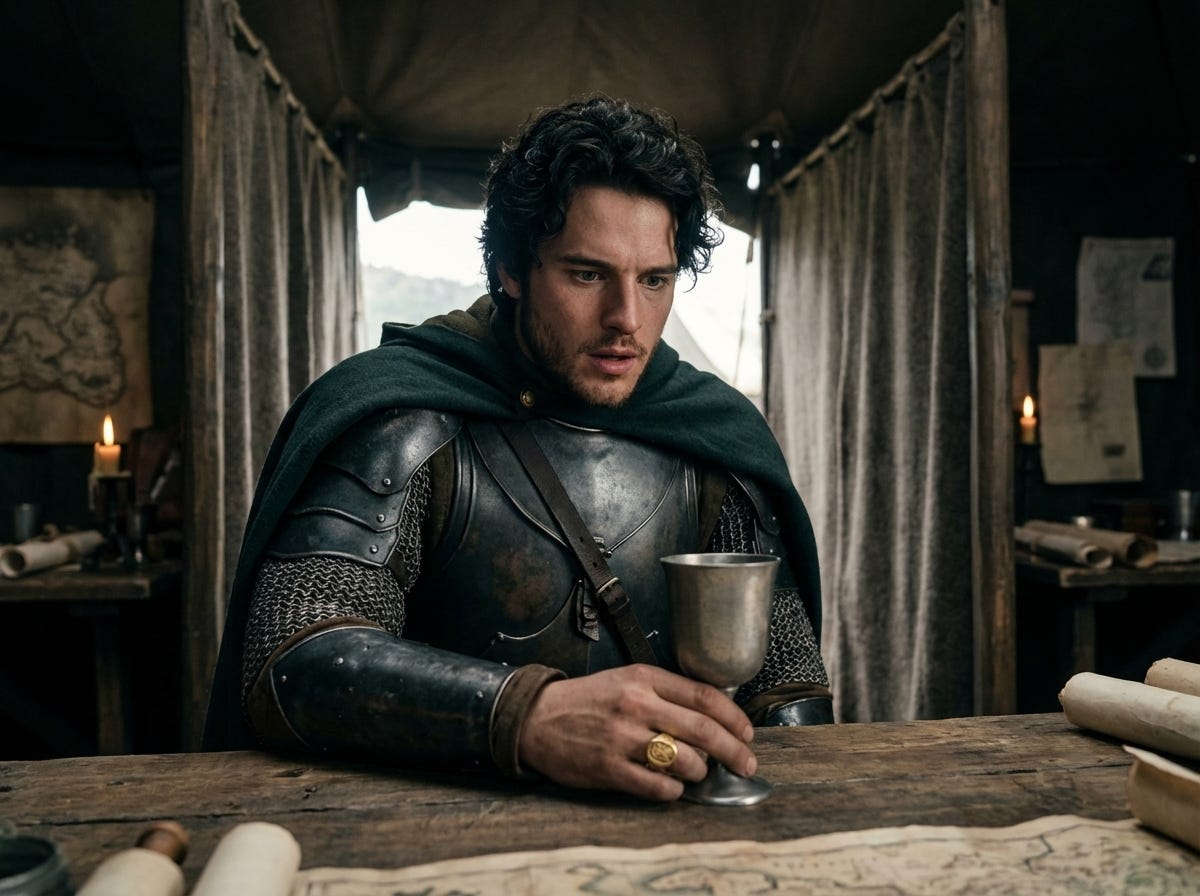
Esmerelda.
“Yeah. That’s what I’ve heard. What’s gotten into you?” Chenguer asked, using a sliver of bone to pick his teeth.
Esme.
Philip turned the ring on his finger. Remembering.
Oh, dear Epherion, can it be?
“You remember I told you about the girl I never quite got over?”
“Oh yeah, the blonde girl—green eyes like the forest—moved like the wind—”
Chenguer went very still.
“Scarlet has green eyes,” he said.
Philip nodded and paced. “I’m the one who found those papers, Chen. I found them. I gave them to her. But she went by Esme in those days. It’s her. It has to be her. No wonder she felt familiar.” He stopped. “How could I not have seen it?”
“My gods, man,” Chenguer said.
Philip turned to his friend.
“Chen—”
“Yeah?”
“I held her in my arms at a dance.”
“Yeah?”
“I have to go after her.”
He moved quickly now. Immediately packing. Rolling up wool blankets, filling his pack with food, checking his sword, stowing his leather armor—less protective, but easier to travel.
He paused at the shelf.
The three books. The Kiranoise primer Chenguer had given him. The Corvaire poetry, which he had never quite finished. And the journal representing six years of the campaign.
He took the journal. Left the poetry. The primer he tucked into the pack after a moment’s thought. He had been meaning to finish it, and the road was long.
The folded letter from his father he had kept on the shelf for three years, moving it from garrison to garrison, lodge to lodge, always to the same position near the lamp. He picked it up, turned it once in his hands without opening it, and put it in his breast pocket where it had always been before he’d started putting it on shelves.
He looked around the lodge.
Six years. The stove that ran from dusk to dawn from Harvest to Myst. The map board with its imprecise lines. The split cedar floor that creaked just slightly, raised off the cold ground on its runners. He had eaten at this table, written at this table, sat across from Chenguer at this table more times than he could count.
He picked up his father’s ring from where he had set it beside the lamp, turned it once in his fingers, and put it on. It still didn’t quite fit. It never had. Out of habit, he spun the ring with his thumb, just to be sure it was there.
He closed the leather partition behind him.
“You’re not going tonight, right?” Chenguer asked.
“A wolf is hunting her,” Philip said. “I’m sorry to do this to you.”
Chenguer looked at him gravely.
“I’ll help you pack.”
Stephen B. Anthony is the author of Transmigrant, an epic science fiction thriller, available on both Amazon and Audible.
AH! It’s all coming together. I wondered how the beginning tied in. Also, I love the pheasant, funny touch 😄
I was just thinking about the kids from the beginning when I started this chapter. Perfect timing for the reveal!