

Two days east of Tallfellow Canyon, Scarlet spoke Urukesh to a king who let her pass in exchange for venison. He warned her about things on this road that feed. Things neither human nor Urukesh.
On the third day, they found the children.
Scarlet saw them first.
She almost didn’t. They were half-hidden in the long grass at the verge, tucked against the mossy root of a fallen oak as if they had simply sat down to rest and never gotten back up. She pulled her horse to a stop.
“Benedict.”
He drew up beside her, took one look, and was off his horse before she’d finished the thought, dropping into the grass with one knee on the ground beside the nearest figure.
“Children,” he said, and his voice had already shifted into something quieter and more careful. “Gods. How long have they been here?”
Scarlet dismounted and came around to look properly, leaning her bow against the tree, her quiver of arrows still on her shoulder.
There were two of them, seated with their backs against the root. The smaller one—a female—had her head resting on the male’s shoulder, her eyes closed, her hands folded in her lap. He sat slightly upright beside her, as though he had meant to keep watch and hadn’t managed it. Small—devastatingly small—with pointed ears and fine angular faces and a stillness that wasn’t sleep.
She crouched down slowly. They were the size of children, maybe ten years old by their stature, but their faces were not children’s faces. The lines around their eyes were deep and long-earned. Their hands, folded in their laps, were the hands of people who had worked for a very long time. The skin at their temples was thin in the way that only comes with great age, and their hair had gone entirely white. A leather satchel sat in the grass beside them. Their cloaks were plain and travel-worn, earth-coloured, practical—the clothes of people in the middle of a journey.
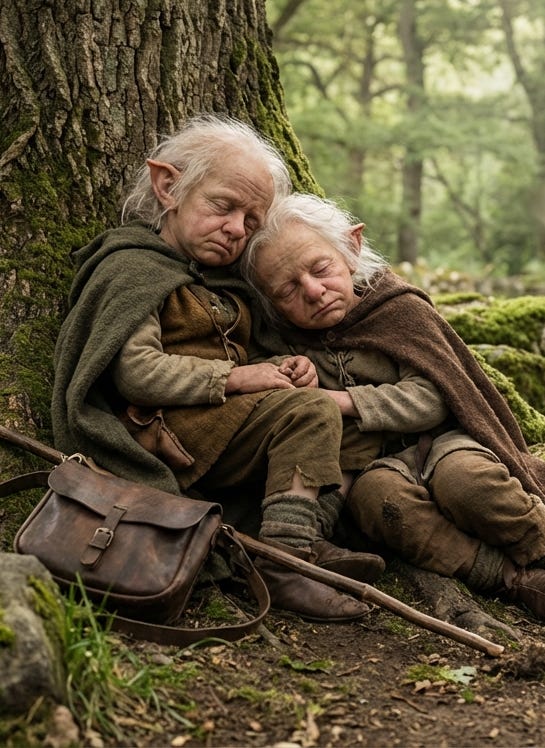
Each wore a small gold band on their left hand, worn smooth with years, still carrying a quiet lustre.
They had been married a long time.
“They’re not children,” Scarlet said quietly.
Benedict had already reached the same conclusion. He placed his hand gently to foreheads, necks, chests. “Stone dead,” he said. “And cold.”
Scarlet looked at the ground around them. A small crossbow lay in the grass near the man’s knee, fallen or set down carefully—she couldn’t tell which. A dagger in a worked leather sheath sat at the woman’s hip, still buckled.
“They’re armed,” she said.
“Aye,” Benedict said.
“Since when do people this old travel through mountain forests carrying weapons?”
Benedict sat back on his heels and looked at them properly—the pointed ears, the fine-boned frames, perfectly proportioned but smaller than a human child. Something at the back of his memory stirred. “They’re not human,” he said. “Nor Urukesh. Nor Oroquai.”
“No,” Scarlet agreed. “They’re Aelvani.”
“I thought that was folklore.”
“Folklore is often based on truth,” she said.
Benedict picked up the bag near the diminutive man’s hip and opened it. “Provisions,” he said. “Still fresh.”
“So they were traveling somewhere,” Scarlet said.
“And then just sat down for a rest, fell asleep together, and died at the same time?”
“No,” Scarlet said. “Old people going on a journey and dying at the same time at the trunk of a tree, while armed?” She looked at them a moment longer. “No, it does not make sense.”
Scarlet looked at the two small figures, at the worn rings, at the fresh provisions that would never be eaten. She reached out and gently moved the hair from the face of the nearest one, the female, and found a face that was almost delicate. Strange and unfamiliar in its proportions, but not unpleasant.
“We can’t just leave them here, can we?”
“No. No we can’t,” said Benedict.
They sat in silence for several minutes.
“Well,” Benedict said at last. “There’s nothing for it but to dig a hole.”
He stripped off his coat, retrieved a shovel from his pack, and began the laborious task of creating a grave.
It took him most of an hour to dig deep enough for the two bodies. Meanwhile, Scarlet did her best to clean the Aelvani, removing little dead branches and leaves that had fallen on their clothing. She considered the value of the rings, but left them on. Nobody needed to have those. Let the gold return to Vael.
“There is no sign of violence,” Scarlet said, looking into the grave where Benedict was hip-deep, shovel in hand, sweat dripping from his body.
“No,” he said. “It’s strange.”
“Wonder what kind they are.”
“Kind?”
“Earth, air, fire, water. Maybe earth?”
“Earth Aelves then,” Benedict said. “In the mountains? Makes sense.”
“Could also be air Aelves. High elevation?”
“Possible,” Benedict conceded.
“Krang said there were things on this land that feed. Could this have anything to do with it?”
“Their bodies are intact,” he said, and grunted as he lifted another shovelful out of the hole.
“What if something feeds on life?”
He tossed another shovelful, then dropped the spade end into the dirt and leaned on the handle, resting a moment. Then he said, “I don’t think I’d like to think about that.”
“But to live your whole lives together, grow old together, venture off on some trip together in your last days? To still sit with your head on your man’s shoulder, still wear your rings, and then pass on peacefully at the same time?” She paused. “Seems strange, but also there’s beauty in it.”
“Aye,” Benedict said, nodding, as he continued his work. “Wish I had something to wrap them in. Say, didn’t you have an extra wool blanket by mistake? From Sir Philip?”
“Oh—,” she said. “Yes, I had quite forgotten I packed that accidentally. But no, I don’t want to use that. It’s going to get colder.”
“Fair enough, my lady. I think this is good enough.”
“I have some handkerchiefs we can use to cover their faces.”
“That’ll work,” he said.
A strange, rough voice startled Scarlet. “Lady? Is that wot ‘e said?”
She turned to see three men on horseback, center of the road. They had arrived with no noise. No warning.
“What kind of lady are ya? Rich one?” asked the closest, a bearded man with a scar under his left eye.
“I beg your pardon?” Scarlet said.
“You go on about your business o’ buryin’ children. We jis gonna help oursel’s to your horses and fings. Pay us no mind.”
“You’ll do no such thing,” Scarlet said. She heard Benedict curse behind her as he attempted to scramble out of the grave.
“Whatever ya say, my lady, but good luck catchin’ us on foot.”
It was then that Scarlet noticed they already had the reins for both of their horses.
But she didn’t flinch.
Instead she grabbed her bow and within a second had an arrow nocked and was beginning to draw.
“Good luck outrunning my arrow,” she said.
He turned and paused, then grinned, displaying gaps where teeth should have been. “Spicy little minx are ya? I might take you too.”
“You will ride on, empty handed, or by gods, you’ll go home full of holes,” Scarlet said, her voice steady.
A second man lifted a crossbow, but before he could train it on her she loosed an arrow taking him through the eye, and nocked a second arrow before he hit the ground.
“Kagan!” The scarred man screamed. He turned to Scarlet. “You bitch!”
He kicked his horse into action, intent to run her down.
Scarlet fired, but moving targets are harder to hit. The arrow deflected off the man’s shoulder guard, and he was upon her.
But she sidestepped, spinning as she did so, the bow dropping and her saber clearing its scabbard in the same motion.
The horse went on past her.
The rider pulled the reins to stop his horse. She held a gleaming saber. He looked down, saw blood gushing from a two-foot laceration in his abdomen, and fainted. He fell from his horse, his head striking a rock with a nasty cracking sound, and the man never moved again.
The third rider fled, bringing nothing with him.
Benedict, who had not even made it out of the grave, stared at her, his arms resting on the grave’s edge.
“Damn,” he said.
“What?” Scarlet asked as she cleaned her blade with leaves.
“Now I’m going to need to dig another hole. Just, great!”
She turned away from him. The road was quiet again, the horses standing where the men had dropped their reins, the forest indifferent to all of it. She stood with her blade at her side and breathed until the shaking in her hands stopped. Killing was mean work, and she felt it drain her each time, even when it was the only choice available.
“You did what was needed,” Benedict said gravely. “I told you at fourteen the medicine was not going to be easy to swallow.”
She nodded, but said nothing. Instead she found a rag and a bit of mineral oil and wiped her blade down silently.
“I’ll dig the second hole,” she said.
“No you won’t, my lady.” Benedict picked up the first of the Aelvani, placing him in the hole on his back. He placed the female next to the male, turning her slightly so that her head rested on his chest. Then he covered their faces before climbing out of the hole.
Scarlet smiled at him—the bitter kind—and then she hugged him.
“Thank you, Benedict.”
He nodded. “You controlled your emotions. That made you smooth, and—”
“Smooth is fast,” they said in unison.
She watched an exhausted Benedict dig a second, larger hole while keeping a better eye on the road. It was nearly two hours later by the time he finished, as he required more breaks the second time.
Once they had all four bodies placed in the graves, she got up and said, “I’ll prepare some food. We can fill in the holes after.”
It was a simple affair of bread, cheese, and thin slices of cured ham, coupled with a pale straw Thylish wine called Silverbell. Light bodied, clean, and effervescent. They both had two glasses, which finished the bottle.
Scarlet found a clear, cold mountain stream to refill the bottle, recorked it, and tucked it into her left-hand saddlebag.
After eating, they took turns covering the graves, and when that was done, Scarlet led a prayer vigil over both graves, commending four souls to the afterlife. For the bandits, she was brief. Even bad men needed a send-off. Let Abba judge.
Scarlet took more care with the Aelvani, wondering what their customs were and whether she was doing them a respectful service. She sang in a soft voice over their graves, a pleading to Abba and Solenne.
You who hold the thread, let it not be cut but kept—woven into what remains, carried where the pattern went.
You who know the door, let them find it soft and wide. They were loved. They walked together. Let them cross it side by side.
What was theirs, return to earth. What was them, return to light. We have laid them down with care and hope that is enough.
They sat together in silence for an hour before Benedict got to his knees, stood, and said, “I’m duly tired, my lady, and will turn in now unless there is anything more you need.”
“No. Thank you. Go rest, Benedict. You’ve worked hard today.”
He was snoring less than ten minutes later.
Scarlet sat by the campfire, bundled up in a wool blanket. The Aelvani stayed with her, and so did the words of Krang Haddagan. Something out here feeds.
She shivered and pulled the blanket tighter, watching the road.
She brought a corner of the blanket up to her face, rubbing it over her nose and chin in soft circles, soothing herself.
She pressed it to her nose and inhaled.
It smelled like him.
Taking it had been no accident.
Stephen B. Anthony is the author of Transmigrant, an epic science fiction thriller, available on both Amazon and Audible. The first seven chapters are available on this website for free.
It’s getting so mysterious. Also, the blanket 🥹🥺
Really enjoying getting more of the world piece by piece