

Scarlet has spent four days on the road with Lance Ashcroft, who has been raising questions about who Philip Beckwith. The Unfinished have a history. She keeps Philip's blanket close.
On the 46th day of Harvest, Scarlet and Lance arrived in Psalter’s Point.
From her reading—which was admittedly outdated—at the time her ancestor was wrongfully hanged nearly eighty years ago, Psalter’s Point was listed as having fewer than two thousand souls. It was four times that now, and it showed in every direction.
As they descended from the mountains in the last day of the trip, they could see several layers of sprawl where the original boundaries of the town had been expanded no fewer than four times. The terrain was rocky coast. It was not uncommon to find cliffs dropping thirty or more feet into the ocean.
The city and the outlying villages were crowded. There was very little space left and arable farming land seemed to be at a premium.
Lance stopped his horse at a promontory overlooking the city. “See the end of the point?”
“Yes.”
“Everything to the left of the point is the north sea, called the Isenic Sea—cold waters. Everything to the right is the central sea, called the Ashiran Sea—warmer. The Ashiran currents are what keeps Psalter’s Point survivable in Frostfall.”
Scarlet considered him for a moment. “Is there anything you don’t know?”
He started his horse down the trail without answering, which was itself an answer.
The poverty announced itself before they reached the outer streets. Many poor quality shacks housed multiple families. The roads near the edge of town were unpaved and rutted from recent rain and the passage of carts and carriages. They picked their way through the worst of it.
Salt and fish and the press of too many people in too little space. Children occasionally stopped to watch them pass. A woman hanging washing from a second floor window watched without expression.
As they neared the old town, larger merchant villas rose and fewer people milled about the streets. The gravel roads gave way to cobblestone, and on more than one occasion, constables roaming on horseback gave them a stern eye. The old town announced itself with a low stone arch—the original boundary marker, worn smooth at the edges and slightly off-centre from the road it once framed, the town having long since grown around it. Through the arch, the streets widened slightly and the buildings took on the character of solidity that had been absent in buildings on the outskirts. Here, damage was repaired.
City hall sat at the end of a short square, modest for its function, a faded Bravian flag hanging limply above the door in the still air.
Scarlet dismounted and Lance did the same. They tied their horses to a hitching post. A constable on horseback plodded around the square, which was enough.
They entered city hall, which was filled with rows of chairs, mostly occupied. The people didn’t seem to be doing anything except sitting.
Scarlet stepped up to a window. Seated behind it was a woman in her forties with grey hair, grey sweater, and a perpetual frown.
“Yes?” the woman asked.
“Yes, good morning,” Scarlet said. “I am Scarlet Wentworth of Kestrelmont.”
“Good for you,” the woman said.
“Uh, Scarlet Wentworth,” she repeated, a question rising in her voice.
“I heard you,” the frowning woman said. “What do you want?”
“I want to speak to the mayor of this city.”
“Right,” she said. She pointed to a roll of red perforated paper hanging from the wall. Each perforation bore a number on it. “Take a number.”
Scarlet did. Number 187.
“Take a seat,” the woman said. “I doubt he can see you today. We’re currently experiencing longer wait times.”
“I could come back tomorrow,” Scarlet said.
“Then you can throw your number out. We’ll have a green roll for tomorrow.”
“It’s a matter of some urgency,” Scarlet said.
“Of course it is,” the frowning woman said. “Take a seat.”
Lance stepped in. “Madam, I don’t think you understand the situation. You are speaking to the daughter of the Duke Wentworth, traveled here from Stormrest to see the city mayor. Now you will produce him, post-haste.”
“That’s nice,” the woman said. “Take a seat.”
“Impertinent woman,” Lance said under his breath.
Scarlet considered the number in her hand for a moment, then set it carefully on the counter. She smiled sweetly at the frowning lady and then completely ignored her. She walked around the partition and opened the door marked Mayor Gavin Straus without knocking. Lance followed without being asked.
The frowning woman was on her feet immediately. “You cannot—stop—you cannot go in there!”
She produced a whistle from somewhere on her person and blew it three times, short and sharp.
The mayor was asleep in his chair, his chin on his chest, a half-eaten meat pie on the desk beside him. He startled awake at the whistle, took in Scarlet, took in Lance, took in the door, and arrived at no useful conclusions.
“What—who—Margaret—”
“I tried,” Margaret said from the doorway, her voice carrying the satisfaction of a woman whose objections were on record.
Two constables arrived at a trot, hands on their clubs, reading the room with the professional suspicion of men who had broken up worse.
“Right,” said the larger one. “Let’s go, the both of you.”
Scarlet did not move.
“You are speaking to the Duchess-apparent of Kestrelmont,” Lance said. “Be very careful what you do and say.”
That gave them all pause. The constables turned to the mayor for guidance. He fumbled with papers on his desk.
“I will be brief,” Scarlet said, addressing the mayor rather than the constables, in the tone her mother used when a conversation was already over. “I am Scarlet Wentworth, daughter of Caspian Wentworth, Duke of Kestrelmont. I have ridden twenty-eight days to speak with you. I have no wish to trouble you further than necessary, and I hope very much that my father does not need to make this journey himself.”
Lance laid his hand on the pommel of his sword, tapping it gently.
She paused. “He is not a patient man, and he has a long memory for discourtesy shown to his family. I would not want the first thing he sees upon arriving in Psalter’s Point to be the inside of your gaol. Such an event would be very unpleasant for everyone involved, but more you than me.”
She let that settle.
“But I am here, and I am reasonable, and I am asking only for a few minutes of your time.”
“Duke—Duke Wentworth?” the mayor asked. “Coming here?”
“Only if he has to,” Scarlet said. “Pray that he doesn’t have to.”
“But why are you here?” he asked.
“I think we should have that talk in private,” Scarlet said. “You, me, and the Baron Lance Ashcroft standing to my left.”
“Ashcroft—? Um, yes, sure. Of course, my lady, my lord,” he said, busying himself straightening things on his desk. “Let me just get a bit organised. You boys can go. Thank you, Margaret.”
The mayor poured himself a glass of water from a pitcher on a cabinet, drank it, and then poured another.
He sat at his desk, indicated a pair of chairs opposite, and smoothed his hair with both hands.
They sat.
“What can I help you with today?” he asked pleasantly.
“That went as well as could be expected,” Lance said.
“I suppose,” Scarlet replied. “He could have been a little more helpful.”
“Men like him are more interested in the loss of tax revenue that your recruitment would present than actually bettering the lives of a town that is not that far from starvation.”
“You’re probably right,” she said. “Shall we check in at the Rusty Anchor?”
“Lead the way,” he said.
It was not a particularly nice inn, but the mayor had hinted it was one of the better ones in town. In truth, it needed more than a fresh coat of paint and varnish. It needed a deep cleaning.
“Good afternoon, miss,” said a middle-aged man wearing spectacles. He had a thick head of grey hair and walked with a slight limp. “My name’s Marcus. What can I do for you?”
“We’d like two rooms, please, Marcus,” Scarlet said.
“Sure enough,” he said. “Where are you folks from?”
“Stormrest,” Scarlet said.
“Stormrest? Well, you’re a long way from home.”
“We are,” Scarlet agreed.
Lance wandered off, examining the posters, written notes, and seafaring artefacts that decorated the lobby.
“I grew up in Stormrest,” Marcus said.
“Really? Where abouts?”
“Well, not in the city proper,” he said. “Rivermark, it’s called, I think.”
“Rivermark? That’s one of four regions of my father’s demesne.”
“Your father?” Marcus asked as he shuffled some papers and reached for room keys.
“Ah, I should have said. My father is Caspian Wentworth, the Duke of Kestrelmont.”
Marcus dropped the keys on the desk.
“The restored Duke?”
“The same.”
“What has become of Rivermark?”
“Still in my family’s hands, but the three outer regions are disputed territory.”
“So, we’re cousins then,” Marcus said. “I’m Marcus Wentworth.”
“You are?” Scarlet said, surprised.
“Yes, my lady.” He put the keys back, reached to a top shelf, and grabbed a different set. “I think I need to change your rooms to the crow’s nest. Best two rooms I have. Side-by-side on the top floor. And there will be no charge for the stay.”
“Nonsense,” Scarlet said. “We will pay just like anyone else.”
He nodded. “Thank you, my lady. I’ll carry your bags.”
“No need,” Scarlet said. “We can manage them.”
Marcus walked them up three flights of stairs to the top floor, unlocked both doors, and handed them their keys.
“So why did you leave Stormrest?” Scarlet asked.
“Wasn’t a safe place for a Wentworth anymore after a different family took over. Let’s see—I would be your father’s second cousin, once removed. I’m a bit older than him.”
“What did you do when you lived in Stormrest?”
“I was a historian,” Marcus said. “But that became an unwarranted endeavour given the bill of attainder. Still, I did spend some time preserving records.”
“Do you have any of those?”
“In storage in the attic,” he said, pointing to a door across the way. “You’re welcome to them. They are yours by right after all.”
“Thank you, Marcus.”
He nodded and descended the stairs.
“Dinner in a while?” Lance asked from his doorway.
“I want to walk about the town a bit and see these people. Not on horseback. On my feet.”
“I’m keen to go with you,” Lance said. “But I’m famished and I saw a pub not sixty yards north of us.”
“Go ahead,” she said. “I’m not hungry. I’ll just walk about.”
“You sure you don’t want to join me?”
“I’m fine,” she said.
She walked the cobblestone streets for a while and then found her way back to a perimeter road that wound around the town and slightly upward toward the cliffs. She enjoyed the smell of the ocean spray and admired the wild roses with the yellow centres that clung to the edge of the cliff with tenacity.
At one point she found a ledge jutting out from the hill, sat down, and took in the town below. It was simpler here in some ways. More complex in others.
“Are you a princess?”
A soft little voice. It belonged to a girl no older than five—a redhead with blue eyes, unkempt hair, dirty face and hands, very rough linen clothing, but a happy smile.
“No, little one. But I will be a duchess one day.”
“What is that? My daddy says I’m a princess. He says all girls are their daddy’s princesses.”
“Your daddy? Where do you live?”
“Just up there,” she said, pointing to a copse of trees that looked like they might, at any point, fall from the cliff edge.
Just beyond them was a small hut in a state of disrepair.
“You live there?”
“Yep, with mama and daddy. It’s the bestest house in the whole, whole wide world. It’s got a bed for me, and I have a dolly named Lucy, and a special treasure.”
“I’m Scarlet. What’s your name?”
“Chelsea, like the sea, but better.”
“What’s your special treasure?”
“I have a white rock and a blue rock. Blue is rare. I have two pages from a real book, and an eagle feather. And a scallop shell that is pink and orange at the same time.”
Scarlet’s breath caught. She looked at the sweet little girl and remembered her own treasure box from when they had nothing. She didn’t even know where it had gone and yet those items—the cookie cutter, the two marbles, and the thimble—had all been her most precious things at one time.
“That’s a very fine collection,” she said seriously, because it deserved to be taken seriously.
Chelsea nodded with the satisfaction of someone whose valuables had been properly appraised.
“I knew you were a princess and would know about treasures,” Chelsea said gleefully.
The hut caught her next—or rather the garden beside it. A small, determined patch of turned earth wedged between the rocks, with a few struggling rows of something green that had not given up entirely despite the stony ground.
“Does your mama grow that garden?”
“She tries,” Chelsea said, in a tone that suggested she had heard this discussed at the supper table.
Scarlet reached into her purse. A shilling. She turned it in her fingers once and then held it out.
“Chelsea. I want you to take this to your mama. Can you do that?”
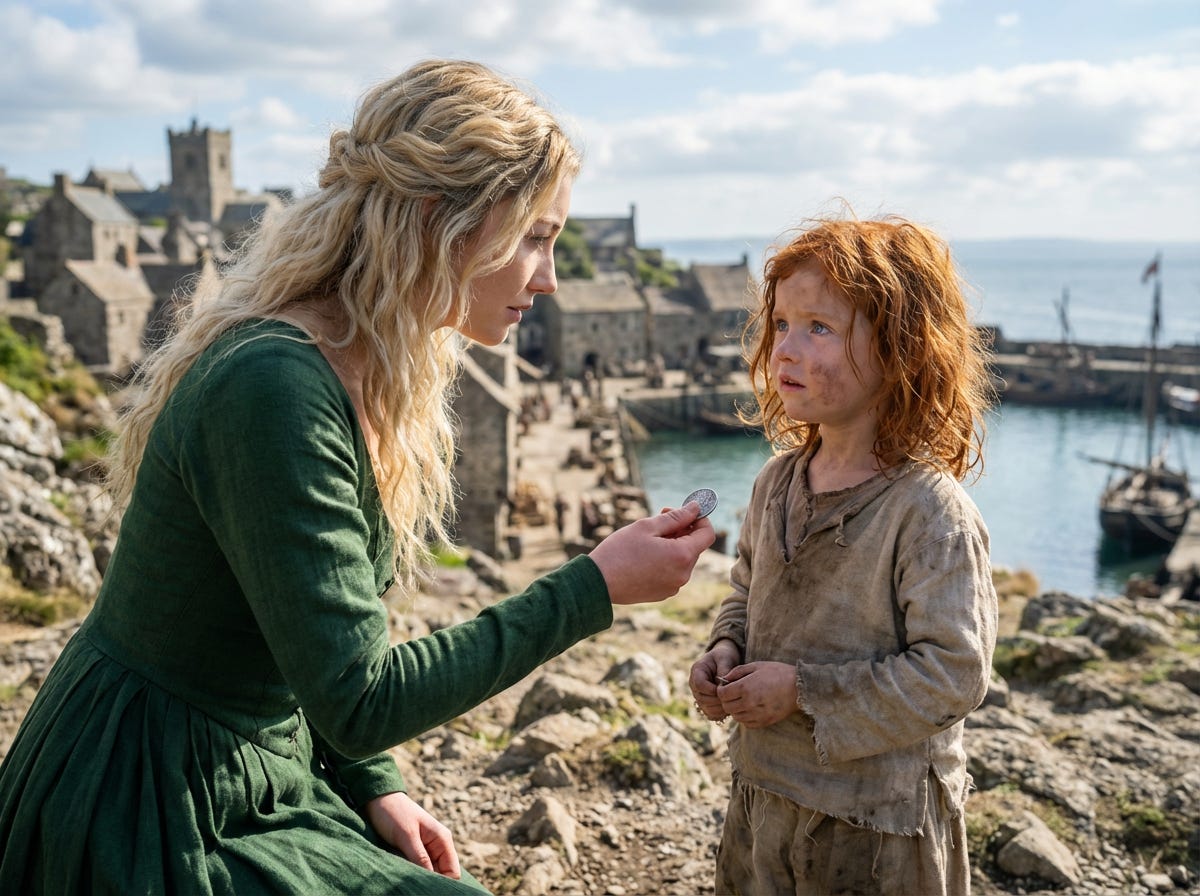
The girl’s eyes went wide. “That’s money.”
“It is. It’s for your family. For food.”
Chelsea took it in both hands with the gravity the occasion demanded. “Are you sure you don’t need it?”
“I’m sure.”
Chelsea turned and bolted for the hut at a dead run, shouting for her mother before she’d reached the door.
Scarlet stood. She was still watching the garden when the parents appeared in the doorway—a young woman wiping her hands on her apron, a lean, weathered man just behind her. They took in Scarlet with expressions that bordered on suspicion.
“My lady,” the man said carefully.
“I was sitting on the ledge there and your daughter found me.” She paused. “She told me about her treasure. The blue rock especially.”
The wariness softened, fractionally.
“She shows everyone that rock,” the mother said.
“As she should.” Scarlet nodded toward the garden. “You’ve worked hard on this ground.”
“It’s not much for growing,” the man said. “But it’s ours.”
“What’s your name?”
“Thomas,” he said. “Thomas Willow. This is my wife Nan.”
“I am Scarlet Wentworth,” she said. “My father is Caspian Wentworth, Duke of Kestrelmont.”
A silence.
“What—what can we do for your ladyship?” Thomas stammered.
“I’ve ridden twenty-eight days to come here, to find people like you. All of you. I mean to hold a meeting, two nights from now, and I want you there.” She paused. “There is good land to the west. Land to be won for people willing to enter my service. If you’re willing to go and help me take it back.”
The man stared at her.
“Land? Service?”
“It’s not without risk,” Scarlet said. “But it’s an adventure, and at the end of it, there’s ground that will actually grow things.”
Her eyes moved briefly to the struggling garden.
Thomas said nothing for a long moment. Then he turned to Nan.
Nan looked at the shilling in Chelsea’s small fist, and then at the garden, and then at Scarlet.
“Two nights from now,” Nan said.
“Two nights,” Scarlet confirmed.
Chelsea held up the shilling. “Mama, the duchess gave me this.”
“Duchess-apparent,” Scarlet said.
“Close enough,” said Nan, and almost smiled. “Would you—would you stay for dinner?”
“How about this,” Scarlet said. “How about we walk back into town, the four of us, and we have dinner together at the Rusty Anchor? Haddock and potatoes and a delicious bread pudding for afters. Surely you’ll come? It is my treat.”
“Oh—okay, my lady,” Nan said.
Stephen B. Anthony is the author of Transmigrant, an epic science fiction thriller, available on both Amazon and Audible. The first seven chapters are available on this website for free.
Psalter’s Point is different from what I expected. Feels very different from Scarlet’s home which makes the world feel all the more expansive
Scarlet’s generosity 🥹