

Scarlet has faced her most formidable foe: a frowning woman with a number roll. She has discovered a cousin—a historian named Marcus Wentworth—and met a girl named Chelsea, like the sea but better. Philip has been trying to catch up to her.
He had been on the road fifteen days, pushing hard, yet Ashcroft and his men were increasing the lead daily.
“How is it possible?” he asked aloud.
He was sleeping only four or five hours a night, pushing through the day, taking a short rest in the afternoon, and then continuing on through the evening until it was too dark to continue. How could they be outpacing him? The remnants of their camps were too far apart, or he was losing his ability to follow a trail.
At some point, he assumed, there’d be another confrontation with the baron. The man was deliberate and prepared in a way that Philip had learned to distrust—not the preparation itself, but the quality of it. There was no waste in Ashcroft. Every word, every gesture, placed like a stone in a wall being built toward something Philip couldn’t yet see.
He now regretted not insisting on accompanying her. But he hadn’t known she was Esme then, had he? The knowledge changed how he thought about his decision, but he wondered if that meant it was a bad decision to begin with. Maybe it had been. He shouldn’t have let anyone pass through the east road without an escort.
But with the certainty that Scarlet was the same girl he had loved in his youth, it brought him back to those years. He had thought about her so much over the decades, wondering why she had disappeared—why she had left him without a word. He hadn’t known that could happen to a person—that someone could simply be gone and the absence would become a permanent fixture, like a room in your house where something had burned.
He’d sought her at all their usual places for weeks and weeks, but she was just gone. Moved on. Maybe moved with her parents to some other part of the city, or some other city entirely. Gone without warning, without explanation.
Philip had courted two other women since then, but neither had been a serious consideration. One was quite pleased with her own beauty and the other quite dull. They had not compared favourably with Esme. Not even close. He’d stopped courting at all by the time he’d turned twenty-one. He didn’t see the point.
Despite that, he had still hoped. Maybe one day he would see her in a market. Maybe in a sun cathedral worshipping Epherion. Maybe at a gate passing into or out of the city. But she had never been at any of those places.
He’d never been truly interested in another girl until the swan. The way she spoke had seemed so witty and familiar and the way she moved had caused him involuntary shivers. There had been one moment when she turned slightly and he’d felt—flustered. Philip never got flustered. By anyone. Even the queen. But the swan had done it, and he hadn’t known what to make of himself afterward.
Then at dinner, with the Duke and Duchess on one side of the table and two young adults sitting opposite with similar features, he had guessed right. The swan had been Scarlet Wentworth—the very girl the queen wanted him to marry.
He hadn’t spoken to her at the dinner after confirming who she was, and had determined that he would not do so. But then he’d walked in the hedge maze on the estate, and she was suddenly there. Despite his intentions, he very much had wanted to speak with her.
But that was before she’d left with Ashcroft, just before Philip had reached her.
And then at the garrison, full of determination and will—and those green eyes—he’d nearly said things. Nearly. But all he could think about in those moments was the girl from his youth, so he hadn’t. His loyalty to a memory of a girl who had been standing in front of him. He’d wasted precious time.
And now he could only pray she was safe.
He stopped for a short lunch and wrote in his journal, one simple statement:
The girl I love is the girl I love.
That’s what journals were for: confessions.
He tucked it away in his saddlebag and rode on, but let his hand drift to it, touching its shape through the leather, knowing those words were there.
When Ashira set that evening, and only Isen graced the sky but was running close behind her, it became too dark to travel further without risk to his horse. He set up his tent and slid his bedroll inside it.
It was a cool night, not yet cold, and he hoped that would hold for a while. Somewhere in his packing, he had forgotten one of his wool blankets—the one that had been on his bed. He had noticed its absence the first night and had not yet determined why it was missing. He found he did not mind as much as he ought to.
He lit a lantern, planning to read more from the Kiranoise primer, but then got up to relieve himself in the forest, carrying the lantern with him.
He had taken only ten steps when he heard the thunder of hooves. Multiple horses, charging in his direction. At least three, possibly four.
He crouched and slipped behind a great ash tree. Steel rang somewhere in the dark—not the sound of blades being drawn, but of something already moving at speed.
Philip sprinted back toward the road.
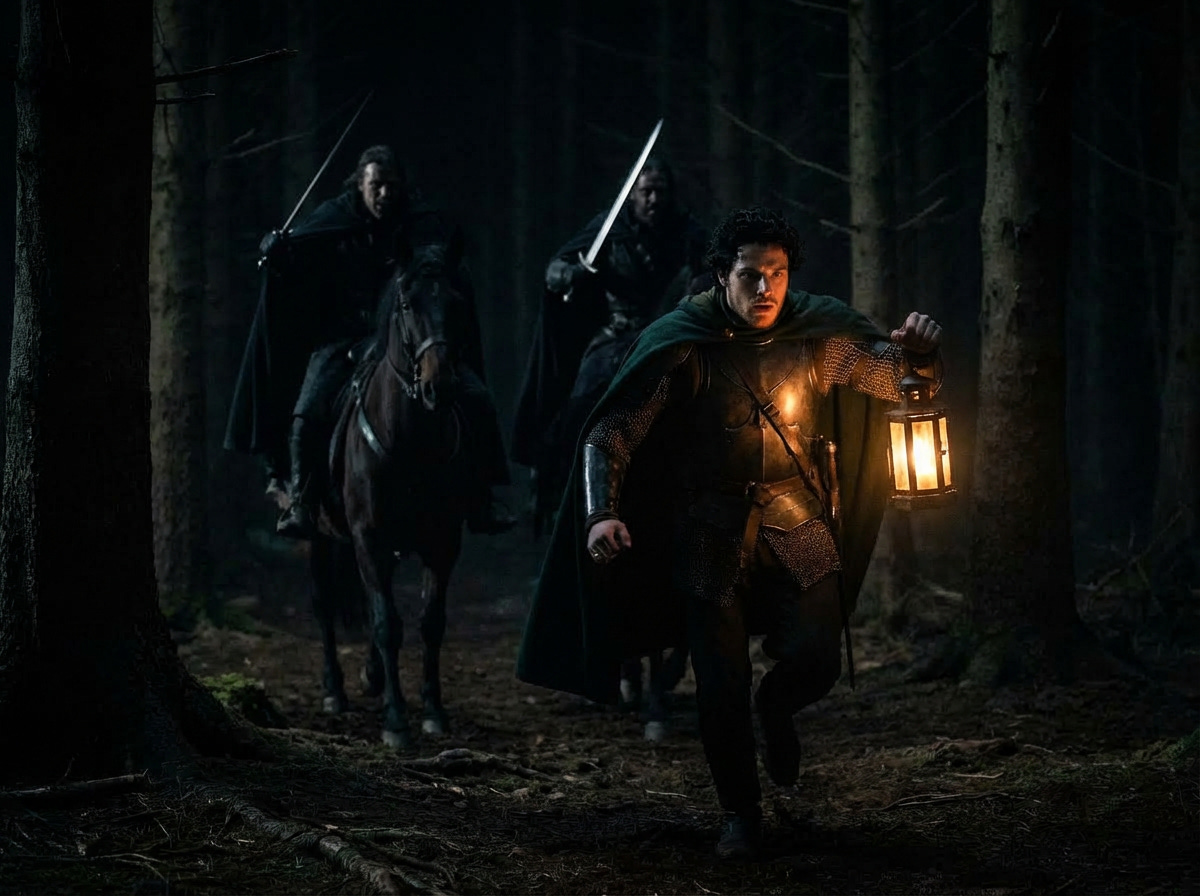
He heard a shriek—not an animal sound, not quite a human one, but something assembled from the worst qualities of both. He ran toward Bella, cursing that he had removed her saddle just twenty minutes earlier.
Going to the road meant open ground where they could ride him down. He chose to forego the horse, but dropped the lantern and grab his sword before a rider was upon him, raining a vicious blow with a long blade.
He barely saw it flash in the moonlight, but it was enough—he sidestepped the arc and slashed at the rider in the uncertain dark. His blade bit something and then was ripped from his grasp.
On the next pass, he leapt at the rider, grabbing him by cloak and collar, pinning his sword arm to the horse’s flank. He pulled with all his strength, lifting his legs as the horse moved, and found purchase on a stirrup with one foot. He heaved backwards, ripping the rider from the saddle.
They hit the ground hard. The wind was knocked out of Philip, but it had no effect on the rider, who didn’t seem to need wind.
He scrambled for his sword, patting the dark ground in widening arcs, and knew he could not stay tangled up with one opponent with three others closing.
The horse was close by. His foot found the stirrup, and he was upon it in two seconds, kicking the animal into motion as three other horsemen gave chase along the road.
He heard the swing of a sword from his right and ducked just in time as the blade passed over his head.
“What do you want? Who are you?” he shouted.
Another strike came from his left. He saw this one and lifted his left leg from the stirrup to avoid the blade—but the strike hadn’t been aimed at him. It bit deep into the horse’s flank, and the great animal shuddered beneath him, its rhythm breaking.
Whoever these men were, they were not beyond killing their own horses to get to him. The thought didn’t cause him fear. It made him determined.
His borrowed horse was already laboring. Probably a punctured lung. It wouldn’t be long before it faltered and went down. Philip decided not to wait.
He leapt from the horse toward another rider—another shadow in the dark—swinging his arms wide to grasp and grapple. It worked. He pulled yet another rider from his mount and they both ended up on the far side of the healthy horse. Philip had the wherewithal to grab the pommel on the way over—just enough purchase to land on his feet.
He heard his opponent’s sword clatter on the road. A glint of steel in the moonlight. He scrambled along the ground and found the blade with his bare hands, slid it carefully through his fingers, found the pommel, and turned the weapon at a lunging figure.
Philip felt the blade pass through the man’s ribs and heard the crunch as it found backbone. His opponent collapsed.
He did not cry out. Philip had felt men die on his blade before—the sharp intake of breath, the surprise of it, the involuntary sounds a body makes when something final has happened. There was none of that. The figure simply stopped, as a candle stops when you put your fingers to it.
That left two, with a third possible a couple hundred yards back. The two swirled around the healthy horse, which Philip used as a shield, crouching under it, swinging his stolen blade from side to side. He drove one back, cut at the other, and felt the blade connect—a solid blow across the shoulder that would have dropped any man he’d ever fought.
The creature turned back toward him without pause.
Philip understood then that he was not fighting men. He was fighting something that wore men. Pain meant nothing to them. Exhaustion meant nothing. The usual calculus of combat—wear them down, find the opening, make them flinch—none of it applied. They would not flinch. They would not tire. They would simply keep coming until they could not.
He backed against the horse, breathing hard. Two against one, with a blade that couldn’t stop them.
“I don’t know who you are,” Philip shouted. “But you have picked the wrong man to mess with.”
He heard what might have been a laugh—if a laugh sounded like a boot heel dragged across stone.
The voice that followed was no more real.
“The master will use you well.”
“Who is your master?”
“He has had many names.”
“What are you?”
“We are the last thing you will know.”
Philip heard the slap of a blade against the horse’s flank and the creature bolted, knocking him prone and scattering the sword somewhere distant.
He was unarmed, against three, and he knew this was it.
But he did not feel the bite of steel.
Instead, rough hands grabbed him from both sides, pulling him up into a kneeling position. The third creature stood before him.
“What do you want?” Philip demanded.
The gravel voice said, “The master wishes you to know that you and all your friends will bide, beginning with her.”
“If you touch her—”
“Fool. Do you not know the hour of your own death?”
He fought to pull his arms free, but they held him with a strength that had nothing natural in it—not the strength of large men or trained men, but the strength of something that did not get tired, that felt no strain, that would hold him until the end of the world if the end of the world was what it took.
Esme.
He stopped fighting. Not in surrender—in clarity.
I found you. After all this time, I found you.
I should have said it at the garrison. I should have said it that night by the fire—not your name, I didn’t know your name—but the thing I knew was true and wouldn’t say.
I should have said it.
The creature stepped forward and pressed its hand to his forehead.
It felt like the wind passing through a canyon—whistling, unstoppable, drawing everything with it, branches, leaves, and discarded things. But it was not those things that actually moved.
It was his thoughts. His memories. The things he’d done well. The things he’d done poorly—being swept from his body as if judgment was occurring.
His mouth went dry and he tried to grasp that hand away—that horrid hand—but he could not move.
His body shivered. He felt tears being drawn from his eyes, forming particles of mist that fell upon the creature touching him.
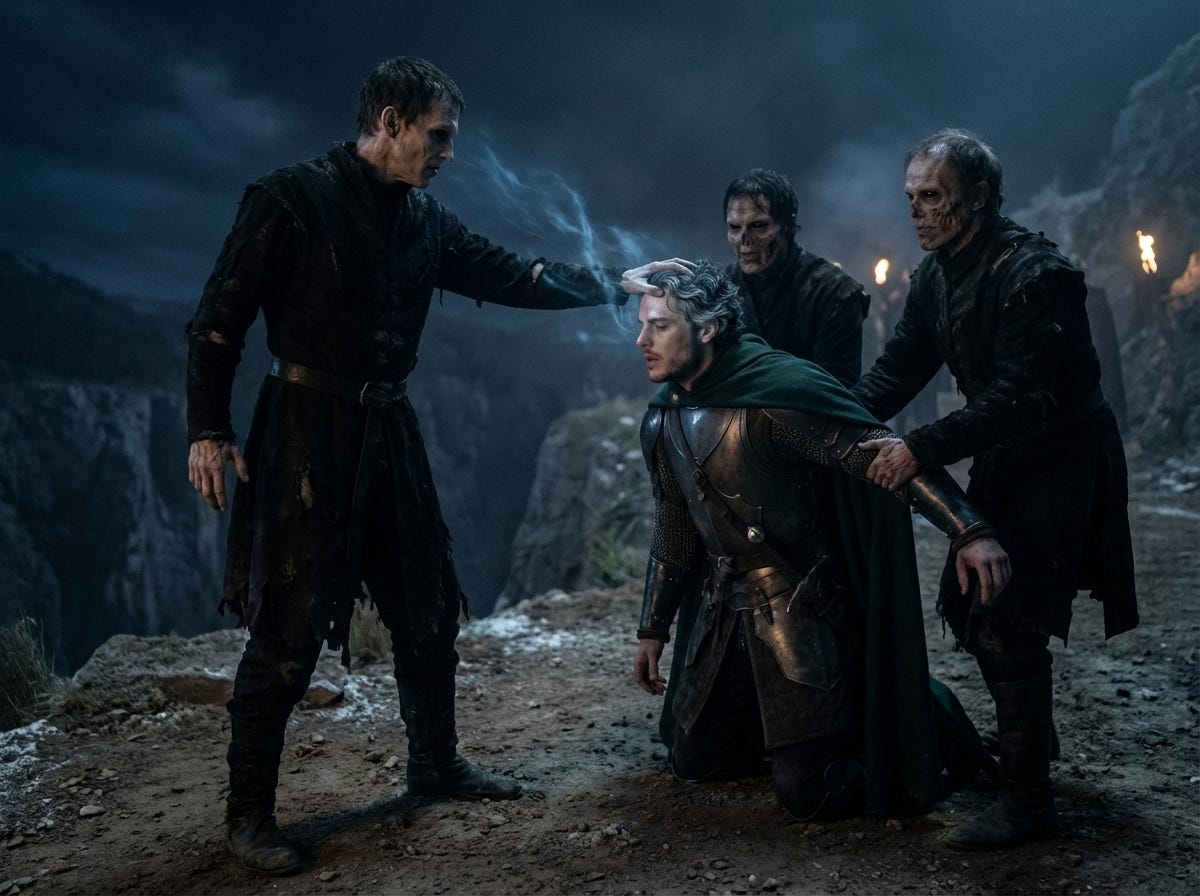
Every drink of water. Every morsel of food, somehow dissolved into memory and filtered away from him as he faded. Faded. Faded.
His skin grew tight.
His eyes grew dim.
There was nothing left of him.
Epherion!
Epherion, hear me. Do not forsake me in my hour of need.
The world faded away into blackness, to be replaced by an ethereal glow.
Philip Beckwith was at peace.
Stephen B. Anthony is the author of Transmigrant, an epic science fiction thriller, available on both Amazon and Audible. The first seven chapters are available on this website for free.
WHAT NO WAIT NO NO IT CANT BE
Noooo Phillip!!!