

Four seasons ago, a monk in Drakkar had a vision and a word arrived in his mind without being spoken. Three people on a ship discover they already know their names. Six of nine accounted for. Back in Psalter’s Point, Scarlet has been asked a question.
Scarlet stood beyond arm’s reach. Lance really could be a sweet, kind-hearted man, and his speech had been endearing, thoughtful—true and meaningful in its way.
Until he said those last words.
She knew it was not true. He did not love her and she knew it. Maybe he wanted to love her. Maybe it was possible for him to learn to love her. But underneath the pretty words, she knew he was saying it to achieve a goal, not because it was real for him.
He did not love her.
But more to the point, she did not love him.
Might she admire his worldly knowledge? Absolutely. Might she respect his dignity and chivalry? Certainly. But could she love him? Not in the way that she wanted to love a husband.
She turned back to him.
“Thank you for your heartfelt proposal,” she said. “It means a great deal to me that anyone would consider me.”
He frowned briefly, then pressed his lips together and leaned back against the wall.
“The truth is, Lance—I don’t think I am good for anyone. I don’t think I am meant for anyone.”
“But that’s not true,” he insisted. “I think you are meant for me.”
“It is a blessing to be well liked by good people. But that does not mean I am meant for them.”
He said nothing for a beat, turning his cup in his hands, and then set it down. “Were you ever meant for anyone?”
Scarlet sighed. “There was a boy once. I believed I was made for him and he was made for me. But he is long gone now.”
“I can’t very well compete with a ghost,” he said.
“No,” she said. “No, you can’t. And I have done you a grave disservice. You have been clear from the beginning. And even though your motives have changed over time, you have been clear. And I have not been.”
“I do like you,” he said softly. “Sincerely.”
“I know you do. That’s why you came to travel with me. I cannot tell you enough how much that means—”
“Please don’t do that,” he said.
She stopped and nodded before continuing.
“The best I can do for you is to be as absolutely clear as I can be. I am not for you, Lord Ashcroft. I am not meant for you, and you are not meant for me. It’s that simple. And it’s never going to change. I may never belong to anyone, and that’s okay. But I decided long ago that I would not compromise. I won’t be with someone to whom I do not truly belong.”
Lance straightened and said, “Very well. I thank you for a straight answer. It simplifies things.”
He stood in the lobby for a moment, and then ascended the stairs.
He grabbed his belongings, packed his horse, and rode west out of Psalter’s Point without another word.
Scarlet watched him go. Tears fell. She never thought of changing her mind, nor did she attempt to call out to him. The wound was fresh. No need to keep cutting at it.
But she did cry, because knowingly hurting someone was never easy. It was a double-edged sword to reject a person. Some of it always comes back to you and takes a little bit out of you.
She wondered if it felt the same to be drained by those creatures, the way she saw it happen to Benedict. Was it the same kind of pain, but multiplied by a thousand? She hoped not. But she could not stop feeling like there was something to it.
So, she cried.
In some small measure, she shed tears for Lance Ashcroft. But really, she shed tears for herself.
She wanted someone else to ask.
But that someone might no longer exist.
After Lance left, she climbed the stairs slowly and collapsed on her bed, with its cotton sheets, quilted blankets, goose down pillows, and Philip’s wool blanket.
She woke some time later to a soft knock on her door. Marcus stood in the hallway.
“Begging your pardon, my lady, but I wonder if you’d like to have dinner with me. I have steamed lobsters, scallops, potatoes, and asparagus.”
“I—I’m not that hungry.”
“It would do your body good,” Marcus said. “Besides, I would like to talk with you.”
“Okay,” she said. “I’ll be down in ten minutes.”
She entered the dining room ten minutes later. A young waiter showed her to a private room where Marcus sat alone. He stood when she entered.
“Good evening, my lady.”
“Please, if you will. Call me Scarlet and I will call you Marcus.”
“Good enough, my—Scarlet.”
The scallops were perfectly braised, the lobster already shelled—tail and claws displayed around the empty shell. Hot butter in small dipping dishes, and mashed potatoes with a gravy she could not describe.
Despite her insistence that she was not all that hungry, she ate two lobsters and four large scallops.
“I’m glad to see your appetite came back,” Marcus said as he ground black pepper on his asparagus.
“I guess I was a bit more peckish than I admitted,” she said. “Thank you.”
“I wanted to talk to you,” Marcus said. “About your offer. The offer you made to each person listening, especially to the offer for those of us with the Wentworth name.”
“What did you think of it?” she asked.
“It is a generous offer and a man would be a fool not to take it—unless he feared death more than he loved life. Or, unless he were too old to serve in an army.”
She set down her fork.
“And that is my case,” Marcus said. “I am now sixty-two and would not be of much use, nor could I guarantee being able to serve three years.”
“What about your children? Sons, daughters?”
“I had two sons,” he said. “But they fell to the dark tide. And my wife passed on four years ago. So there is no one.”
“I’m sorry to hear that, Marcus.”
“It is the will of Epherion. Who can question it? In any case, I find myself in a position that I must refuse your offer, because I cannot fulfill the bargain, and I am now too old to fight or work the land in such a way that would not waste a thousand acres. I have no heirs to inherit it. So, as much as it pains me, I must refuse.”
“Marcus—”
“Hear me out though,” he said. “I would very much like for you to take the histories with you. They are thirty-nine volumes that I have worked on for the better part of thirty years, although admittedly less so in the last decade. But they belong to the estate, and I would ask you to take them with you. And when you begin to read them, I would beg of you to write me and ask any questions you may have, so that I can answer them or instruct you where to find the answers.”
“Marcus,” she said.
“Yes, my lady?”
“I want these to go to our new historian at Kestrelmont. He lives at the estate with our family and we value him highly. He has no need of land or war.”
“A new historian? Why, that’s wonderful news! I should like to write to him. What is his name?”
“His name is Marcus Wentworth, of Psalter’s Point, formerly of Rivermark.”
His hand came to rest over his heart.
He sat that way for a long moment, his mouth open as though words were assembling themselves in an order he hadn’t yet approved. Finally he looked down at the table, at the remains of the meal between them, and was quiet.
Scarlet did not rush him.
Over the next several days, there were more rejections. People with families who had settled, who loved the sea, who held property dear to them here. In each case, they were reasonable rejections, but for the most part they were offered almost as an apology. In some cases, it appeared as resignation to an inevitable lesser life here.
But she did not push them. She had said that every man and woman would make up their own choice and answer to no one but the gods for it, and she certainly was not going to contradict herself.
The rejections hit harder than the acceptances lifted her, which she hadn’t expected. She sat with that for an evening, turning it over. She had prepared herself for refusals. She had not prepared herself for the particular weight of watching someone choose a smaller life because the larger one frightened them. She recognized that weight. She had felt it herself, once, before she had stopped being frightened.
It made her think of Lance. And her rejection of him. She knew that he would have felt no joy if she’d accepted him, so the only possibility for an emotional response was rejection. But she also knew it wasn’t sadness on his part. It had really been frustration at losing. Lance, she knew, did not like losing.
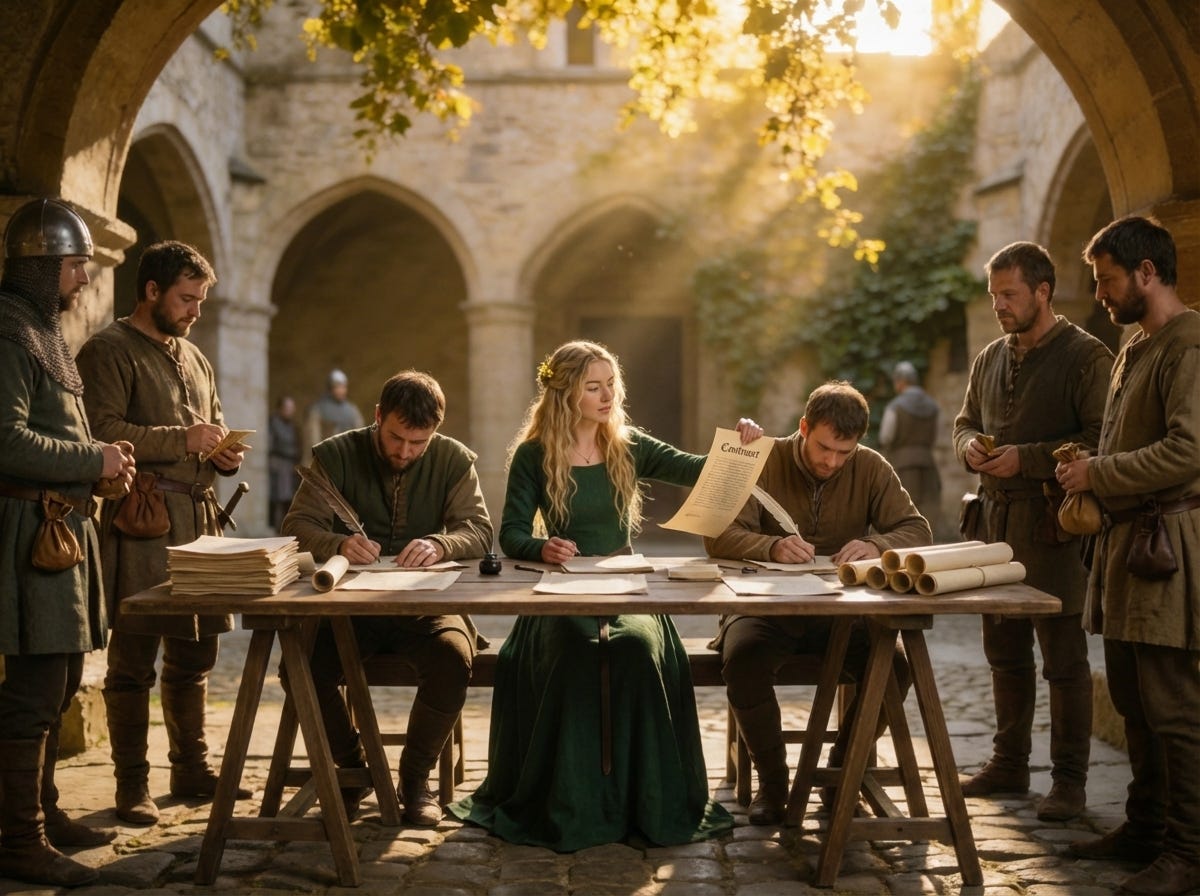
But there were acceptances that gladdened her heart, and she kept a team of four scribes busy drafting service and land contracts for the better part of two days. She didn’t keep count, but was certain she had met her goal of two hundred fighters. As many as Philip had. It would make a difference.
Thomas and Nan Willow were among the first to sign. He was still able-bodied and keen to learn something other than carrying baskets of fish between fishing vessels and merchants, which he had been doing for the last decade. They would be moving from a quarter acre of stony ground to a hundred acre farm, and she made a special note to ensure they got a riverfront property so that they might have a house overlooking water.
The father-and-son pair, Travis and Bertrand Wentworth—the older thirty-three, the younger sixteen—signed on for a combined total of two thousand acres, with Travis wanting the contract to stipulate that his son Bertrand would inherit the total upon Travis’ death unless other heirs should be born first. They had both worked as wheelwrights in Psalter’s Point and had plans to continue that trade after their mandatory three years of service. Travis wanted to grow Argonette, a cold-hardy grape known to do well in Bravia, which produced a high tannic wine.
The man who had stood to defend the Urukesh—she had learned his name was Cael Moran—signed on along with his two sons and the husbands of three of his daughters. Five contracts, five hundred acres. When she thought about the household that would be moving—children, babies, wives, the old man himself—she counted fourteen people. A small migration. A new beginning with its own momentum.
On the fourth morning after her recruitment speech at the community theater, a man brought a wandering horse into the town square to demand knowledge of its owner and, if one was not found within three days, to claim ownership of it.
She was deep in contracts at her table when Marcus found her.
“My lady,” he said. “I believe they have found the baron’s horse wandering alone.”
Scarlet went outside to find a dozen or so people looking the animal over. The mayor was drafting a document for abandoned property, accompanied by two constables.
She checked the animal over.
“Do you know this horse?” the mayor asked.
“This horse belongs to the baron, Lance Ashcroft,” she said. “He departed here four nights ago heading west.”
“I found it wandering at the trailhead,” a man said, sullenly, now realizing he probably wasn’t going to get a free horse out of the find.
“With its saddlebags and packs completely empty like this?” she asked.
“I didn’t touch anything, if that’s what you’re asking,” the man said.
“They were empty?”
“Yes, my lady.”
“Take me to where you found him.”
The small crowd grew as they climbed to the western road, people trickling in here and there until about thirty were in the party.
“I found him here, munching grass,” the man said.
Scarlet followed the horse’s tracks backward. It had meandered along the road for some time. Others, seeing her search the ground, joined in.
“What are you looking for?” the mayor whispered.
“Anything that might have dropped out of the saddlebags. Surely if someone robbed him, they wouldn’t have taken every single thing and left the bags behind.”
“Ah, I get your point,” he said, and directed the constables to the task.
A half hour into the search, a man yelled, “Over here! I’ve found him. Over here.”
They rushed to where the man was standing.
Seated, his back to a tree, was Lance Ashcroft. But it was not obvious at first.
He looked to be a hundred years old.
A constable knelt by him, placed his hand under Lance’s nose, then felt along his neck and wrist.
“He’s dead.”
Stephen B. Anthony is the author of Transmigrant, an epic science fiction thriller, available on both Amazon and Audible. The first seven chapters are available on this website for free.
Every time I think I know where things are going you add a twist that has me on the edge of my seat. Definitely did NOT see that coming!
She said no, good! But wait, Lance is dead? I was certain he had more evil to work.. maybe it’s a trick..