

Scarlet has spoken to hundreds of strangers in a theater at the edge of the world, drawing her saber to demonstrate her resolve to recapture her family’s lands. Elsewhere in the world, some two hundred days ago, parallel events began to unfold.
Four seasons ago…
Sir Drogoth Pennath, third son of the Caliph of Drakkar, joined the Knights Celestial on his fifteenth birthday, the traditional age. Because he changed his name upon joining, as all members of the Knights Celestial do, no one knew he was the son of the Caliph, and he gained no favors from his birthright.
He would never be Caliph unless both of his older brothers died, which suited him fine. In fact, should they both die, Drogoth would certainly abdicate to his uncle.
Had he stayed in Drakkaris, he might have been granted a substantial estate and income, a meaningless title, and lived out his days in unearned luxury.
On the 7th Moonsday of Frostfall, he sat in the outer courtyard of Kethavar Monastery, looking at the clouds beneath his feet and smoking a pipeful of Greenwhistle, which he had found expanded his mind at high altitudes.
Drogoth was the second largest man in the monastery—deep ebony skin, head shaved close, a scar running from his left jaw to his collarbone that he did not discuss. He kept his Knights Celestial insignia on a simple cord at his throat rather than displayed on his chest, which was not regulation. But nobody had ever mentioned it.
Despite the season and altitude, it was quite warm. Frost never actually falls in Drakkar.
He had finished perhaps half the pipe when the vision came.
Not a dream—he was fully awake, the courtyard stone beneath him, the pipe warm in his hand. But between one breath and the next, the clouds beneath him were gone, and the sky was clear as far as his eyes could see, and he was no longer in the temple.
Instead, he stood outside what he could only describe as a citadel. White stone catching a light that was not quite the sun’s light, though it came from the same direction. Gold-capped towers he had never seen, in a landscape he did not recognize, among snow-covered mountains.
He remembered a name, but could not recall learning it. It wasn’t spoken to him, nor written—simply present in his mind the way his own name was present.
Helios.
And then he was suddenly seated back in the courtyard of his adopted temple.
His pipe was out. He relit it, wondering what it meant.
When it went out a second time, still unsmoked, he knocked the pipe out against the stone, rose, and went inside.
He approached an ancient man who sat on a woven mat, legs crossed, palms up on his knees.
Drogoth knelt in the same position and waited.
Forty minutes later, the ancient man spoke. “You may speak, my large friend.”
“Sifu,” he said. “I have had a vision.”
“I smell it on you,” the Sifu said.
“A true vision, Sifu.”
“Tell me this vision.”
Drogoth described it just as he had experienced it, leaving nothing out.
“You say it was called Helios?”
Drogoth considered this for two minutes while neither of them spoke. Finally, he said, “I cannot say that is true. I merely know that I know the word now that I did not know before the vision. Setting aside unlikely coincidences, the logical conclusion is that the word is associated with the vision.”
The Sifu nodded. “Well considered,” he said. “But I have not heard of Helios, nor do I know of a shining citadel among snowy mountains. You might ask Durgen.” The Sifu closed his eyes.
Drogoth waited the customary half hour before standing quietly, bowing, and leaving. The Sifu did not acknowledge his departure.
The waiting had always been the hardest for him.
He left the master’s meditation chamber and took the stairs down to the library where an Oroquai man sat at a table leafing through an ancient tome.
Durgen was the only person in the temple larger than Drogoth. He was not especially big for an Oroq, but he was bigger than Drogoth, though barely. His pale blue-grey skin carried darker striations like the grain of old timber, his pale eyes moving across an ancient text that he had probably already read no fewer than four times. He wore the monastery’s simple robes, clearly made for him specifically, with a single dark feather tucked behind one swept-back ear.
Drogoth sat opposite him and waited the requisite thirty minutes, though his right knee bounced the entire time.
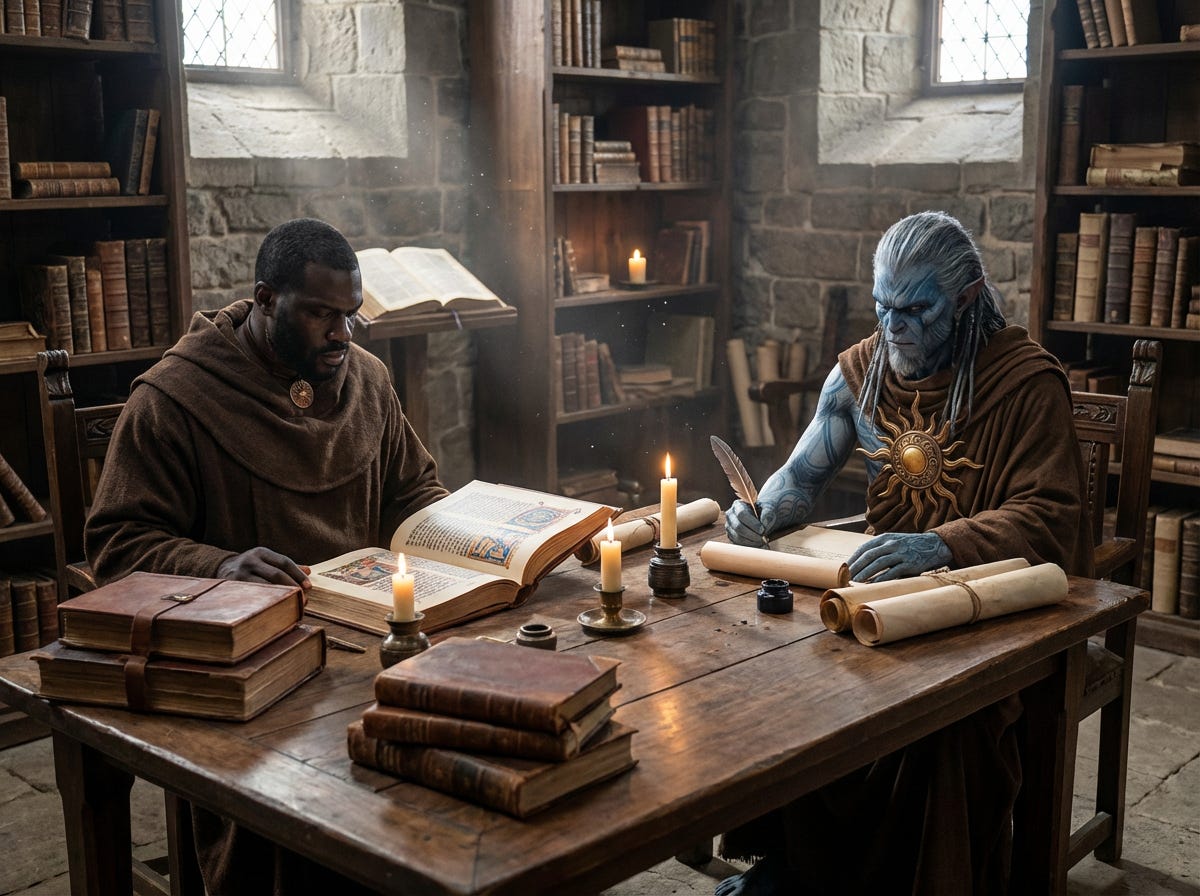
When the impatient silence ended, Durgen asked, “What thoughts of the sun do you have today?”
“Helios,” Drogoth said.
Durgen raised his eyes.
“A word,” Drogoth said.
“I gathered it was a word. I believe it is a synonym for the sun.”
“It is a place,” Drogoth said.
“Where did you come by this knowledge?”
“I had a vision.”
“Have you been smoking again?”
Drogoth fidgeted slightly. “I have, but that is beside the point. Have you not heard of it?”
“Give me a few minutes,” Durgen said. “I have some tomes that may be of value.”
He rummaged in the stacks for two hours, by which point Drogoth was biting his fist to stay silent.
“I found a reference to Helios as a place in the mountains of Bravia. The Dragonspires, they are called. But it is an apocryphal text not considered canon and likely untrue.”
“May I take it with me?”
“These are very ancient documents. You must take great care of it,” Durgen said.
“I will keep it safe,” Drogoth said. “Thank you. I’m not sure when I will return.”
Durgen looked across the table at him.
“I am going to travel,” Drogoth said.
Durgen nodded and returned to the manuscript he had been studying before the interruption.
Drogoth did not wait the required half hour. He was through the monastery gate before the afternoon bell.
Sixty days on the road was not hardship for a man raised in the monasteries of Drakkar, where silence and patience were considered the same virtue. But silence on a mountain road was a different thing than silence in a courtyard—it had weather in it, and altitude, and the loneliness of a man carrying a question he could not yet answer.
He crossed three mountain ranges and two languages, passed through villages where no one had heard of the Knights Celestial and others where they were regarded with a suspicion he had learned not to take personally. He slept in barns when he could find them and under the sky when he could not. He read the tome by firelight until he had it memorized, then read it again to find what he had missed.
Somewhere in the highlands of Elindor, fording a river so cold it briefly stopped his breath, he understood that the journey itself was part of whatever this was—that Epherion was not the kind of god who sent visions to men who stayed put.
Wind-burned and considerably leaner, he came down out of the heights into the green wet air of Elindor, where the mist sat in the valleys like it had taken up permanent residence, which was closer to the truth than Drogoth knew.
He found the harbor at Caer Moren on the thirty-second day of Plantings, where a vessel was being provisioned for the crossing to Bravia.
He paid the requisite fee, knowing that he would be in Stormrest before the Burning of the Flax, the festival that fell between Harvest and Blight.
To Drogoth’s great surprise, just before the ship departed, two of the Knights Celestial—a woman and a man—boarded the vessel. He had never seen a female member of the order, although they were not strictly forbidden by any part of the archive that he had studied.
They saw his insignia. The woman noticed it first.
They joined him in the common room on the second deck.
“I am Senna,” the woman said, sitting. She was tall and strong, nearly six feet tall. Her companion was an inch or two taller.
“I am called Aldric,” he said.
“Both Elindoran?”
They nodded.
“I am Drogoth,” he said.
“What did you see?” she asked.
“What do you mean?”
“You’ve seen what we’ve seen. I can hear it in the way you say your name—like a man who has just been given new instructions.”
“Helios,” Drogoth said.
They nodded gravely.
Drogoth reached into his pack and produced the tome. It was small for its age—palm-sized, bound in something that had once been leather and was now closer to stone, the pages so thin they were nearly translucent. He set it on the table between them.
“I have read it perhaps forty times,” he said. “I will tell you what it says and what it does not say, which is almost more important.”
Senna leaned forward. Aldric said nothing, but his hand moved to the edge of the table, closer to the book.
Drogoth opened it carefully to the relevant passage—he knew the page without looking—and turned it so they could see. The script was archaic, the hand cramped and faded, and several lines had been lost entirely to water damage at some point in the book’s long history.
“The Sun Citadel,” he said. “In the Dragonspire Mountains of Bravia. A site called Helios. The text calls it the most holy of all sites to Epherion—his seat in the world, hidden from those who would desecrate it.” He paused. “Hidden, notably, for a very long time.”
“Hidden from whom?” Senna asked.
“The text does not say that directly.”
He turned a few pages, stopping at a passage marked with a thin strip of cloth he had torn from his sleeve somewhere in the Elindoran highlands.
“Here,” he said. “This is the part that concerns me.”
He read it aloud, slowly, as a man reads something he has memorized but still wishes to get exactly right.
When the darkness moves upon the world as a pawn of the Imprisoned One, nine judges shall be called from the corners of the earth. They shall be called to Helios, and there begin the judgment of darkness.
Their chief justice shall be known as Lightbringer. The eight judges are named Sunfury, Constellation, Darksbane, Shadowbreaker, Sunrise, Eclipse, Lifegiver, and Sunflare.
“Sunflare!” Senna said. “That’s me!” Then she paused. “How do I know that?”
“I am Darksbane,” Aldric said, as if afraid to admit it. “I remember.” He looked at Drogoth. “Then who are you?”
“Since the first time I read this book,” Drogoth said, “I knew I was Sunfury. I could not and cannot explain it.”
“There is no need,” Senna said. “We understand.”
“But what does it mean?” Aldric asked. “What does the text say?”
“Just that there is a pawn of the Imprisoned One and we are to judge the darkness he brings.”
The common room was quiet for a moment. Below them, the ship’s timbers creaked.
“There is only one candidate,” Drogoth said.
“Shaetan,” Senna said. Not a question.
“Yes, but who is his pawn?” Aldric asked.
Drogoth frowned. “Darkness is his instrument. So someone related to darkness.”
“Nine,” Aldric said, studying the page. “We are three.”
“We are three who found each other on a ship,” Drogoth said. “The others are somewhere.”
He closed the tome carefully and returned it to his pack. Then he was quiet for long enough that Senna glanced at Aldric.
“What is it?” she asked.
Drogoth turned to the small porthole and the grey water passing beneath them.
“When I had the vision,” he said slowly, “I saw Helios clearly. The citadel. The mountains.” He paused. “And I saw figures. Nine of them, I assumed, given what the text says.” He stopped again.
“How many did you see?” Aldric asked.
“Six,” Drogoth said. “I could see only six.”
The ship moved beneath them. Somewhere above, a sail snapped in the wind.
“Perhaps the vision was incomplete,” Senna said.
“Perhaps,” Drogoth said.
He did not sound convinced. And neither, from their silence, did they.
Stephen B. Anthony is the author of Transmigrant, an epic science fiction thriller, available on both Amazon and Audible. The first seven chapters are available on this website for free.
Oooo the mystery
Ohhh this is adding such depth to the story