

An ancient entity has taken residence in the butterfly named Isabelle. It has been manipulating events for decades. Perhaps longer. Meanwhile, Philip faces his doubts while he pursues Scarlet—the girl he loves.
He had not recognized Scarlet as Esme when she took her mask off at the masquerade dinner, nor when she spent a day and night with him at the garrison. He remembered the easy comfort of her presence, and beneath it something he could not name that had unsettled him without his knowing why. And even with her green eyes matching his memory of Esme, he had not put it together until he’d heard that her middle name was Esmerelda.
They were both very different people from then. He had to allow for that.
Celeste Boffrey had been the proprietor of the Crusty Edge in those days. He hadn’t been back there in years and wondered if Celeste was even still living. She must have been in her fifties then.
He’d been a street urchin, of sorts, although he wasn’t homeless like most—just mostly homeless. He had a bed near his father, but his father was gone by dawn and not back until well after dark, earning a half shilling a day and spending two pence on booze a night. It had been survival—nothing more.
There were kids far worse off—those who slept in abandoned buildings or under someone’s house curled up against the hearth footing where a little heat could almost be felt. He’d never quite reached that point. In fact, he’d often brought those kids into the flat when his father was passed out, hiding them at the foot of his bed under clothing so they could sleep through a particularly cold night.
He’d hung near Celeste’s place most mornings, hoping for a dropped scrap—but rarely finding one—until one morning she’d confronted him.
“You’re here every morning,” she said.
“Yes, mum,” Edmund said.
“That’s better than I can say for some of my helpers. What say we get some bread into you this morning? But here’s the catch—you work for me. Taking deliveries ‘round. You do that for me, you get one square a day. Got it?”
He got more than one square meal per day out of the deal. There might be some leftover crusts, or something burned, or an extra biscuit that accidentally fell into his mouth while carrying a package of them to Mrs. Yearnst. Or Betty Moss who, whenever he brought her a pecan pie, would always give him a tiny sliver of it as a reward, with a little fresh cream on the side.
It took him about two hours in the mornings and another three in the afternoons, leaving four hours midday with nothing but time on his hands.
That’s when he discovered the old common house—a building bought by a new owner who intended to tear it down and replace it with a new tavern—which he eventually did. On the site now sits the well-regarded Cap and Quill, an establishment frequented by university students who would one day become merchants.
But before the Cap and Quill, the old common house had been a place for adventures.
The pretty blonde girl with the green eyes, like a living forest, had come to Celeste’s to buy a basket with bread and hermits. Celeste was well known for her hermits—a delicious molasses cookie filled with nuts and bits of fig, cooked as a single loaf on a large rectangular cooking sheet and then cut into squares and wrapped individually.
She had caught his eye while holding the basket, and he’d smiled goofily at her. She remained aloof through the encounter until she’d paid a penny for her basket. She skipped off, heading wherever it was she lived, but stopped a few paces on, turned her head, made sure he was watching, and gave him a wink.
Later, he saw her near Celeste’s, moving slowly as if she’d misplaced something, and then brightening when she spotted him.
“Hi,” she’d said. “I’m Esme.”
“Edmund,” he’d said. “Pleased to meet you.”
She’d fiddled around in her skirts and produced two of the individually wrapped hermits, giving him one.
They’d gone to his hideout—the old common house basement, where they ate hermits and planned how they might one day become king and queen and make sure that children everywhere always had hermits to eat.
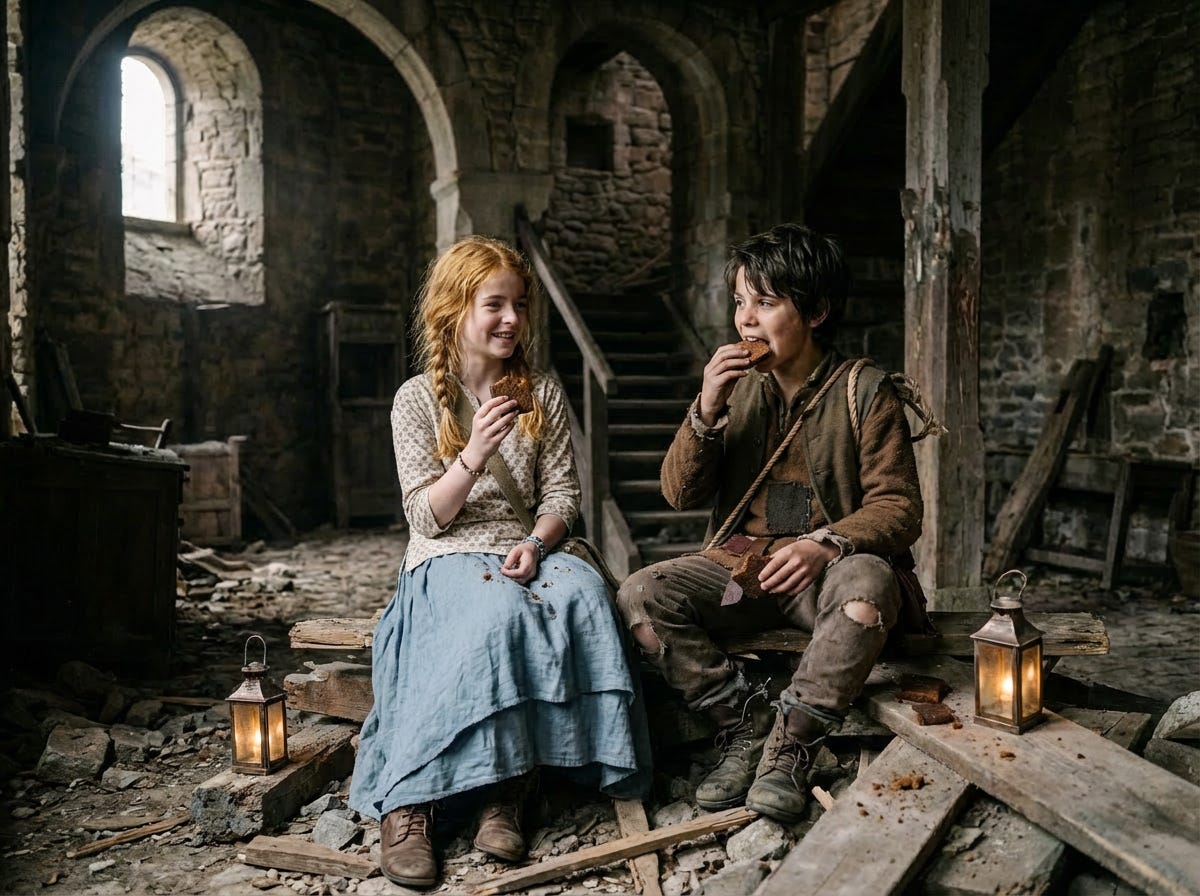
Three years they had adventured in the old common house while the city argued with the new landowner about the size of the tavern.
By then, they’d shared many hermits, doughnuts, sponge cake, and even a slice of strawberry pie once that Edmund had thought the best thing ever invented, except girls. Well, except for one girl. One certain girl. With the eyes like the forest, who moved like the wind, and who smelled of every spring flower all at one time.
They were twelve by then, and he was totally in love with her, though he was afraid to say it, and she never gave any hint of reciprocating—instead reminding him often he needed a bath, which were very hard to come by. On the other hand, she continued to show up three or four times a week, even against her father’s wishes, and that was not nothing.
So when he’d shown her his treasure, and she kissed his cheek, he had turned his head on purpose to try to catch her lips. It was a joke, really. Just fooling about. But the result had been something that landed differently than anything before it, and he had not been the same about her afterward.
And then she had simply been gone.
Philip had excuses for why he hadn’t recognized it was her.
But he’d spent the time since assuming she hadn’t recognized it was him either. What if she had? What if she knew he was Edmund all along and had made it clear she didn’t want him? Why should he assume she didn’t know? Why should he think he was the only one operating with limited knowledge?
Was it because, when he was introduced as Philip Beckwith, she hadn’t asked, I thought you were called Edmund? Was that the only reason he assumed she had not recognized him too?
Maybe he was the only one without a full hand of cards. Maybe at the masquerade, when the owl’s mask came off, she had known exactly who he was.
His stomach turned at the thought.
But what was there to do other than ride to her, hopefully find her, and let her know he finally knew who she was? He could apologize and try to explain his failure to see it. She might accept that. Esme had always been brighter than him. It was one thing that had drawn him to her.
He was almost certain that Scarlet and Esme were the same person. He’d convinced himself it was true—it must be true. It must be the same family—the same girl to whom he gave the papers and, eventually, the ring, when her father had demanded it.
That day in the abandoned house when she’d returned with her father in tow. He’d been happy to see her and then immediately fearful for his life. It had been the last time he saw her. He could still remember her turning her head to glance over her shoulder as her father pulled her by the hand, out of his life, for good.
It had to be the same girl. He was sure of it. Wasn’t he?
He reached down and patted Bella’s neck. She was one of six he owned, but she had recently become his favorite—steady and reliable. Not perhaps as fast as Dart, his chestnut Bagstock stallion who he rode in battle. Bella had become more of a traveling companion on a lonely road. She was, as he was, growing tired of the journey, but she never complained.
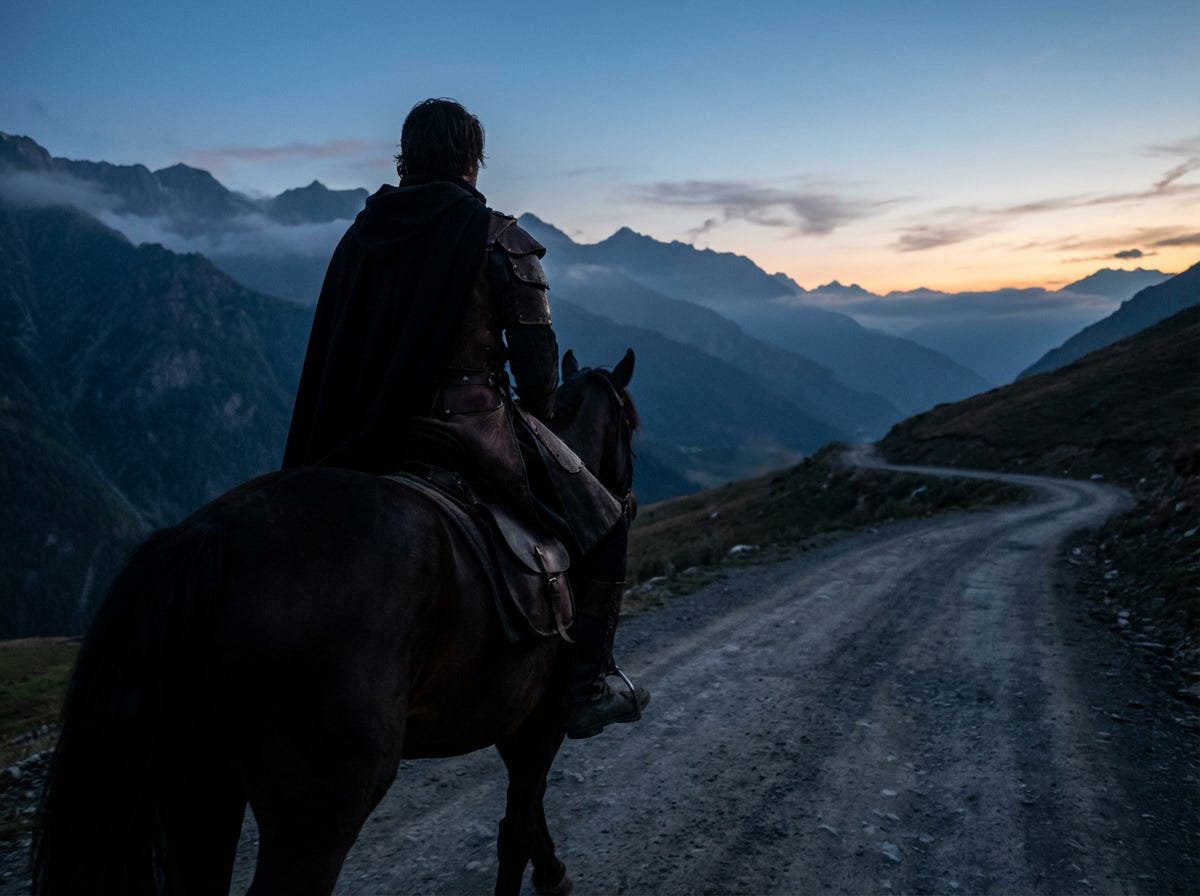
He stopped early for the day, with the sun still up. If Scarlet were still alive, she would certainly be in Psalter’s Point by now. But so would Ashcroft, who almost certainly had some association with the creatures of undeath that had attacked him and drained his life force.
He shuddered at the thought of one of them touching Scarlet.
But he was so far behind that if they’d meant to do that, they might already have done so. Either he would find her or he wouldn’t. Trying to ride at breakneck speed to overtake them was pointless. He hadn’t caught them and wouldn’t.
But he would not be much good to her without sleep, and he hadn’t rested well for a couple of weeks. He built a bigger fire than normal, given the increased chill of the last few nights, and cooked a piece of salted pork alongside beets.
He was halfway through his first beet when a northern fox came threading through the woods at the edge of the firelight. Much bigger than a typical red fox, but smaller than a wolf, they were efficient predators, though not a threat to a man. This one had its nose to the ground, unaware of him as he sat silently, unmoving.
The fox paused, one paw up midstride.
And then something between them scurried.
Philip heard a sound like the snap of a whip. The fox jumped, whined, and darted past the fire.
He heard a second snap.
Then he felt the sting. Two of them. One in the thigh, another in his ankle. Like bee stings.
He never saw the creature. Just motion in the underbrush that moved through the forest and disappeared.
“Shardtail,” Philip whispered.
That was not good news.
The creatures weren’t normally dangerous to humans, provided you left them alone. They were a medium-sized lizard, low to the ground, typically slow moving, but capable of dashing quickly for short bursts. They grew five to seven quills from their tail which, when whipped at a creature, flew at significant velocity and embedded in the flesh.
Hence the initial sting.
But the initial sting wasn’t the problem. The venom was the problem. And two quills in Philip was the worst kind of wound. Not enough to kill him, just enough to make him wish he was dead.
They didn’t act like arrows. An arrow tore, bled, declared itself. These went in almost clean. The tail flicked, there was a sting like a wasp, and then—nothing that seemed worth stopping for. A rider might curse, shift in the saddle, and keep moving.
The quills were barbed, but not for holding. They were designed to catch on withdrawal. The shaft was rigid near the tip, then subtly jointed. Every step of the horse, every twist of the rider’s torso, worked it. Not deeper—looser. The outer segment separated along a natural fault line, like a twig bent back and forth with each movement.
Inside each quill was a narrow reservoir, sealed under pressure. The venom was contained, waiting for the break. When the shaft finally fractured, it didn’t just snap. It splintered inward, a tiny collapse that drove the fluid through microchannels along the barbs and into the surrounding muscle.
It wasn’t a flood. It was worse than that.
A slow leak.
The long-term effects were unpleasant to deadly and the worst thing you could do was pluck the quills, breaking them off inside you—which they were designed to do. There would be fever, muscle stiffness, paralysis. If they stayed in long enough, every movement over multiple days would break open more of the channels in the quill, redosing you with venom over and over again, eventually distributing paralytic agent to your heart and lungs.
Philip cut his trousers at both the thigh and ankle, carefully pulling back the cloth and inspecting the quills.
The one in his ankle was not deep and not dangerous. A few minutes with his knife, a binding cloth, and torqwood sap would do the trick, but working on his ankle with a quill still in his thigh would not be easy. It would risk continual breakage along the length of the quill. And the one in his thigh was deep.
The tiny wounds were already reddening at the edges.
There was no choice. He was going to have to cut the one out of his ankle whole and accept that the one in his thigh was going to remain there. It just meant he would have to ride gingerly for the next several days, possibly up to a week, leaking a little more venom with every movement, and being prepared for the sickness, until it became infected. Eventually, the venom would weaken, pus would surround the quill, and he could then extract it like a large sliver and begin the healing process.
But that meant a very bad week coming up.
Philip gingerly leaned down and held his knife blade in the flames, and opened the flesh of his ankle as tears came to his eyes.
He held the extracted quill up to the firelight. The end barb was fully intact. He tossed it into the fire.
Then, wincing, he dug through his pack. Torqwood sap and cloth strips. The sap was known to be clean and hold flesh closed. The cloth strips would protect the injured flesh.
He applied them carefully, first to his ankle, and then over the small spot in his thigh where he had cut off the second quill.
He lay down in his bedroll, draping his arm over his forehead.
“Well,” he said. “This trip just got worse.”
He grabbed his journal, opened it to the last page and saw his last entry.
The girl I love is the girl I love.
Below that, he wrote:
I don’t love shardtails.
Stephen B. Anthony is the author of Transmigrant, an epic science fiction thriller, available on both Amazon and Audible. The first seven chapters are available on this website for free.
That last line made me laugh
Whoa! What a creative kind of predator!! I’m glad those don’t exist 😳