

Scarlet Wentworth has been summoned to answer a queen's suggestion that is nearly a command. She will not be handed to a stranger like a parcel, and she has said so.
Sir Philip Beckwith came in past the picket lines as the light was going—two hundred horses on rope lines in the last of the afternoon, shifting and blowing, the smell of them rising in the cool air the way it always did at day’s end. He noted that the lines were quiet. No gaps. Nothing taken.
The Urukesh had a taste for horseflesh. It was one of several things that made the campaign personal.
The stable sat apart from the lines, as it always did—a timber-framed structure with canvas sides and a proper ridge pole, designed to be struck in a day and reassembled in two. It had made the journey with them four times now. Inside were his six: the Bagstock stallion he’d ridden today, Bella the Corvaire mare, and four others. Worth more than most men earned in a decade. Worth protecting.
He noticed the seventh horse before he reached the door.
She was tied at the near post—a grey, tall and clean-limbed, with tack that had no business being within a hundred miles of a campaign stable. Good leather. Good fittings. The kind of animal that came with a groom and a covered stall and a name someone had chosen carefully. Philip ran his hand along her neck without thinking, checked her feet, noted the shoes. Recent work. She’d traveled hard but not far.
Someone wealthy. Someone who’d ridden out today.
He removed the saddle from his chestnut Bagstock stallion, running his fingers along the animal’s spine, caressing and scratching.
“Thank you, old boy,” he said. “It was a long ride today.”
The horse turned its head to Philip, nuzzling, then shivered all over.
“I’ll brush you out in a moment.”
“Captain?”
Philip lifted his head. Chenguer, a sergeant in the Knights Celestial, stood at the stable entrance.
“Chen,” Philip said. “How was the day?”
“Good, sir. Barley is all in on Hillcrest Siding.”
Philip nodded. “Let’s hope for good weather.”
“Sir—” Chenguer hesitated.
“What is it, Chen?”
“The Queen is in the lodge.”
Philip set down the saddle. He was tired in the way a man gets after six years of a campaign that never truly ends. He didn’t need a queen tonight. He needed a bath, a meal, and silence.
“I’ll see her at once, though I should bathe first. I smell of horse and blood.”
“Might I suggest—”
“I know, Chen. Thank you. We’ll go see her at once.”
“I’ll accompany you.”
“Of course,” Philip said. “Because you expect her to be in Lady Christine’s company. Don’t take me for a fool.”
“Never, sir,” Chenguer said. He led the way toward the lodge.
“What’s the topic?” Philip asked.
“She’s been reticent.”
“So, about the lands, then.” Philip frowned.
“Your guess is as good as mine,” Chenguer replied.
They entered the lodge—timber and oilcloth, spare as everything else on the frontier—and immediately bowed before the Queen, who had made herself at home in one of the camp chairs by the iron stove. A cook moved quietly in the kitchen, and the smell of something roasting reached Philip before he’d fully crossed the threshold. His stomach answered before he could.
“My queen,” Philip said, kneeling.
“Stand, Philip,” she said. “I want to look you in the eyes.”
She took her time, inspecting him for injuries, as a woman who had sent men to war might. She was somewhere past fifty, with the kind of stillness that comes not from ease but from long practice at composure. Her hair had gone partly silver, worn simply for travel. The eyes that moved over him were sharp and, Philip had always thought, faintly tired—the eyes of someone who had been making difficult decisions for a very long time and expected to make several more before she was done.
“How goes the campaign?”
“There are good days and bad,” Philip said. “Today was one of the better ones. We’ve pushed the Urukesh back beyond Tallfellow Canyon, but I expect reinforcements.”
“Good progress,” she said. “Back to the original frontier line.”
“It’ll be tough to maintain without more men,” Philip said. “But we have chemists working on a nasty surprise should they return.”
“I’ve never met one of these Uruks. Are they as fierce as they say?”
“No fiercer than humans, though perhaps more savage in some ways. They are tribal. I hope to negotiate boundaries that satisfy both sides, even if neither is fully happy.”
“But they know these are our ancestral lands?”
“They do,” Philip said. “Some respect that; others believe conquest overrides any claim.”
“A strange dichotomy,” the Queen said. “Might serve us to remind them that conquering works both ways.”
“Indeed. We are making that clear.”
“Speaking of ancestral rights…”
He had known this was coming. The Queen never rode this far for good news.
“My queen,” Philip said, “I’ve spent six years on this campaign. If we reacquire land lost to conquest, it’s equal to new acquisition. Ancestral rights become moot.”
“In theory,” the Queen replied. “But many sages disagree. They argue that occupation doesn’t erase a family’s claim—or their children’s.”
“I’m not sure I agree that decades of possession are equal to temporary occupation,” Philip said.
“Indeed,” she said. “That is the dispute in a nutshell. But I’m not here to adjudicate legality. I’m here to propose a different resolution—one that avoids dissatisfaction on all sides.”
Philip blinked.
She smiled.
“You are what—twenty-three?”
“Yes, your majesty.”
“And unmarried.”
“Yes—” He paused. “Where are you going with this?”
“The eldest Wentworth child is a girl. About your age. Also unmarried.”
Philip went still.
“I can think of a way,” she said, “to wrap this up neatly, tie it with an elegant bow. I wager you can too.”
“My queen,” Philip said. “There—is another girl.”
“Another girl?” she repeated, amused. “Knights are always thinking of chivalry and honesty. I’m talking practicalities.”
“I understand, your majesty. But hearts do not always bend to practicality.”
“Don’t lecture a queen on that,” she said sharply.
“Yes, my queen,” he said, and left it there.
“Who is the girl you love?”
“Just a girl I knew in my youth.”
“You court her now?”
“No, your majesty.”
“Then what is the impediment? She may already be another’s.”
“Sadly, yes,” Philip admitted, more to himself than her. Years in the field forced such reckonings: all the doors left unopened, words unsaid. He didn’t know where she was, or if she thought of him at all.
“Then there is no difficulty beyond your feelings,” the Queen said, “which I encourage you to set aside swiftly. Meet the Wentworth girl. Judge for yourself.”
“Daughter of a noble? Probably big-boned, boring, willful, and smells of saffron and sweat,” he muttered.
The Queen laughed aloud.
“She is willful,” she said. “I’ll grant you that. But the rest—you should judge yourself. For the sake of resolving a delicate situation.”
She stood, signaling the conversation was over.
“I must return to the castle. My staff left a meal for you after your ride.”
“Thank you, your majesty.”
“I’ll arrange a meeting,” she said. The word arrange did the work of a command.
Philip watched her leave, then turned to the stable, to the horse still needing brushing, to the simple work of his hands. Chenguer walked with him.
“Christine was not here,” he observed.
Chenguer nodded his head, the expression on his face unreadable.
In the morning, Philip took a different horse, to let his main rest following yesterday’s long ride.
He saddled a white-chested black Corvaire mare. Bella was quite full of energy. He had not taken her out in weeks and thought a stretching of the legs would be good for her.
He took his time with the animal. She was excited, dancing slightly at the cross-ties, tossing her head, and making the saddling harder than it needed to be. It was his own fault for letting her sit idle for too long, so there was no urgency in his movements. There was no point fighting an animal ten times stronger than him. So he waited her out.
They were on the move twenty minutes later than he’d hoped, but she had the energy to make up for lost time.
He took the road east through Tallfellow, the Dragonspires flanking him on either side—close on the south, more distant to the north, the whole range cupping the sky in a way that never quite felt like open country. The settled farmland of the lower foothills had given way to scrub and scattered pine weeks ago; out here the land was contested in the most literal sense, every cleared field a former argument. The first of the Harvest color was showing in the broadleaf trees along the creek beds.
To the southeast, above the whole range, Elduros dominated the horizon—the one peak that was brown rather than white, still exhaling a thin thread of smoke into the pale sky. Hundreds of miles beyond it lay Earthmelt, invisible from here, three centuries of cooled black rock and poisoned ground where the city of Sardis had been. Nothing had reclaimed it. Nothing tried.
Philip intended to follow the road further east today, riding solo—quicker, if more dangerous. His purpose was to scout for Urukesh activity east of Tallfellow Canyon as the road climbed up into the Dragonspires. His secondary purpose, known only to himself, was venison. Which was why he carried his shortbow—a weapon he could manage from horseback.
He saw a doe with a pair of yearlings early in the day, but they were both too far for a safe shot, and too young to be left without a mother. They’d be old enough to survive on their own in another season, but he had passed on the opportunity.
Shortly after noon, he saw the smoke of a fire. It was off the road, perhaps a hundred yards outside the tree line, burning with the deliberate economy of someone who knew what they were doing—not the careless blaze of an accident or a camp in a hurry, but a fire built to last and cook over. Philip slowed Bella and studied it from the road.
Nobody was tending it.
That was wrong. A fire that size, in contested territory, with nobody sitting beside it meant either a trap or trouble. Philip had survived six years by treating both possibilities with equal respect.
He tied Bella at the road’s edge and moved into the tree line on foot, hand on his sword.
What he found at the fire was a quartering operation of considerable skill. Two massive hind quarters from what Philip initially took to be a large deer—but no. Too big. The legs alone were the length of his arm. An elk. Whoever had taken it down had already boned out the backstraps and laid them carefully beside the hinds, wrapped in broadveil leaves to keep them clean. The forequarters were absent.
Whoever had taken the elk had gone back for forequarters.
Philip checked the fire, the meat, the faint path worn between the woods and the clearing—someone had crossed it enough times to leave a route.
Then he heard it. Someone returning with a load, but something faster, heavier, and more urgent than a human. The crack of underbrush giving way all at once. A sound he recognized from six years of ambushes.
He was back at the road and mounted before he’d consciously decided to move, Bella responding to his urgency with her ears already forward and her body coiled. He pushed her toward the tree line at an angle to intercept whatever was coming, and then he saw it.
An Uruk burst from a dense stand of pine at a dead run, a massive forequarter across one shoulder, pale skin catching the broken light through the canopy. He was faster than a man had any right to be under that load—but not fast enough.
Six wolves came out of the trees behind him.
Not the lean timber wolves Philip knew from the southern ranges. These were mountain wolves, heavy-shouldered and grey, the kind that pulled down elk in deep snow without particular effort. The Uruk dropped the forequarter without breaking stride, spun, and had an arrow on his string before Philip had fully processed what he was seeing. The shaft took the lead wolf through the chest and it rolled without a sound. The Uruk was already nocking a second arrow.
The remaining five didn’t slow.
Philip put his heels to Bella.
She went without hesitation, the result of battle experience that had made her something other than an ordinary horse. They hit the pack from the flank at a full gallop. Bella’s shoulder caught the nearest wolf and sent it cartwheeling into a tree trunk with a cracking sound and a yelp that ended the matter entirely. Philip was already off the saddle before she’d fully stopped, sword drawn, landing between two wolves that had turned from the Uruk toward this new threat.
The first one came in low and fast. Philip drove the blade down into it before it reached him.
The second was already airborne. The Uruk’s second arrow took it through the neck from ten feet away.
The remaining three scattered, dissolving the moment the calculus of the fight shifted against them. There was still a carcass somewhere in the distance that didn’t fight back with sword and arrow.
Philip stood there, breathing heavily.
The Uruk snorted.
Neither moved.
Philip knew this face—or faces like it. He’d seen Uruk at close quarters plenty of times. Had put his sword through them. Had the scars to confirm they returned the favor without sentiment. The pale grain-patterned skin, the ram’s horns, the pointed beard braided at the tip, the broad ears that were now rotating slowly through the tree line, checking.
The pale grey eyes settled on Philip.
The Uruk bent, picked up the forequarter, and settled it back onto his shoulder as though the last two minutes had been a minor inconvenience.
He said something in his own tongue—a short phrase, two or three words, delivered with the flat affect of a man stating a fact.
Then he walked back toward his fire.
Philip sheathed his sword, retrieved Bella, and stood at the tree line for a moment before following the Uruk back to the fire. He wasn’t sure why he followed. He went anyway.
The Uruk set the forequarter down and crouched to tend the coals, which had burned lower in his absence. Philip crouched on the opposite side without being invited, which seemed to be acceptable. The Uruk added wood without comment, repositioned the backstraps on their green stick, and produced a small pouch from which he pinched something—dried herbs, Philip thought, something sharp and resinous—and applied it to the meat with the unhurried precision of someone who took cooking seriously.
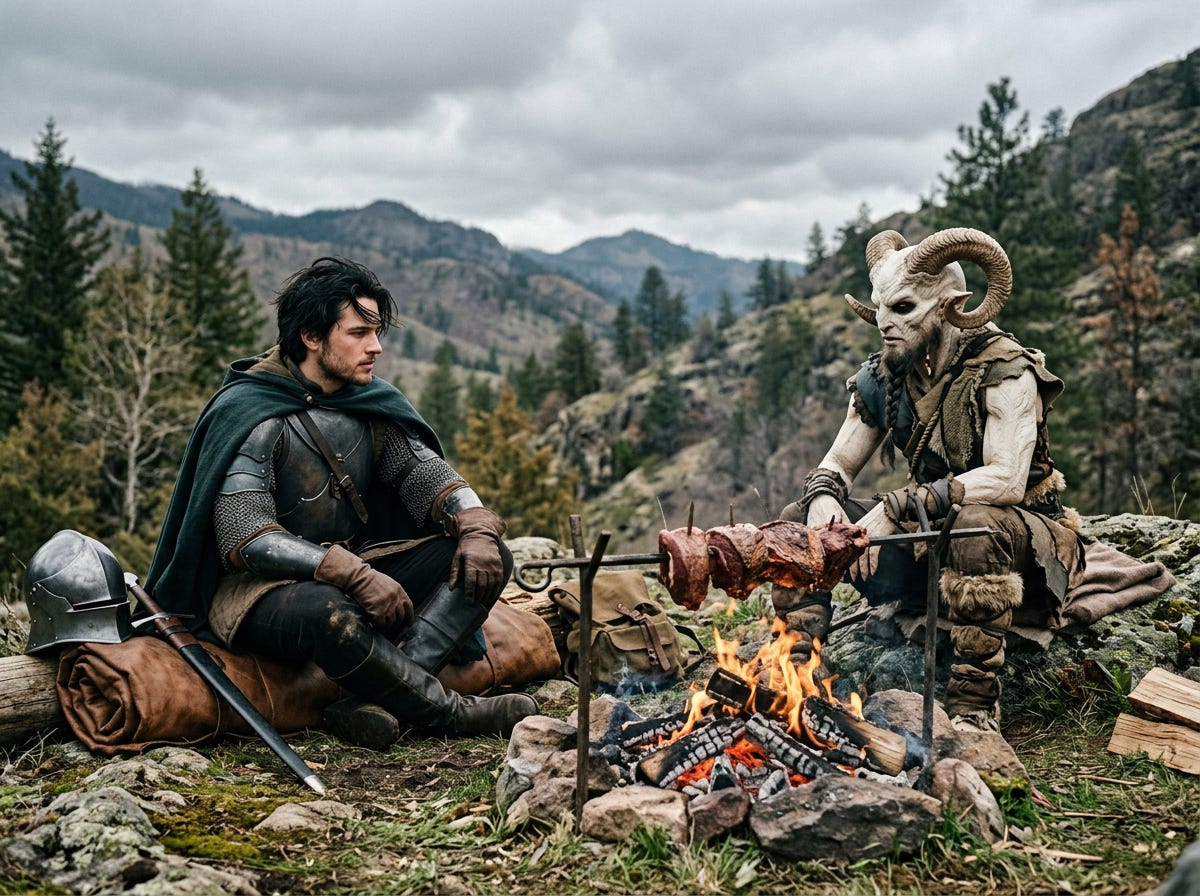
After a while he spoke again. His human tongue was accented and economical, each word arriving separately, with room around it.
“Grakh took carcass,” he said. He tilted his head toward the forequarter. “Kept what matters.”
Philip noted the hinds, the backstraps, the tenderloin already resting on a flat stone near the coals.
“You planned that,” Philip said. “The quartering. You knew they’d come.”
The Uruk’s ears moved. Something that might, in a human face, have been the beginning of a smile.
“Grakh always come,” he said.
He cut a section of backstrap and set it on a stone on Philip’s side of the fire without ceremony, the way a man pays a debt he considers minor but real.
Philip picked it up and ate.
It was excellent.
They sat while the fire did its work, two men who had spent six years trying to kill each other, saying nothing.
When Philip rose to leave, the Uruk did not look up.
Philip nodded once anyway.
He rode west with the taste of woodsmoke and unfamiliar herbs on his tongue, thinking about a queen who wanted elegant solutions and a land dispute that six years of war hadn’t resolved.
He thought about Grakh always come.
There might be something in that worth considering.
Later that evening, when Philip arrived at the lodge, Chenguer found him in the stables, brushing Bella in the last of the light.
“Evening, sir. What of the day?”
“Had lunch with an Uruk,” Philip said. “Also, fought some wolves.”
Chenguer was quiet for a moment. “You what?”
“I’ll tell you about it over whiskey. What’s happened here?”
“A letter for you.” Chenguer held it out. Then, after a pause: “I received one as well.”
Philip took his without comment. They stood there a moment, two men holding blue envelopes in a stable that smelled of horse and hay and the coming cold.
Philip broke the seal. Fine calligraphy on deep blue paper—court stationery, the kind that didn’t make the journey to the frontier unless someone wanted to be certain it arrived with its dignity intact.
The masquerade ball was in a fortnight.
He looked at Chenguer. Chenguer looked at him.
Neither said anything about the other’s letter.
“Whiskey,” Philip said.
“Yes, sir,” Chenguer agreed.
Stephen B. Anthony is the author of Transmigrant, an epic science fiction thriller, available on both Amazon and Audible. The first seven chapters are available on this website for free.
I don’t know why but I wasn’t expecting Uruks to not be human. The plot thickens!