

A knight named Philip Beckwith smells of horse and blood and has been told by the queen to consider marrying a woman he's never met. He had lunch with an Uruk and fought some wolves.
On Thormsday, Lady Christine LaPointe arrived at Kestrelmont unannounced, asking for Scarlet by name, which meant Scarlet needed to rush up several flights of stairs, already tired and sweating from two hours of practice with a saber in the lower armory, where the stone walls kept the cold in regardless of season. With no time to bathe properly, Scarlet used a sponge to dab the sweat from her body and sprinkled a little saffron in her bodice.
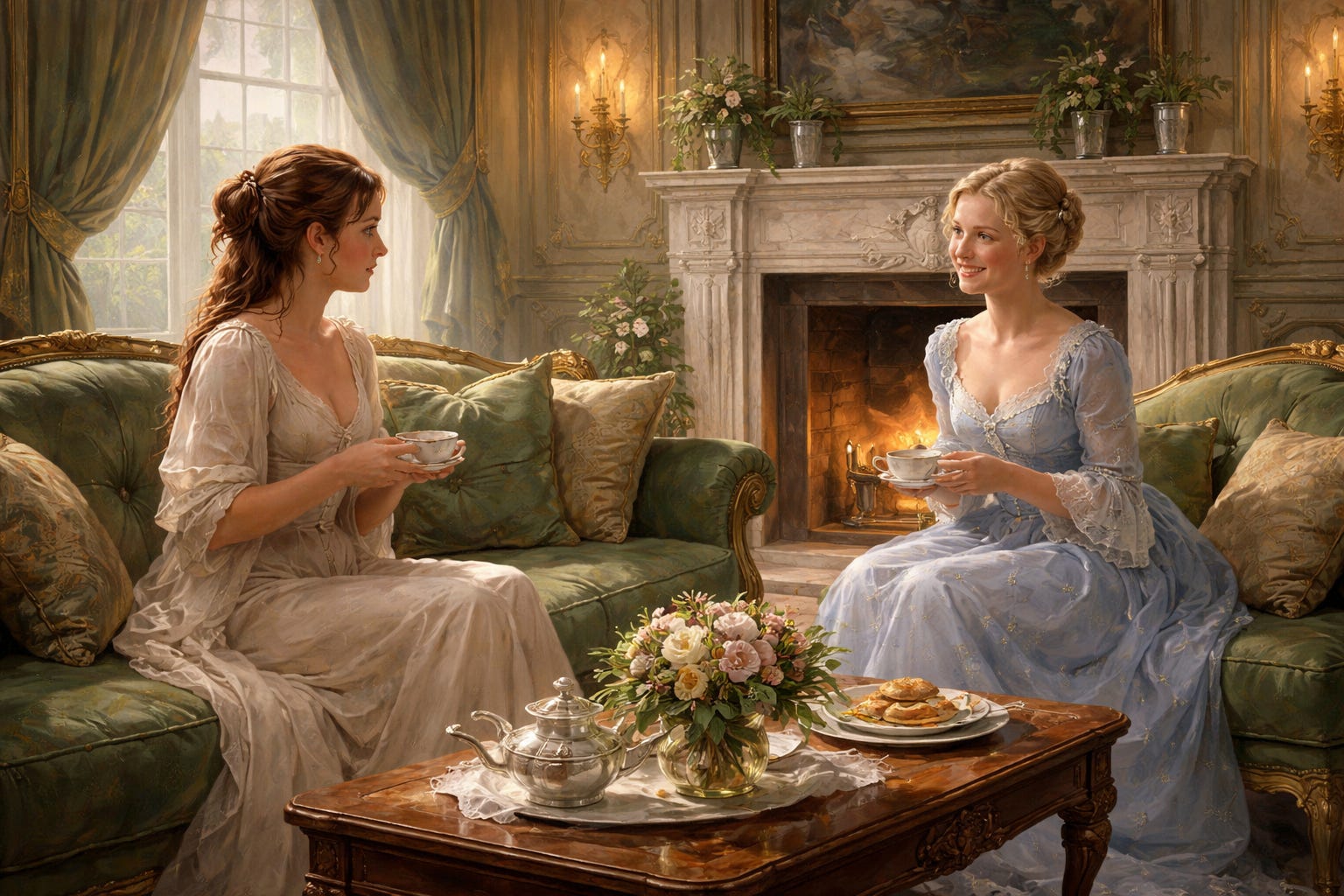
The drawing room was the finest room in Kestrelmont. The ceiling was high enough to make voices sound considered, the plasterwork above decorated with the Wentworth falcon in relief—restored at considerable expense, her father had noted, with the tone he used when something cost more than it should but was nonetheless necessary.
Two tall windows looked out over the east garden, which her mother had reclaimed from decades of neglect, the beds still more in a state of planning than flowering. A fire burned in the hearth beneath a marble mantelpiece that had survived the Ashcroft occupation intact, either through oversight or indifference.
The furniture was new. Her mother had selected every piece herself—good solid things in deep green wool, built to last, chosen with the quiet determination of a woman furnishing a room she had waited her entire life to furnish. Nothing in it had belonged to anyone else.
Scarlet had not yet decided whether she was comfortable in it.
She arrived in the drawing room to find her mother already chatting with Christine. Her mother was in full form, which meant Christine was being charmed whether she wanted to be or not.
Her mother sat in her usual chair beside the hearth, back straight, hands settled—the posture of a woman who had decided long ago to occupy whatever room she was in with complete authority. Her hair had gone silver at the temples but was otherwise still the same dark blonde Scarlet had inherited, worn in the precise knot she never varied. She was not a tall woman, but she had never needed to be. Beside her, in the chair that was usually her father’s, sat Christine, turned slightly toward the fire, a small sealed envelope in her hands that she was turning over and over without appearing to notice she was doing it.
“You must see what we’ve done with the east garden,” her mother was saying as Scarlet entered. “It’s still more ambition than achievement, but the roses along the south wall are coming wonderfully. Do sit, dear.” This last directed at Scarlet, as though she were the guest.
“Lady Wentworth,” Christine said warmly, “the room is absolutely lovely.”
“It is, isn’t it,” her mother agreed, with the satisfaction of someone who had earned the right to that opinion. “We had it all done fresh. Nothing from the previous occupants. I wouldn’t have it.”
Christine reached forward without thinking and adjusted a log with the poker, settling it more firmly against the others. The fire responded immediately, burning a degree brighter and steadier, as though it had been waiting for exactly that correction. Neither woman remarked on it. The fire settled into a steady, even burn, the kind that produces more heat than sound, comfortable and constant.
Scarlet sat. She accepted the tea her mother poured without being asked. It was mountain sage—her mother’s preference, ordered in from the Dragonspire traders who came through Stormrest at the start of each season.
She sipped it and studied Christine over the rim of the cup. She was aware, in a distant and irritating way, that she still smelled faintly of saffron and effort, and that Christine—who always looked as though she had spent the morning being painted—would certainly notice and certainly say nothing.
Christine was thoroughly enjoying herself—which was, Scarlet had long decided, her natural state. It was difficult to resent. She was the kind of woman whose fiery auburn hair caught light from across a room and whose attention, when it settled on you, felt like being chosen. Scarlet had watched men lose entire trains of thought simply because Christine turned her head.
“And how is your mother?” Scarlet’s mother asked, resettling into her chair with the authority of a woman who had no intention of leaving. “I heard she had a difficult winter.”
“Much improved, thank you,” Christine said. “The light has returned to her eyes. She’s been directing the servants again, which we take as a promising sign.”
“Good servants need directing,” Scarlet’s mother said firmly. “Otherwise they direct themselves, which never ends well.”
“Mama,” Scarlet said.
“It’s true,” her mother said serenely.
Christine smiled into her teacup.
They covered the expected ground—the weather, the state of the roads, a mutual acquaintance whose youngest son had made a questionable marriage that both older women assessed with careful neutrality while meaning the same thing. Scarlet drank her tea and waited. Christine was building toward something. She always was.
The afternoon light had moved off the east windows and was warming the center of the room now, catching the dust motes above the tea service. Christine turned the sealed envelope over in her hands once more, then set it on the table beside her cup.
“I’ve been thinking of throwing a small gathering,” Christine said with the casualness of someone who had been thinking of nothing else. “A masquerade, actually. Something festive before the season turns.”
“How delightful,” Scarlet’s mother said. She did not look at Scarlet. This was itself a form of looking at Scarlet.
“I do love a masquerade,” Christine continued. “There’s something wonderful about a room full of people who are pretending to be unknown while knowing perfectly well who everyone is.”
“Who is on your guest list?” Scarlet’s mother asked.
“Oh, the usual. Lord and Lady Pembrook. The Ashcroft boy—young Lance, the new Baron.” She paused just long enough. “Several of the Knights Celestial, I think. Sir Philip Beckwith, if he can be persuaded away from his campaign.”
Christine set the envelope on the table and slid it toward Elise with two fingers, as though she’d been meaning to do it since she walked in.
Elise took it with both hands and set it on the arm of her chair without opening it. “Philip Beckwith,” she said thoughtfully, as though testing the name for weight.
“He’s quite well regarded,” Christine said. “Honorable. Accomplished. Not of noble birth, of course, but the Knights Celestial rather transcend that distinction, I think.”
Scarlet set down her teacup.
“You mentioned Lance Ashcroft,” she said.
Christine met her eyes. “I did.”
“He’ll be there?”
“He’s always everywhere, lately,” Christine said lightly. “Since his father passed and the barony was—restructured, shall we say—he’s been very present at court. Very charming about the whole thing. Remarkably gracious, actually, given the circumstances.”
“Remarkably,” Scarlet agreed.
Her mother had turned to the window, which was itself an answer. Outside, the east garden caught the afternoon light. The roses along the south wall had gone past their Bloom peak now, the beds showing the first quiet exhaustion of Harvest.
“In any case,” Christine said, “I do hope you’ll come, Scarlet. It would mean a great deal to me. And Chenguer will be there, which is—well.” She stopped, suddenly less composed, a faint color rising in her cheeks. “Several of Sir Philip’s men will be attending.”
“Of course they will,” Scarlet said.
Christine’s composure returned, accompanied by a smile she didn’t bother to hide. “Will you come?”
“Champagne?” Scarlet asked.
“Naturally.”
“Crumpets?”
“Obviously.”
“Then I suppose I have no particular objection to a party,” Scarlet said.
Her mother turned from the window and said nothing, which said quite enough.
“I’ll have Cook send you home with some of those lemon biscuits you love,” she told Christine. “For your mother’s recovery.”
Christine accepted this with the grace of someone who understood that the lemon biscuits were not really about her mother.
“On the other matter—” Christine said cautiously.
Scarlet shook her head, only slightly.
Her mother set down her teacup with the deliberate precision she applied to everything.
“I believe I’ll go and see about those biscuits myself,” she said. “Cook has been in a generous mood since the Harvest vegetables started coming in—the kitchen smells of something wonderful all day long, which I take as a promising sign, though it does nothing for portion control.”
She smoothed her skirts, nodded to Christine with the warmth of genuine affection, and touched Scarlet’s shoulder once as she passed—the same gesture her father had used at dinner, carrying the same unspoken weight.
The door closed behind her with a soft, definitive click.
A moment passed.
“She knew the entire time,” Christine said.
“She knew before you arrived,” Scarlet said. “Did the queen put you up to this?”
“She just mentioned in passing that it had been a while since anyone had thrown a good party, how it would be nice for someone to do so, and how a masquerade before fall would be welcomed.”
“As I told someone recently,” Scarlet said, “a queen’s suggestion is very nearly a command.”
“Indeed,” Christine said, blushing slightly. She bounced her knee.
Scarlet glanced over at her. “What?”
“Lance Ashcroft has been asking about you.”
“Asking in what way?”
“Feels like he’s planting seeds, honestly.”
“The ground is not fertile,” Scarlet said. “But you’re dying to tell me about someone else, aren’t you?”
“Chenguer? Oh, he’s perfectly agreeable.”
“You know who I’m talking about.”
Christine said nothing.
“Go on,” Scarlet said. It was permission.
“Oh, do you mean Sir Philip Beckwith?”
Scarlet snorted at her.
Christine continued. “He commands two hundred men. He’s just twenty-three.”
“My age,” Scarlet said.
“What I would say is that he’s organized, disciplined. He handled the queen surprisingly well for a man not born into nobility.”
“What was his manner of speech?” she asked, with as little interest as she could muster.
“Neither coarse nor formal. Simple, I would say.”
“Is he simple?”
“Perhaps in the right ways.”
She turned her teacup in its saucer once, slowly, the way she turned a problem over before committing to it. Scarlet wondered what that meant, and whether Christine’s measure of the right ways had a great deal to do with a certain sergeant who was not born into nobility either. But she kept that observation to herself.
They sat a moment.
“Are you going to ask,” Christine prompted.
“Ask what?”
“You know what.”
“You want me to ask if he is attractive? And you want to give an answer?” Scarlet sighed. It might have been slightly overdone.
Christine was very nearly failing to keep a straight face.
“Very well,” Scarlet said. “I’ll play your game. Is he attractive?”
“Gods, yes,” Christine said, laughing.
Despite her intention not to crack, Scarlet did. She laughed with Christine. But the laughter faded and her expression turned serious.
“War does things to men,” Scarlet said. “Unpleasant things.”
“That’s a real concern,” Christine admitted. “You’d have to discover that. But I did make one observation.”
“Which was?”
“He insisted on brushing down his own horse, saying that the stallion had worked hard that day and needed some attention.”
Scarlet nodded slowly and said nothing, turning her cup in its saucer.
Finally she asked, “Tell me about Chenguer.”
Christine’s eyes lit up.
“He’s hardly said a word to me,” she said. “He’s perfectly correct, perfectly proper, perfectly gentle, and there’s something in his eyes—darker than most in Bravia. Older than his years, somehow. Perhaps it’s his Kiranoise blood.” She paused, and then shivered slightly, as if the thought of him had its own warmth.
“Oh, I didn’t realize he was from the East,” Scarlet said.
Christine smiled and nodded. “But you’d think I was furniture, because he doesn’t speak to me. Still, I can see it. When I come into a room something in him goes still, as if moving would give something away. I catch his eyes just before he looks away. But the way he looks away is—its own story somehow. It’s almost more meaningful than if he openly stared at me.”
“You’re certain?” Scarlet asked. “About his interest?”
“I think so,” Christine said. “I just need him in a room where being proper is slightly harder than usual.”
“So,” Scarlet said. “Champagne, many dark rooms, masks? I sense an opportunity.”
“So do I, my dear friend,” Christine said. “So do I.”
They sipped their tea as the afternoon sun warmed the room.
“I should really go. Much to do,” Christine said. She rose.
“I very much appreciate you coming to visit,” Scarlet said, standing.
Christine grabbed her in a hug, which Scarlet returned warmly.
“Nine days!”
“I’ll need to get a dress,” Scarlet said. “Or make one.”
“Make a dress?”
“Yes.”
“By yourself?” Christine asked.
“Why not? My hands are capable.”
Christine shrugged and departed the drawing room, Scarlet close behind.
At the main entrance they embraced again. Christine took two steps down, walked to her carriage, and turned on the step. “Have you thought about coming as a swan? It suits you.”
Scarlet shrugged and watched as the white horses pulled the black-lacquered coach down the drive, the LaPointe crest on the door catching the afternoon light as it turned—a torch on a field of midnight blue, the colors of Wyndmere estate.
A swan? Interesting idea.
Stephen B. Anthony is the author of Transmigrant, an epic science fiction thriller, available on both Amazon and Audible. The first seven chapters are available on this website for free.