

It wasn’t a siege from without. It was a rising from within. The graves opened slowly and somehow that was worse. The knights are active. Reinforcements have come, and Christine has filled a courtyard with flames that did not harm her.
It began in the old quarter near the river, where the streets were narrow and the cobblestones had not been relaid in a generation. A section of paving shifted and cracked, and then the first of them came up.
The horns at the north wall sounded at the same moment.
Philip was on the wall walk when the outside force moved. Five days of patience, five days of holding position beyond the walls while the city learned to fight—and then all at once, without signal that Chenguer had caught in the web, the outer mass compressed inward and hit the north wall.
He had thirty fighters on the north walk and a gate captain who had been awake for two days. He had Lightbringer.
Ladders went up in three places at once. He burned through the first two before they were seated and took the third personally, Lightbringer clearing the top of the ladder and the wall walk below it in a single pass. The thirty fighters held the line on either side.
Then Scarlet was beside him. He hadn’t sent for her. She had come up the wall stairs with Lifegiver drawn and her jaw set, and she looked at the ladders and the mass beyond the wall and did not ask permission, nor did he need to give it.
He moved left and she moved right.
Senna arrived at the first hole at a run, Sunflare already in her hand. Aldric was already there—she did not know how, he was simply there, Darksbane at his side, watching the column of Unfinished pushing up through the broken ground.
The column was narrow—the tunnel below couldn’t be wide, the Unfinished had been digging in secret for five days with dead hands and no tools but themselves, and the passage they’d made was barely wide enough for one body at a time. That was the only good thing about it. They came up in single file and spread the moment they cleared the opening, and if you let them spread you had lost the street.
Senna stepped forward and pulsed.
Sunflare’s burst went straight down into the column—a flash of blinding radiance that flooded the hole and the tunnel below it, disorienting everything still underground. The Unfinished already above ground staggered. The reaching stopped. Her vision went with it, the familiar blinding whiteness, and in those seconds she was fighting by the sound of boots on cobblestones and the memory of where everything was.
Aldric moved through the gap.
She heard Darksbane rather than saw it. One. Two. Three. Precise and clean, a single strike each, the thread of stolen life severed at the source. By the time her vision returned he had cleared the spread and was back at the hole.
More coming up.
She pulsed again.
The second hole opened two streets north while Senna was blind from the first pulse.
She heard it—the crack of cobblestone, a shout cut short—and when her vision returned she looked at Aldric. He looked at the first hole, still open, then north.
“Go,” he said.
“I can’t leave you—”
“Go.”
She ran.
The second hole was wider. Either the tunnel beneath was broader or the Unfinished had broken more ground coming through, and they were spreading faster than the first. Three fighters from the house guard were holding the edges with torches but the torch line was bowing and one of them had gone down.
She pulsed into the hole without breaking stride.
The flash lit the whole street. The Unfinished at the edges staggered. The guard who had gone down was on his hands and knees, not drained, just knocked—he looked up at the sudden light and found his feet. Senna stepped over him and drove into the spread with Sunflare blazing between pulses, not dissolving the way Darksbane dissolved but driving them back, breaking their focus, keeping the line from collapsing until—
The third hole opened behind her.
She spun. The second hole still open. The third, forty feet south, a seam rather than a tunnel mouth—the Unfinished below had found a fault in the street’s foundation and run the length of it, and what was coming up now was not a column but a line. Aldric’s hole, north.
She couldn’t cover all three.
The west horn sounded.
Philip turned. The west wall was the thinnest section—fifteen fighters, no gate, a stretch of old stone that had held for five days because the outside force had never concentrated there. It was concentrating there now.
He caught Scarlet’s eye.
“Can you hold this side?”
She took in the north walk, the ladders, the mass below. “Go,” she said.
He went.
The west wall was two hundred yards. He ran it. Three ladders up when he arrived, fighters on the wall engaged on both sides, one section of the parapet giving way under the weight of bodies pressed against the outside face. He hit the first ladder and cleared it and moved to the second and the third and came back to find a fighter down and two more backing toward the stairs.
He put himself between them and the wall and held it.
Behind him he could hear the north walk—Scarlet’s voice once, giving an instruction to someone, and then the sound of Lifegiver doing what Lifegiver did. He did not look back.
Then Yselle came over the rooftops.
She dropped into the street between the second and third holes, Eclipse in hand, four Air Aelvaeni landing behind her. She took the situation in without being told.
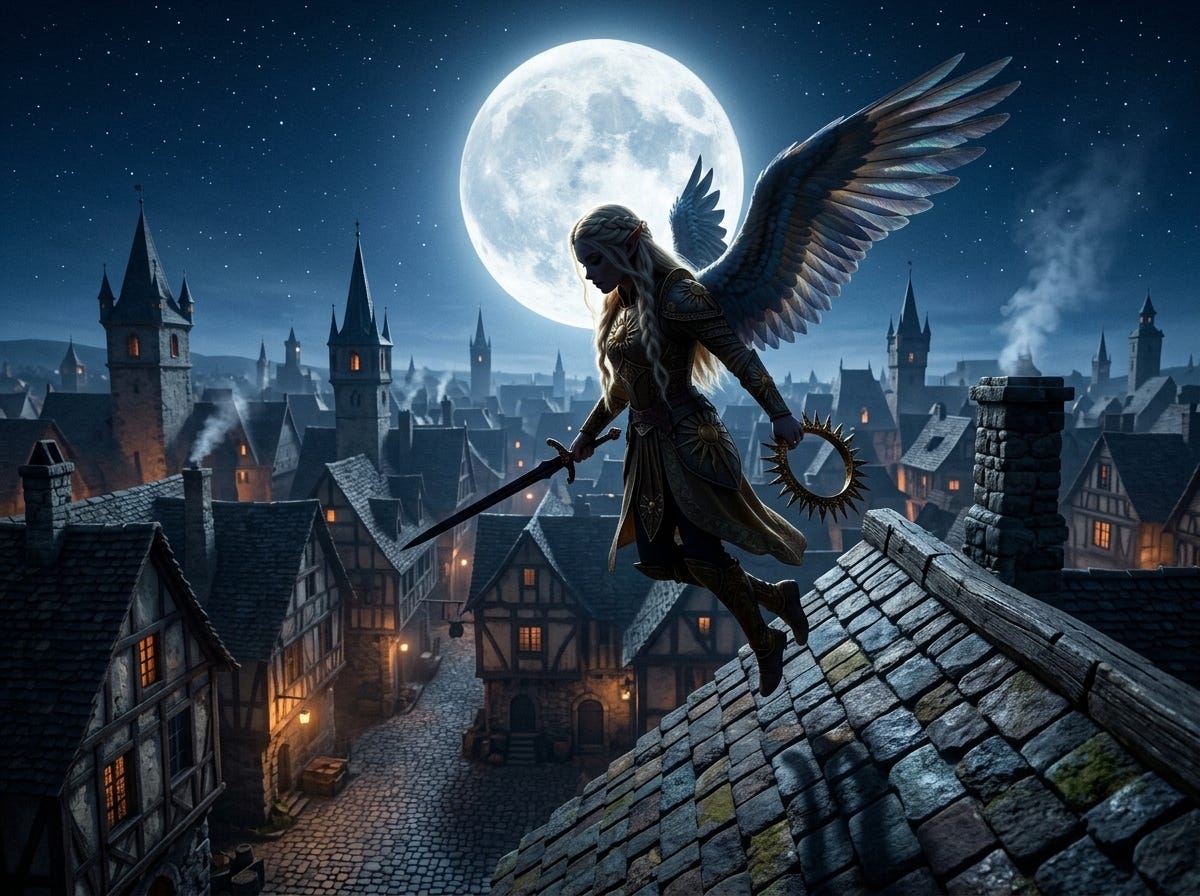
Eclipse went dark.
Not the street—the holes. The light above each opening snuffed out in a targeted circle, darkness falling precisely where the Unfinished were emerging, and the Unfinished, which had spent five days in tunnels underground navigating by the absence of light, found themselves blind. The columns faltered. The line at the third hole compressed back on itself, the emerging bodies pressing against the ones below that had stopped moving.
The Earth Aelvaeni came up through the walls.
Senna hadn’t known they were there—they had come through the foundations in silence and emerged from the base of the nearest building, a dozen of them, small and grey, unhurried. Their senior shaper knelt and put both hands flat on the cobblestones.
The ground moved.
Not violently. A slow, deliberate compression, the stone and soil below shifting inward, the tunnel mouths narrowing from the edges, the Unfinished still partially above ground caught in the closing and dissolved by the pressure.
The first hole sealed.
The shaper moved to the second, knelt, pressed her palms flat.
The second hole sealed.
She moved to the third. The seam was longer and she took more time with it, the ground shuddering faintly along its length as the fault was closed from below.
The third hole sealed.
The street went quiet.
Senna stood over the closed ground, breathing hard, Sunflare still warm in her hand. Aldric appeared at her shoulder—she never heard him coming—and looked at the three sealed points in the cobblestones, now slightly raised where the earth had compressed.
On the north walk, the ladders had stopped coming.
Philip felt it before he understood it—the pressure at the west wall easing, the mass outside pulling back from the face of the stone, not retreating exactly but withdrawing, as if whatever had been driving them forward had found the tunnels failed and the walls had held.
He stood at the west parapet and watched the outside force pull back.
Scarlet appeared at his shoulder. Her sleeve was torn at the elbow and there was blood on her forearm that was not hers. She was breathing hard. She looked at the retreating mass and said nothing for a moment.
“They were waiting,” she said. “The tunneling. The wall assault. Both at once.”
“Yes.”
“He thought if we were looking down we wouldn’t see what was coming over the walls.”
“He was nearly right,” Philip said.
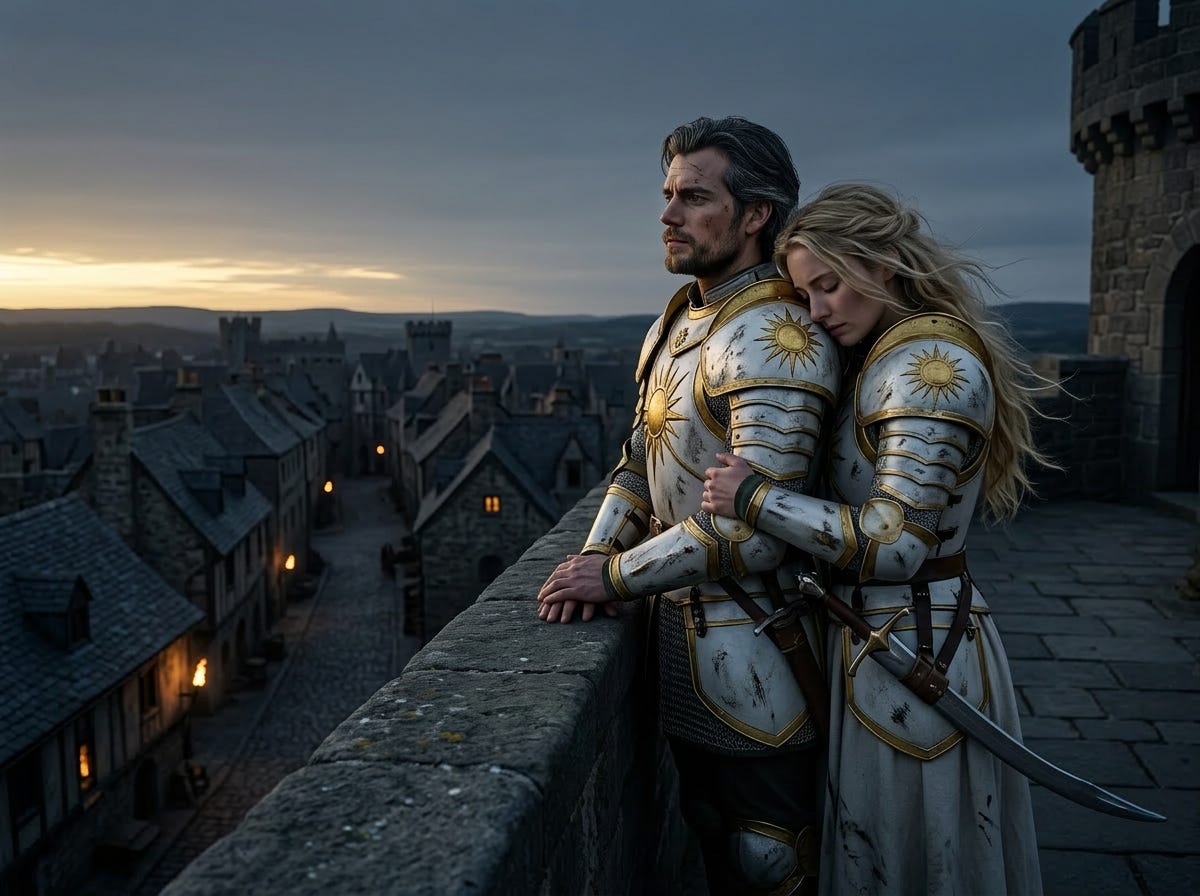
She wrapped her arms around his waist. He leaned his head on hers and they stood there a moment, the city breathing behind them, the dark still retreating below.
Above, the night sky was beginning to lighten at its eastern edge. The first grey of a dawn arriving the way it always did—on schedule, without drama, indifferent to what it was arriving into.
“All that patience,” Scarlet said quietly. “Five days. And it still wasn’t enough.”
Philip turned his face east and let the light find it.
By afternoon, a few hundred Unfinished remained, compressed into the old quarter near the river—not by strategy, but by pressure, pushed there over five days.
He laid it out in the keep: three pushes, two gates, Yselle overhead, Earth shapers sealing the basements from below, Fire shapers driving the Unfinished toward the light.
“My column takes the river road,” he said. “Drogoth with the fire shapers on the south approach. Senna and Aldric take the eastern alleys.”
Wardyn said, from across the table, “I am in your column.”
“You don’t have to,” Philip said.
“I know,” Wardyn said.
“River road,” Philip said.
They went in on the morning of the sixth day, in the grey light before full dawn.
Philip moved through the river road with Lightbringer warm in his hand and the column tight behind him. Chenguer was at his left, calling positions from the web in the low, level voice that had been calling positions since Faerlong Dell.
“Seven ahead, tight formation. Left side of the road at the crossing.”
By midmorning the river road was clear to the second gate.
Drogoth took the warehouse district with the fire shapers on the south approach.
The district had been thick with Unfinished since the first day. The fire shapers cleared building by building. Drogoth moved with them.
The school was on the south end of the district, a single-storey building with a low wall around a yard where children had played before any of this. The teacher had barricaded the doors on the first night with the children inside—eleven of them, the youngest four, the oldest perhaps ten—and they had been there since, surviving on what was in the storeroom, while the district around them filled and the Unfinished pressed against the barricaded door and found it held.
Amira found the teacher at a window when the column reached the yard wall. She was a young woman, not much older than some of her students, and she had been protecting them, alone, for six days.
The yard was clear. The building was not. The Unfinished had finally broken through after nearly a week. Through the barricaded door they could hear the movement inside—the sound of Unfinished in an enclosed space, the scrape and press of bodies that felt no urgency and would not leave.
Drogoth looked at the building. Then at Amira.
“Thank you, Amira,” he said.
She understood.
“The children first,” he said.
He went over the yard wall and through the side window that the teacher had pointed to—a window on the far end from the main concentration, a room that had been a storage space and was now empty. He moved through it and into the corridor and Sunfury’s heat moved with him, the blade running hotter than the air around it.
He drove them toward the front of the building, Sunfury warm in his hand, the radiance of it moving ahead of him in the corridor, the Unfinished retreating from the heat the way they retreated from fire. Behind him the teacher was bringing the children through the side window one by one, passing them over the sill to Amira in the yard.
He could hear them counting. He counted with them.
Seven. Eight. Nine.
The front rooms were full. He had compressed them there and they had nowhere further to go and they knew it in whatever way they knew things, and they turned.
Ten. Eleven.
The hands found him before he reached the side room. Two at his arms, one at his throat, the cold of them immediate and absolute. He felt the years begin to move—not painfully, simply steadily. And then the paralysis—the hollowing of will that preceded the theft, the Unfinished suppressing the spirit before they took the years. His grip on Sunfury loosened. His legs stopped answering.
He looked through the side window.
Amira was in the yard with the last child against her shoulder, looking back at him. She saw his face. She saw his grip. She shifted the child to one arm and raised Sunrise through the window opening without hesitation. She was not close enough to touch him, but the light found him anyway, warm and steady and the color of first morning.
His will came back.
Not his years—those were still going, the hands still on him, the cold still moving. But the will came back, and the grip came back with it, and Sunfury was in his hand.
She was still looking at him, the child against her shoulder, Sunrise raised, her face open the way it was always open. What was in it now was everything she had never said and would not say.
He nodded.
She turned away, the child against her shoulder, and walked toward the yard wall.
Drogoth released Sunfury.
Not at partial force, not at the measured output he had used on the river road and the south gate and every engagement since Faerlong Dell. He let it go entirely—the full, unmediated channeling of Epherion’s concentrated heat, the thing the blade had been holding for two thousand years, released at once in an enclosed space with nowhere for it to go but through everything in the room.
The south wall of the warehouse district lit the morning sky orange for three seconds.
Then it was over.
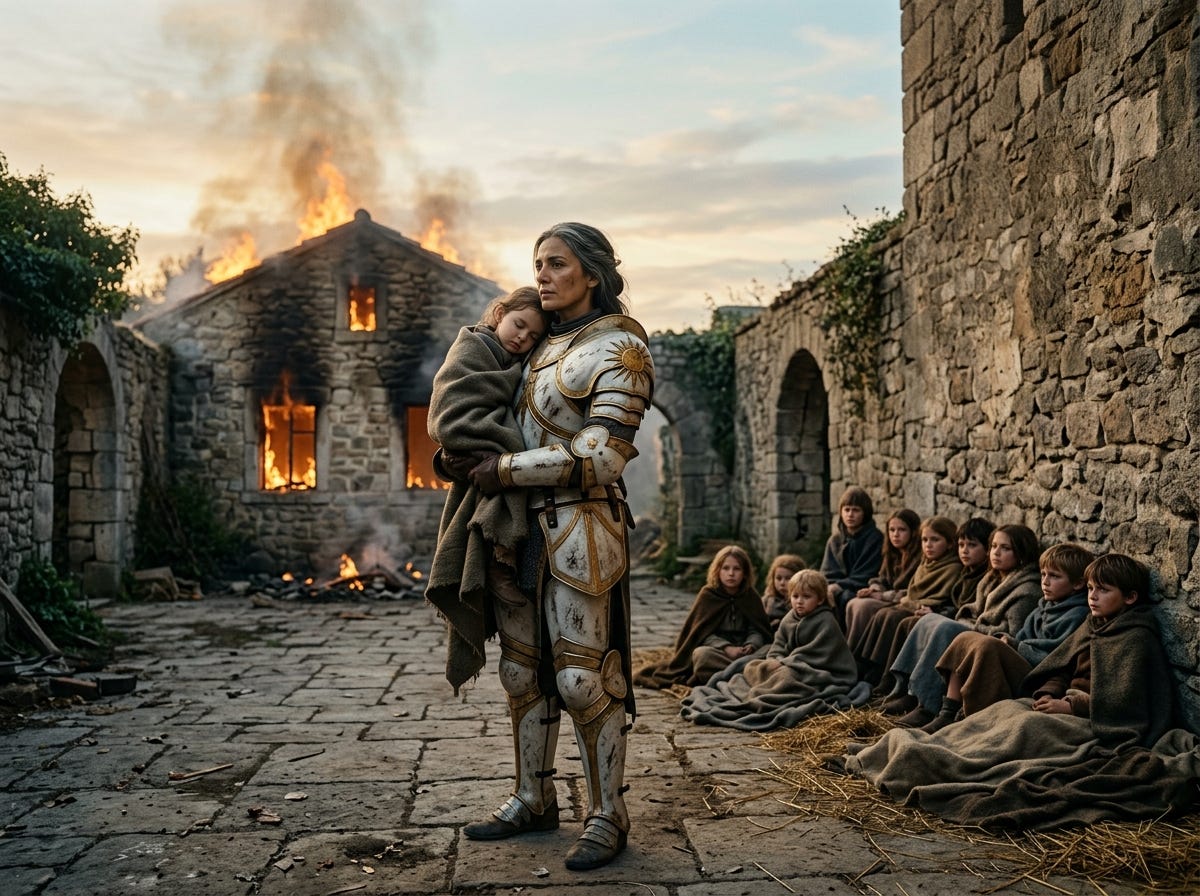
Amira stood in the yard with the last child in her arms and did not look back at the building. She stood there until Philip arrived, which was less than two minutes—he had seen the light from the river road and come at a run. She was still standing in the same place when he reached her, the child asleep against her shoulder, her face turned away from the building, tears in her eyes.
Philip stopped beside her.
She didn’t speak for a long time. When she did, her voice was unsteady. “He said goodbye to me with his eyes.”
Philip looked at the eleven children sitting against the yard wall in the morning light, wrapped in whatever the column’s fighters had been able to find, alive and bewildered and looking at Amira.
She handed him the sleeping child and walked to the building. Philip watched her go. Then he looked down at the child in his arms—a boy, four years old, deeply asleep in the way that children slept when they had been frightened for a long time and had finally stopped.
Philip carried him to the yard wall and sat down with him, and waited for someone to come and take him home.
After a while he noticed that the city had gone quiet. No horns. No shouts from the wall walk. No sound of boots on cobblestones moving at the pace of people who had somewhere urgent to be. The fires were still burning somewhere to the north—he could smell them—but the fighting that had fed them for six days had stopped.
He sat with the boy and let the quiet settle around them both.
Amira climbed through the burned out windows. She did not return for an hour, but when she did, she carried a suit of armor and Sunfury.
Stephen B. Anthony is the author of Transmigrant, an epic science fiction thriller, available on both Amazon and Audible.