

A wolf danced with the swan and found her clever. An owl danced with her and found her already moving the way he wanted to lead. The masks are about to come off.
Servants moved quickly, hands steady, lifting cloth, feathers, and paint from each guest. Scarlet felt a strange thrill as the room shifted from spectacle to recognition. Faces emerged from their disguises, some familiar, some startling, some entirely unknown.
Lady Marguerite Branne’s peacock feathers revealed the sharp, calculating smile behind them. Sir Thomas Allaire’s fox mask came away, and though he still grinned, something in his eyes unsettled her—the memory of his offhand comment about her birthing hips returned unbidden, and she let it go with the practiced ease of someone who had decided not to spend the evening on it. Lady Isabelle Marlow, the butterfly to her right, had a face as gentle and bright as the wings had promised. Lord Frederick Callahan, the stag she had danced with earlier, settled into his seat beside her, his gaze steady and calm.
Scarlet exhaled quietly. The table was a living web of personalities. The scarecrow’s mask vanished, revealing Chenguer’s precise Kiranoise features. The griffin feathers of Lord Duvall fell away, leaving a commanding presence. Lance Ashcroft, the wolf, removed his gray mask, and even without the concealment, the same air of calculated attention clung to him. One seat over, Jonathan Lorrimer’s harlequin colors were now paired with a face lively and mischievous. To her left, across the way and near Chenguer, the owl mask lifted from the pleasant face of a man whose blue eyes she recognized even before the mask was fully gone.
Charles leaned close. “Switch with me,” he murmured.
She looked at him. He was already not-looking at Isabelle Marlow with considerable effort.
Scarlet picked up her glass and her napkin and moved one seat to the left without a word—and found herself one seat closer to Philip Beckwith, who had just set down his mask, and whose blue eyes, when they found hers a moment later, suggested he had noticed.
Charles was already introducing himself to the butterfly before Scarlet had fully settled.
The hall erupted the moment the masks were lifted. Gasps and laughter rippled from table to table as faces once hidden were revealed in full: friends and rivals, nobles and lesser lords, each suddenly familiar and yet startlingly new. Exclamations of surprise bounced across the polished wood tables—”Is that really you?” “By the stars, I didn’t recognize you!”—and a cascade of names followed, shouted, whispered, and repeated.
In the ensuing chatter, there was a quiet moment between her and the man who had been the owl.
She mouthed the words: Who are you?
He considered it with that same unhurried seriousness she had noticed on the dance floor. Then he mouthed two words back.
Philip Beckwith.
Scarlet stared at him for just a moment too long, then dropped her forehead into her hands, hiding her face from him.
She stayed like that for a moment—the clink of crystal, the flood of names, the laughter of a hundred unmasked faces pressing in around her—and then she turned to her right to see Lance Ashcroft’s wolf smile still on his face, still assessing her.
She turned back to her left, eyes half hidden behind her fingers, and looked back across the table. His eyes moved across the table—her mother, her father, her brother—and then back to her. Then he leaned forward almost imperceptibly, and whispered across the distance between them: “Are you Scarlet?”
She lowered her hands. Met his eyes—those deep, steady pools of blue.
And nodded.
Something moved across his face. Not smoothly—not the way Lance Ashcroft’s expressions moved, practiced and deliberate. This was unguarded. A slight parting of the lips. A blink. The stillness of a man who has just received news he expected and yet somehow was not prepared for.
His hand, resting on the table, closed briefly around nothing.
He looked away first—just for a moment, just long enough to collect himself—and when he looked back there was something new in his expression. Quieter than surprise. Deeper than pleasure.
He nodded once, as though confirming something to himself.
Then someone spoke to him from his left and the moment closed around them like water, and dinner continued, and the hall was full of light and noise and the business of people being themselves.
The dinner was lively enough that private conversation was impossible, which suited no one at the table equally. Lance was charming in the way expensive things are charming—you admire them while wondering what they cost. Philip said little and looked at her less, which was its own kind of attention, and she was aware of it the entire meal—a pressure at the edge of attention, like a word she kept almost saying.
The Corvairian hens were worth the journey alone—rich and herb-dark, the cranberry cutting through cleanly. The wine was pink and slightly dry, unfamiliar on her tongue. She thought it might be from Drakkar, though she couldn’t have said why she thought so.
When Scarlet saw Chenguer rise and excuse himself, and then observed Christine disappear only a minute later, she whispered, “Good luck, Christine” under her breath.
There was more dancing after dinner, but the ballroom without the masks was more sparsely populated as people walked around the grounds.
Wyndmere unfurled beyond the ballroom doors into something that felt less like a garden and more like an argumentative wildness refusing to be tamed. Formal hedgerows gave way to wandering gravel paths that lost their certainty in the dark, and lanterns had been strung between the old oaks at intervals just generous enough to make the shadows between them feel intentional. Somewhere water moved—a fountain, or a stream, she couldn’t tell which—and the sound of it threaded through the night air beneath the distant music still drifting from the open ballroom doors.
The maze occupied the eastern quarter of the grounds proper, its hedges tall enough to swallow sound and old enough to have developed opinions. Beyond it, a long reflecting pool caught the lantern light and held it still. Stone benches appeared along the paths with the irregular generosity of things placed by someone who understood that people needed to sit down and think. The air smelled of late roses and cooling earth and somewhere, faintly, woodsmoke.
Lord Frederick Callahan fell into step beside her near the reflecting pool, which was where people went when they wanted to walk without committing to a direction. He had the comfortable gait of a man who had stopped caring about appearances at some useful age and was better for it.
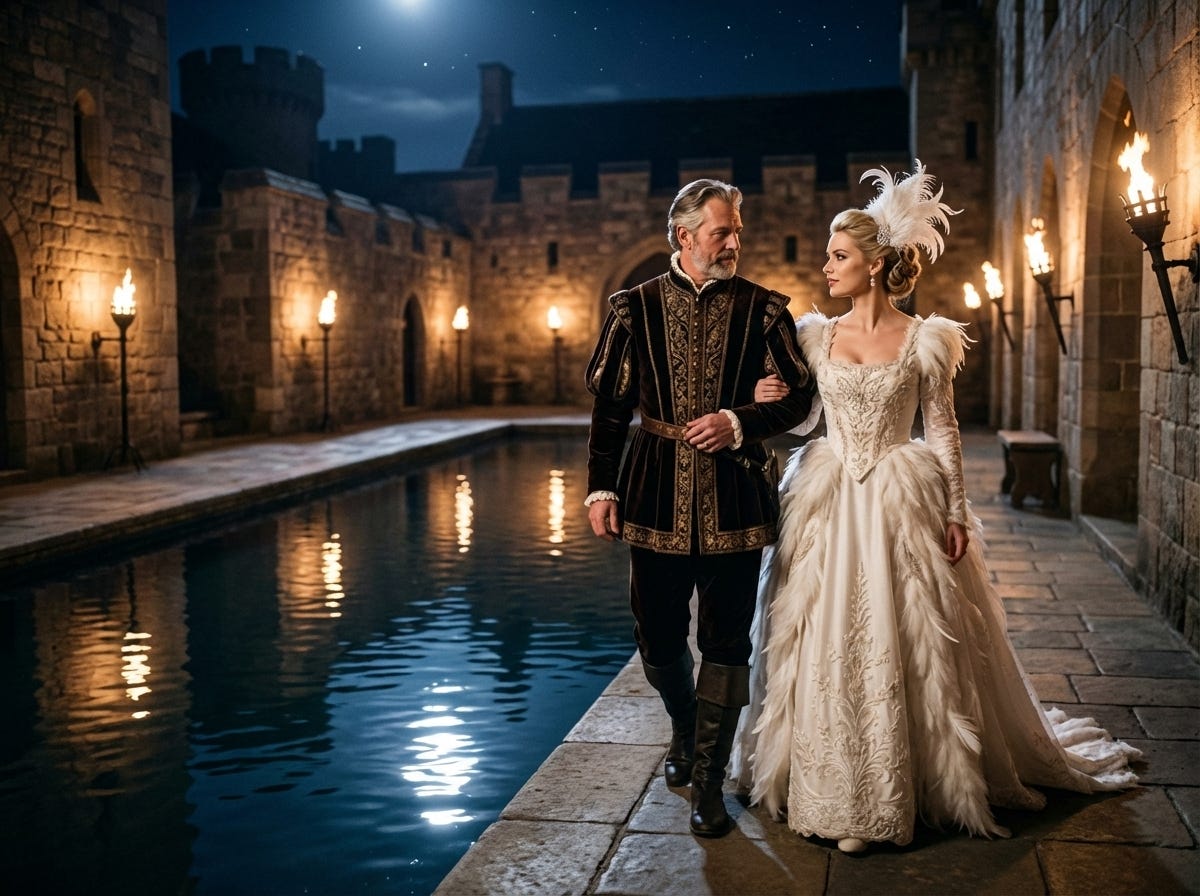
“The Wentworth falcon,” he said, nodding at the embroidery along her sleeve. She had worked it into the gown herself, small and precise, almost hidden in the white. “Your father’s doing, or yours?”
“Mine,” she said.
He nodded as though that told him something. “Your father and I share a great-grandmother on his mother’s side. Distant enough to be comfortable, close enough to matter.”
They walked a few steps in companionable quiet.
“You know the history,” she said. It wasn’t a question.
“Some of it.” He clasped his hands behind his back in the manner of a man organizing his thoughts. “The Ashcrofts were ambitious in the way that requires other people’s misfortune to sustain itself. Your family had land they wanted, a name they couldn’t acquire any other way, and a signet ring that made the forgery defensible in court. Defensible being, of course, a different thing from true.”
“My father doesn’t speak of it.”
“Men who have been wronged in ways they couldn’t prevent often don’t,” Callahan said. “It becomes a thing they carry rather than a thing they say.”
The reflecting pool gave back their shapes in wavering gold.
“The old Duke had three sons,” he continued. “The eldest died in the eastern campaigns. The middle son—your grandfather—was the one they displaced. The youngest took a position at court and kept his head down and his name clean for thirty years.” He paused. “There are Wentworths in the eastern provinces still. Distant branches. They remember.”
“I didn’t know that,” she said quietly.
“There are things worth knowing,” Callahan said, “that nobody thinks to say because they assume somebody else already has.”
He stopped at a stone bench near the end of the reflecting pool and bowed, being very tender with his knees. “I’ll leave you to the evening, Lady Wentworth. It does my heart good to see the falcon back where it belongs.”
She watched him go, and stood alone a moment, the water still beside her.
The fox found her near the entrance to the maze, where the hedgerows began and the lantern light thinned.
Jonathan Lorrimer, without his mask, was younger than she’d expected—bright-eyed, a little flushed, with the look of a man who had been rehearsing something.
“Lady Wentworth.” He bowed. “I owe you an apology. Earlier this evening, I said something I thought was clever and wasn’t. It was unkind, and you didn’t deserve it.”
She considered him. He held her gaze.
“No dart was intended,” she said, “and no wound was received. We’ll say no more about it.”
The relief on his face was genuine and slightly comic. “You’re very gracious.”
“I’m practical,” she said. “Grudges are heavy and the evening is long.”
He laughed, bowed again, and retreated back toward the lights. Scarlet thought that he might actually be worth knowing someday, given sufficient seasoning.
The path beyond the maze entrance was darker than the others, the lanterns spaced wider here, their light more suggestion than illumination. The gravel gave way to flat stones, irregular and old, set into the earth by someone long dead.
She heard him before she saw him—or rather she felt the quality of the darkness change, as though it had acquired weight.
He was perhaps thirty feet away, moving slowly, hands clasped behind his back in the manner of a man who was either thinking or trying not to. The path was narrow between the old hedgerows, and they were walking toward each other with the unhurried inevitability of two people who had seen each other coming and made no adjustment.
Twenty feet.
The nearest lantern was behind her. His face was in shadow but she knew the shape of him—the solid, unperforming presence of a man who was simply there, not performing it.
Fifteen.
She thought about the champagne glass she had handed him without thinking. The way he had taken both glasses without comment. The hand that had closed briefly around nothing.
Ten.
She could see his eyes now. Blue in the lantern light, steady, finding hers without surprise as though he had known exactly where she would be and had simply been walking toward her.
Five.
“Lady Wentworth—”
“Sir Philip—”
They had spoken simultaneously, which produced a brief silence of the most specific kind.
He almost smiled. She felt herself almost smiling back.
And then—
Lance Ashcroft materialized from a branching path to her left, a champagne flute extended in each hand, his wolf smile finding her in the dark. “I’ve been searching everywhere. The Drakkar vintage, as promised—you mentioned at dinner you thought the wine might be from there, and I happen to know for a fact that it is.”
He was perfectly charming. He had listened at dinner. He had remembered.
She took the glass because declining required explanation, and her explanation was standing five feet away.
“Sir Philip,” Lance said, turning with the smooth acknowledgment of a man who had catalogued the situation in an instant and chosen his response. “Good evening.”
“Ashcroft.” Philip’s voice was level. Nothing in it that could be named.
“The grounds are remarkable at night,” Lance said pleasantly, already turning back toward the lights, her hand drawn gently into the crook of his arm with the practiced ease of a man who understood that momentum, once established, was its own argument. “Christine has outdone herself. Have you seen the reflecting pool? The effect with the lanterns is extraordinary.”
She went with him because the alternative was a scene, and a scene would cost everyone something she wasn’t ready to spend.
She looked back once. Philip stood where she had left him, hands at his sides, watching her go.
He led her to a bench just at the edge of the light—close enough to be seen, far enough to suggest privacy. Deliberate. Everything about him was deliberate.
“Shall we sit?”
She sat at the far end. He settled at the other without comment, as though the distance were his preference too.
They watched the lantern-light on the water for a moment. He seemed in no hurry.
“I owe you an apology,” he said finally.
She hadn’t expected that. “Do you?”
“Our families have made enemies of each other for eighty years over something neither of us chose and neither of us did.” He turned the champagne flute slowly in his fingers. “You’ve borne the worse end of that. I know it.”
“That’s a generous accounting.”
“It’s an honest one.” He glanced at her sidelong. “I find I prefer honesty when I can afford it.”
When I can afford it. She filed that away.
“There’s a rumor,” he continued, “that the queen intends to settle the land question through marriage. A frontier arrangement. A man you’ve never met, for a purpose that serves everyone but you.”
“Rumors are unreliable.”
“Some of them.” He smiled. “Lady Wentworth—Scarlet—what if there were another resolution? One you might actually choose.”
She looked at him directly. “Say what you mean.”
“I mean you.” He said it simply, without flourish, which was its own kind of flourish. “I mean that the dispute is between our houses, and here we sit—the two people it damages most—and I find myself wondering why we shouldn’t be the ones to end it. On our own terms.”
The silence stretched. A moth circled the nearest lantern.
“You are proposing marriage?”
“I’m proposing the consideration of marriage. There’s a difference.” The smile again, brief and real-seeming. “I’m not asking you tonight. I wouldn’t insult you that way. I’m asking whether you might allow the possibility to exist. That’s all. What is there to lose by having another option?”
She studied him. His eyes were steady. Patient. The eyes of a man who had learned that waiting was often more effective than pressing. Not his words—those had been prepared long before tonight—but the spaces between them. The way he held himself. The ease with which he had said we. As though the thing were already half decided, needing only her agreement to become inevitable.
“You’ve thought about this,” she said at last.
Lance smiled slightly. “I think about most things that matter.”
“I’m sure you do.”
Her gaze drifted past him for a moment, toward the lantern-lit paths, as if the answer might be written somewhere in the hedgerows.
When she looked back, there was something cooler in her expression.
“You make it sound like a kindness,” she said. “Like you’re offering me a way out.”
“Aren’t I?”
“No,” Scarlet said gently. “You’re offering me a different way in.”
That gave him pause—not much, but enough to be seen.
She shifted slightly on the bench, not closer, not farther—just enough to remind him the distance between them was chosen.
“You say I should be free to decide my own future,” she went on. “And in the same breath, you’ve already decided what that future ought to be.”
“I’ve suggested—”
“You’ve constructed,” she corrected, still calm. “Neatly. Elegantly. I admire that.”
There was no mockery in it. Which somehow made it worse.
Lance watched her more carefully now.
Scarlet folded her hands in her lap.
“I don’t doubt you believe what you’re saying,” she said. “That this would solve things. That it would be… better.”
“It would be,” he said.
“For whom?”
The question landed between them and stayed there.
For the first time since he’d begun speaking, Lance didn’t answer immediately.
Scarlet let the silence stretch. Not unkindly. Just long enough.
Then she inclined her head, just slightly.
“You asked what I lose,” she said. “I think that’s the wrong question.”
“And the right one?”
“What do I become,” she said, “if I say yes?”
That one, she did not soften.
Lance held her gaze.
Scarlet rose before he could answer.
“I will think about what you’ve said,” she added, which was not a promise and not a dismissal, but something far more useful than either.
Then, after the briefest pause—
“And I appreciate that you asked,” she said.
That, at least, was true.
She turned back toward the lights, leaving him on the bench with his careful plans and his very reasonable proposal, and the faint, unfamiliar sense that he had not quite said enough.
Stephen B. Anthony is the author of Transmigrant, an epic science fiction thriller, available on both Amazon and Audible. The first seven chapters are available on this website for free.