

Christine LaPointe arrived at Kestrelmont with a sealed envelope and a masquerade invitation. Scarlet has agreed to attend, primarily on account of the champagne.
The guests arrived at Wyndmere, trickling in through the orange glow of late afternoon, costumes ranging from Lady Appleton as a plump carriage to Sir Chenguer, tall and solemn, clad as a scarecrow. Others appeared as birds, predators, and prey, or took the forms of sea creatures—a mermaid gliding past a wolf, a heron flapping through the hall.
Candles burned in clusters of three and five along every surface, and the effect was less illumination than the suggestion of it—pools of warm gold separated by shadow, the kind of light that made everyone beautiful and nothing certain. The musicians played from the gallery above, invisible, their sound descending like mist. The floor had been cleared and polished to a mirror finish that caught the candle flames and multiplied them underfoot, so that dancing couples moved above an inverted sky.
The doors opened.
Scarlet was white fire in a room of candlelight.
The gown moved before she did—a slow exhale of feathers and embroidered silk that caught every torch in the hall and gave it back softer, purer, as though the fabric itself were luminous. She paused at the threshold as if at the edge of still water, like a creature that knows it is being watched and has accepted its role.
Her mask was silver and white, shaped close to her face, and above it rose a headdress of white plumes that arched like a question no one in the room had the courage to ask aloud. The feathers trembled with her breath. A single strand of crystal lay against her throat.
Scarlet’s hair was wound up through the swan feathers, her neck bare, her posture the result of years of Benedict’s corrections.
She smiled—not at anyone in particular, which somehow made every man in the room believe it was meant for him. A hush fell, brief and delicate, before the room returned to life: whispers first, then muted conversations, until the hum of chatter filled the air once more.
Christine was the first to greet her, with her mother, the Baroness LaPointe, in tow. Christine was dressed as the Queen of Hearts. Her mother wore a simple green mask of leaves with a matching gown.
“You look gorgeous,” Christine said, taking in the dress, mask, and headpiece.
“I spent a lot of time sewing when I was young,” Scarlet said. “It made this much easier.”
“You made this yourself?” demanded the Baroness.
“Mostly,” Scarlet said. “The crown was pre-made. I only added the swan feathers.”
“Lovely,” said the Baroness.
“I’ve seated you near us for dinner,” Christine said, squeezing Scarlet’s hand. Then she let go and drifted away, leaving Scarlet alone.
A wolf found her first.
He materialized from the crowd with the unhurried confidence of a man accustomed to difficult terrain. The mask was grey and silver, well made, fitted close to his face—not a costume so much as a second skin. He was tall, broad through the shoulders, and moved the way men move when they have learned that rooms, like fields, have tactical advantages worth identifying before committing.
He bowed. She curtsied.
“The swan,” he said. His voice was smooth, practiced—the voice of a man who had learned conversation the way some men learn swordsmanship.
“You have me at a disadvantage,” she said. “I don’t know what animal you are beneath the wolf.”
“Does it matter?” he asked. “Tonight we are only what we appear to be.”
“An interesting philosophy,” she said, “for a masquerade. Or for anything else.”
He smiled—visible at the edges of the mask, in the corners of his mouth. “You’re clever.”
“You sound surprised.”
“Pleasantly.”
She accepted his hand for the first dance because declining would have required explanation, and she had none ready. He was a competent dancer—precise, controlled, leading with the quiet authority of someone who expected to be followed.
There was nothing wrong with any of it.
That was the problem.
“I have heard,” he said as they turned, “that the swan is newly returned to her ancestral home.”
“The swan’s home is wherever there is water,” she replied.
He held her gaze a beat longer than necessary. Deliberate—everything about him was deliberate—and she felt the pressure of it as something separate from attraction. He wanted her to feel seen. She felt, instead, observed.
“We needn’t be rivals,” he said.
“Are you giving your identity away already?”
“Touché.”
The dance ended. He bowed again, low and correct.
“I hope,” he said, “the swan will save me another dance before the evening is done.”
“The evening is long,” she said, which was neither yes nor no. He accepted it with the smile of a man filing information away.
Then he was gone, back into the crowd, and she breathed.
A harlequin asked her next—a young lord she half recognized by his laugh, someone’s younger brother, harmless and enthusiastic. He talked about his horse the entire dance. She found it restful.
After him, a stag—older, some minor baron whose name she couldn’t retrieve—who danced with the careful dignity of a man whose knees troubled him. He asked about her father. She answered warmly. He reminded her of someone’s favorite uncle.
A peacock who talked only about himself.
A fox who was quite funny, until he wasn’t.
She was standing at the edge of the room, accepting a glass of champagne from a passing tray, when she became aware of being watched.
Not the wolf’s watching. That had been assessment, calculation—the gaze of someone deciding whether a thing was worth acquiring. This was different. It settled on her the way sunlight settles, present in a way that was almost impersonal and yet somehow the opposite of impersonal.
She turned.
An owl stood at the far edge of the candlelight.
The mask was tawny brown, wide-eyed, the feathers swept back from a face she couldn’t read. He was tall, but not in the same way as the wolf. Less lean. More solid. He held his glass without drinking from it. He was not working the room. He was watching it with the patient attention of someone who had all night—and knew it.
He was watching her. When her eyes found his, he didn’t look away.
Most men did.
The wolf had held her gaze as a challenge. This was neither challenge nor retreat. He simply continued to watch her, as if being caught looking required no adjustment. Someone spoke to him and he nodded, but never looked away from her.
She looked away first. She didn’t know why that felt significant.
He appeared at her side between dances, which should have startled her and didn’t.
“You’ve been busy,” he said.
His voice was neither smooth nor coarse. It was direct. It was not performance. It was simple. Like clean water.
“The room has been generous with its invitations,” she said.
“The harlequin talked about his horse.”
She turned to look at him. “You were watching that long?”
“Horses are worth talking about,” he said. “Though perhaps not for an entire dance.”
“And what,” she asked, “would you talk about for an entire dance?”
He considered this with a seriousness that was almost funny, as though the question deserved actual thought rather than a prepared answer.
“I’m not sure yet,” he said. “I’d have to see what the dance required.”
She handed him her champagne glass without thinking about it, which he accepted without comment, holding both glasses with the easy competence of a man comfortable with unexpected things.
“Then I suppose,” she said, “you’d better find out.”
He placed both glasses on a passing tray—his mostly untouched.
He danced the way he stood. Without the wolf’s controlled precision or the harlequin’s enthusiasm. He danced like a man who had learned it later than most. But he was present to the music, present to her, and made corrections without apology when the movement required it.
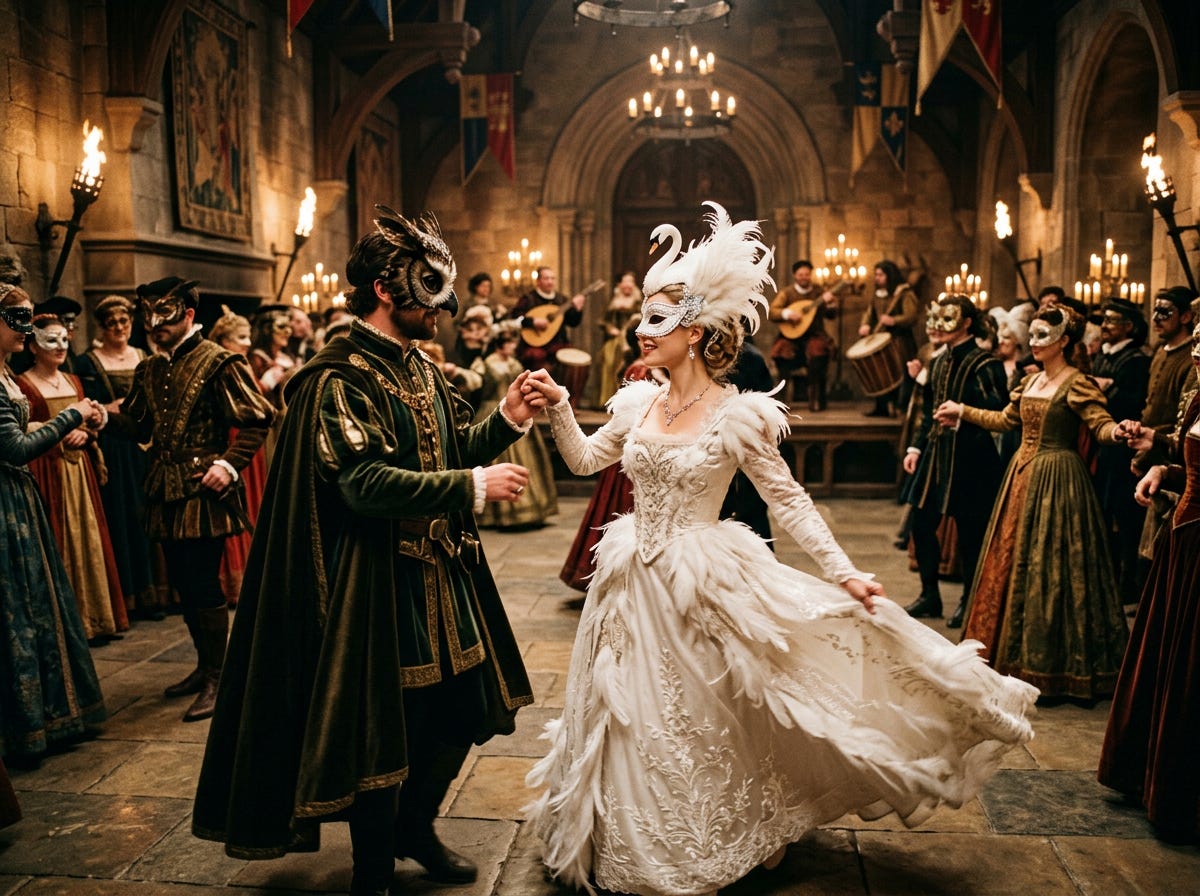
He led, but not as if in command. It wasn’t direction. It was how she already wanted to move.
He didn’t talk for almost a full minute. She found she didn’t mind.
“The wolf danced with you earlier,” he said finally.
“He did.”
“He’s been watching you since.”
“I know,” she said.
A pause. Two beats. Three.
“Does that concern you?” he asked. Not possessively. With the genuine inquiry of someone who actually wanted to know.
“I haven’t decided yet,” she said honestly.
He nodded as though that were a perfectly reasonable answer, which somehow made her trust him more than anything clever he might have said.
They turned. Her dress swirled wide, and when they settled, his hand found her waist—light, steady, as if it had always known where to go.
She spun away, just their fingertips still touching, and then she spun back to him, momentarily in his arms, her back to him. For a breath, both his hands rested at her waist.
She turned her head and met his eyes. Deep pools of blue.
And she caught it then—something clean and cold. Like the smell of first snow, just before it happens.
“You’re not what I expected,” she said. She hadn’t meant to say it.
“How could you know what to expect without knowing who I am? Or do you know?”
“I don’t. I mean that I didn’t expect someone like you to be here.”
“That’s a fascinating statement,” he said. “I was thinking exactly the same thing.”
“You were?”
The corners of his eyes creased. Behind the owl mask, something that might have been a smile.
“The wolf wasn’t the only one watching me,” she said.
He nodded, unembarrassed. “Sometimes men watch the sunrise because it is worth seeing.”
She smiled despite herself.
“Why do I feel like the swan is the opposite of a disguise?” he asked.
“Maybe,” she said, “I’m fierce behind this mask.”
“Swans can be fierce and still graceful. I’ve seen it.”
Scarlet laughed, and he laughed with her.
He said nothing more. As the music climaxed he spun her once, and she was breathless when it ended.
“Thank you for the dance,” he said, bowing.
“Thank you, sir,” she said as her fingers slipped from his hand.
Scarlet’s mind went blank momentarily, and then the music started and the harlequin was leading her again, perhaps even more energetically this time. She tried to focus on the task at hand, but she found herself glancing around from time to time, looking for the owl.
Scarlet declined the next offer, too out of breath to continue, and grabbed a champagne glass from a passing tray. She leaned against one of the great columns supporting the arched ceiling to catch her breath, and then peered around it to find the owl.
She saw him, speaking with Christine and a scarecrow—and she wondered if this might be Chenguer. The owl glanced at her and smiled, and she withdrew behind the column. A few moments later she looked again, and it was just the two men talking. Christine had moved elsewhere.
She was approached again by the wolf, accepted a second dance, but her eyes flicked to the owl.
“I see I have a rival,” the wolf said.
“A rival for what?”
He laughed—a genuine laugh, which surprised her. “You know, most women would have denied it.”
“I answered the question I was asked.”
“Indeed you did.” He glanced across the floor toward the owl. “He’s watching us right now, you know.”
“Is he?”
“You already knew that.”
He was not wrong.
The musicians brought the dance to a close. She let the wolf return her to the edge of the floor, offered a composed farewell, and followed the slow drift of guests toward the dining hall.
The hall was long and narrow, its arched ceiling echoing the ballroom’s grandeur but scaled for intimacy. Torch sconces and tall candelabras cast pools of golden light along the polished wood tables, where silver chargers and crystal goblets caught and scattered the flame. Each table ran nearly the full length of the room, with plush velvet chairs positioned close enough to encourage conversation, yet far enough apart to avoid cramped elbows.
Gilded mirrors lined the walls, reflecting candlelight and the occasional shimmer of passing masks, making the space feel larger than it was. Between the tables, waitstaff moved with silent efficiency, the scent of spiced wine and roasting meats mingling in the air.
A low hum of polite conversation filled the room, punctuated by the clink of silverware and the occasional laugh. From the windows along the far wall, the last light of day filtered in, brushing the hall in soft amber that gave way to the warm glow of torches. The hall was deliberately arranged so every guest could see the head table, yet the long tables encouraged shifting currents of conversation, laughter, and observation.
The head table was reserved for the Baron, dressed as a nutcracker, the Baroness, their seven children, and several aunts, uncles, nieces, and nephews. The near side remained empty so the LaPointes could be seen.
Scarlet counted seven tables, each seating twenty guests. Christine had placed the Wentworths at the center of the middle table—Scarlet and Charles on one side, her parents on the other. Her mother had opted to wear a standard gown rather than a costume, accompanied by a hand-held mask of snowflakes covering her eyes. Her father wore a lion’s mane and mask.
Candlelight flickered across jeweled masks and swaying feathers, catching on sequins, plumes, and silks. She noted the sharp angles of a fox mask that tilted with a sly grin to her left, the arching plumage of a peacock, the delicate wings of a butterfly fluttering with each movement. To her left and across from her, the scarecrow’s straw-tipped edges swayed with deliberate slowness, a griffin’s wings rustled faintly. To her right, the harlequin shifted in a swirl of color. A gray wolf moved in the shadows, near the harlequin. Seated two positions past her mother was the owl.
She took a deep breath, letting the patterns of color, texture, and movement wash over her. Names, faces, alliances—all hidden beneath masks. All she could do was to observe, guess, and wait.
Christine’s voice cut through the hall, crisp and commanding: “Remove your masks!” She was standing near one of the tall candelabras, and the light caught her hair and the gold of her costume, and for just a moment she looked less like a woman at a party and more like a mirror reflecting the firelight.
Stephen B. Anthony is the author of Transmigrant, an epic science fiction thriller, available on both Amazon and Audible. The first seven chapters are available on this website for free.
Oooo the intrigue! Love a good masquerade
I loved the dialogue in this one!!