

[ Tales | Map | Races | Nations | Calendar | Cosmology | Pantheon ]
The Year
The Vael year is 350, 24-hour days. The year is divided into seven seasons, each 50 days long. The calendar is the same every year, and every season, so there is no need to project out a long series of years and months. Because the calendar never changes, they are rare.
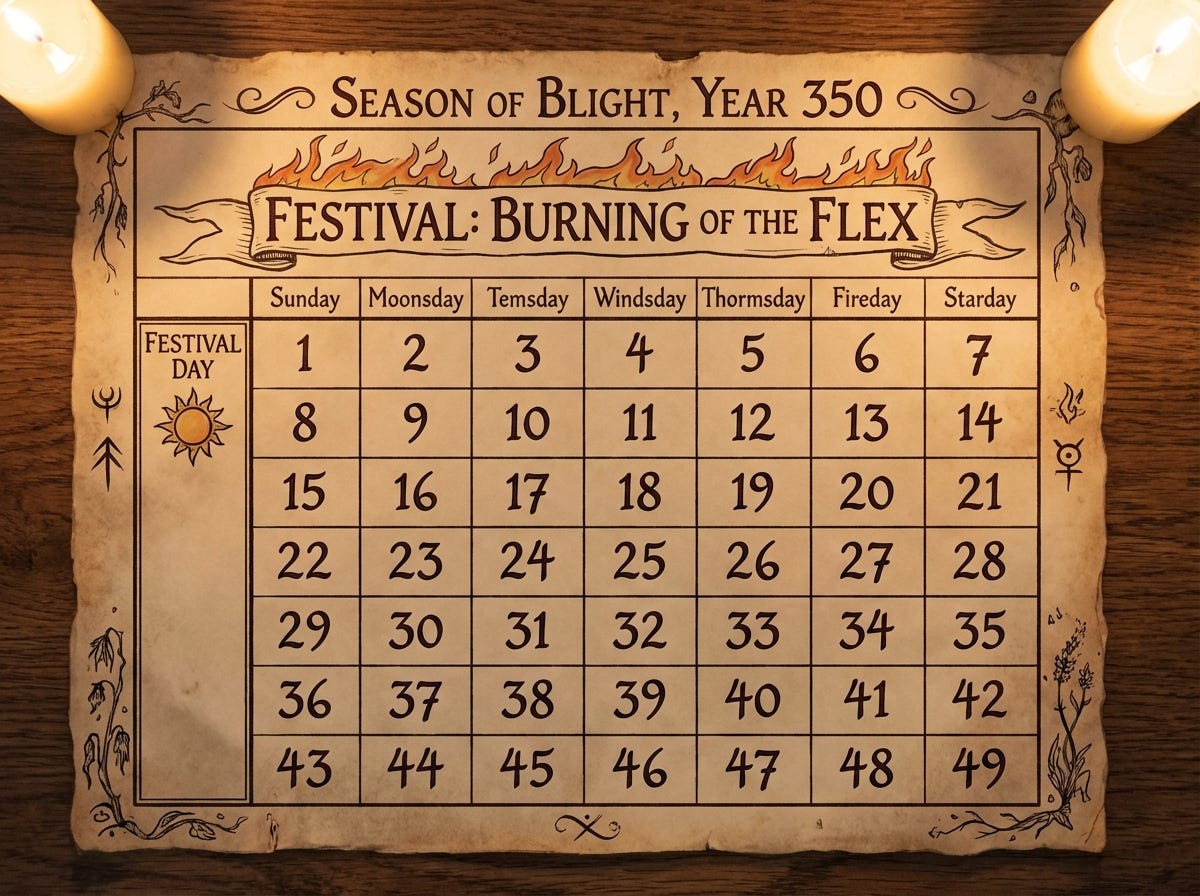
Each season is 50 days long. It begins with a festival day that is NOT a day of the week, and is then followed by a 7-week season, each week containing 7 days.
Weeks
Each week is made up of seven days.
Sunday
Moonsday
Temsday
Windsday
Thormsday
Fireday
Starday
Date References
Sundays can only occur on the 1st, 8th, 15th, 22nd, 29th, 36th, and 43rd of any season in any year. People refer to a date in the past, not by the number of the day but by the week number and day of week.
For example:
3rd Temsday = 17th day of a season.
5th Windsday = 32nd day of a season.
6th Starday = 42nd day of a season.
An example of this can be found in the literature of the noble houses of Corvaire. About thirty years ago, Arcturus of the House Knill wrote the following in the introduction to his narrative on the attack of the capitol city by a blue dragon:
On the 5th Thorm’s Day of Harvest in the 13th year of the Reign of Ussisius, a terrible calamity arose in Carathel....
Seasons
Terra has Seven Seasons each is 50 days long resulting in the 350 days a year. Each season begins with a festival day, not counted as a day of the week or a numbered day of the season. The seasons and festivals are as follows:
Mysts – Festival of Tears
Plantings – First Seed
Bloom – The Sun’s Height
Harvest – Festival of First Fruits
Blight – Burning of the Flax
Storms – Festival of Lights
Frostfall – Hearth’s Day
The Festival Calendar of Vael
Mysts / Festival of Tears / Abba
The year begins in grey and cold under the goddess of fate. The gift is forgiveness — written as a letter, delivered in person. Once given, the wrong named in it can never be spoken of again by either party. The letter is both the gift and the silence that follows it. People begin tending their seedlings around mid-Mysts, the quiet hopeful work of new growth running alongside the harder work of letting go.Plantings / First Seed / Verna
The ground opens under the goddess of the living world. The gift is seedlings — started around mid-Mysts and tended through the cold weeks, roughly six weeks old by the festival and ready to grow. Seeds saved from the previous year’s late crops are also given. The gift flows to neighbors and community, carrying the winter’s quiet care with it.Bloom / The Sun’s Height / Epherion
Midsummer under the life-giver himself, the light at its absolute peak. The gift is flowers and light — bouquets, garlands, candles, lanterns, oil lamps. Homes and streets are filled with both. The festival honors Epherion from one horizon to the other, people staying up through the shortest night of the year to watch both sunset and sunrise.Harvest / Festival of First Fruits / Ashira
The yield comes in under the goddess of beauty and abundance. The gift is produce, preserves, and cuts of meat — given freely, with the flow of generosity running naturally toward those with least, without shame or ceremony around the direction of it. The season is marked by communal feasts every Starday through all seven weeks. Poor families give what little they have and receive more back than they gave. This is simply what the season is for.Blight / Burning of the Flax / Solenne
The world dies back under the goddess of death and the afterlife. The gift is something the deceased favored — given not to the dead but to the living who mourn them. Whiskey for the man who loved whiskey, books for the woman who loved books, dice for the brother who gambled. The gift requires knowledge of both the dead and the grieving. Its specificity is the point. To receive a well-chosen gift is to know that someone else carries your loss alongside you. In the background the fields are cleared and the flax burns, its smoke rising through the cooling air.Storms / Festival of Lights / Thorm Stormbringer
The violent season arrives under the god of thunder and storms. The gift is something you have in genuine excess and do not need — released into the community without direction, redistributed like the storm itself. The flow is unpredictable. You may receive something extraordinary or something odd and useless. That is the nature of the storm. Giving trash is considered petty and is socially noted. Against the chaos, people fill their homes and streets with candles and lanterns — light pushed back against the dark, defiant and generous simultaneously.Frostfall / Hearth’s Day / Isen
The coldest and darkest season closes the year under the god of weather and the seas, who loves his sister without certainty of return. The gift is a declaration of romantic love — given without guarantee of reciprocation. The act of saying it is the gift itself. Unrequited love is not shameful here; it is honored by the festival, because Isen gives without certainty and asks nothing back. The year that began with forgiveness ends with longing, and the door closes against the cold.
[ Tales | Map | Races | Nations | Calendar | Cosmology | Pantheon ]
Stephen B. Anthony is the author of Transmigrant, an epic science fiction thriller, available on both Amazon and Audible.