

The garrison at Tallfellow Canyon. Scarlet, who speaks Urukesh, asks why, after all this time, nobody has tried talking.
One night.
She had agreed to one night, which was a practical decision made for practical reasons. She needed an escort. He had men who knew the terrain. The road east was dangerous and the season was turning and it made sense to wait until morning.
She had told herself this approximately eleven times between the garrison road and the lodge.
“I’ll setup over here,” Scarlet said, indicating a flat spot to pitch her tent.
“Nonsense,” Philip said. “You’ll stay in my lodge.”
Scarlet eyed it warily.
It looked a little too cozy.
But then something caught her eye. It was pegged together as if—
“Wait, is this thing portable?”
“It takes about a half day to break down and another to set it up, so we don’t move it very often. Every few weeks if we are lucky. We haven’t had to go backwards, but we’ve sat in one spot for multiple seasons before.”
“Fascinating,” she said.
“It’s a marvel of modern invention,” he said. “Timber frame. Forty-eight interlocking sections, four feet each. Pinned together with iron rods. It can be broken down into four wagons in about four hours. Want to see inside?”
“Okay,” she said. “Exterior is oilcloth. Good design.”
He stared at her, fumbling for words.
“Double-layered,” he said finally, raising his eyebrows. He pulled the doorway open, turned it inside out and showed her. “Two fingers of wool batting makes it warm in the winter and cool in the summer.”
“And you—you live here. All the time?”
“For most of the last six years.”
They stepped inside an interior lit by oil lamps. When he let the doorway close, it suddenly became very quiet inside. The wool kept out more than weather. It kept out sound or, kept in sound, if —
Now why on earth was she thinking like that?
Philip moved on ahead of her, comfortable in his home and skin. He walked to a wash basin, grabbed a dark green cloth, and washed his face, hands, and arms while she looked around, walking in small steps as if each one might be a trap.
The floor was split cedar planking, laid in numbered sections, like a puzzle. It creaked just slightly, suggesting it was raised slightly off the ground on low runners. Keeps the cold out, she thought. And the damp. Smart.
The lodge was divided into three rooms by hanging wool partitions. She wondered if these were movable. The main room was laid out as a command space. A rudimentary table with eight chairs, a map board mounted on a folding stand, and a pair of high-backed camp chairs flanking an iron stove. The stove itself was the heart of the whole structure, a squat, efficient thing with a chimney pipe that threaded up through a reinforced collar in the roof. Being Harvest it probably ran from dusk to dawn.
Again, cozy.
Off the main room to the left was a smaller space — a second stove, a worktable, a pair of bunks for the senior sergeants. To the right, behind a heavier partition of boiled leather, was a private room, presumably Philip’s.
“You can look,” he said. “You hungry? I’ve got quail eggs and bread.”
“Uh— Yes I suppose I am,” she said, still looking around.
Philip stepped over to his private room and pulled the boiled leather wall back exposing a low-slung, but very inviting bed. A campaign chest set on the back wall. A single lamp on a wall bracket, and a narrow shelf that held three books, a whetstone, and a folded letter.
Something drew her in.
It was the books—she was almost certain of it.
“You’ll sleep there,” he said.
“What?”
“You can sleep in my bed.”
“I’m—”
“Oh, gods. Let me clarify. You’ll sleep there. It’s the best bed. I’ll take a bunk. I’m sorry if that came out incorrectly the first time.” He turned his back to her and started cooking quail eggs on top of the stove.
“I’ll be fine in a bunk, thank you.”
“This is your last night not sleeping on the ground. You get the best bed. Besides it’s private. Women need their privacy.”
“Okay,” she said.
She stood there while he cooked, watching his back, looking around, watching his back. Trying to find something more interesting, she turned to the map.
“I’ve never seen the land laid out quite like this,” she said after a moment of study.
“It’s still not exact,” he said, flipping the eggs over easy, followed by the bread which he toasted both sides. “Strangely enough, walking a cartographer through a battlefield leads to shaky lines on maps.”
Philip set a cup in front of her without asking what she wanted, and poured from a clay jug.
She looked at it.
“It’s not wine,” he said, taking the other chair. “We’re a long way from wine.”
She tasted it. Something warm and faintly resinous, with the character of the mountains in it. “What is it?”
“The men call it hearthwater. The Urukesh make it from pine resin and grain. We trade for it when we can.” He watched her face. “You don’t have to drink it.”
“I didn’t say I didn’t like it,” she said.
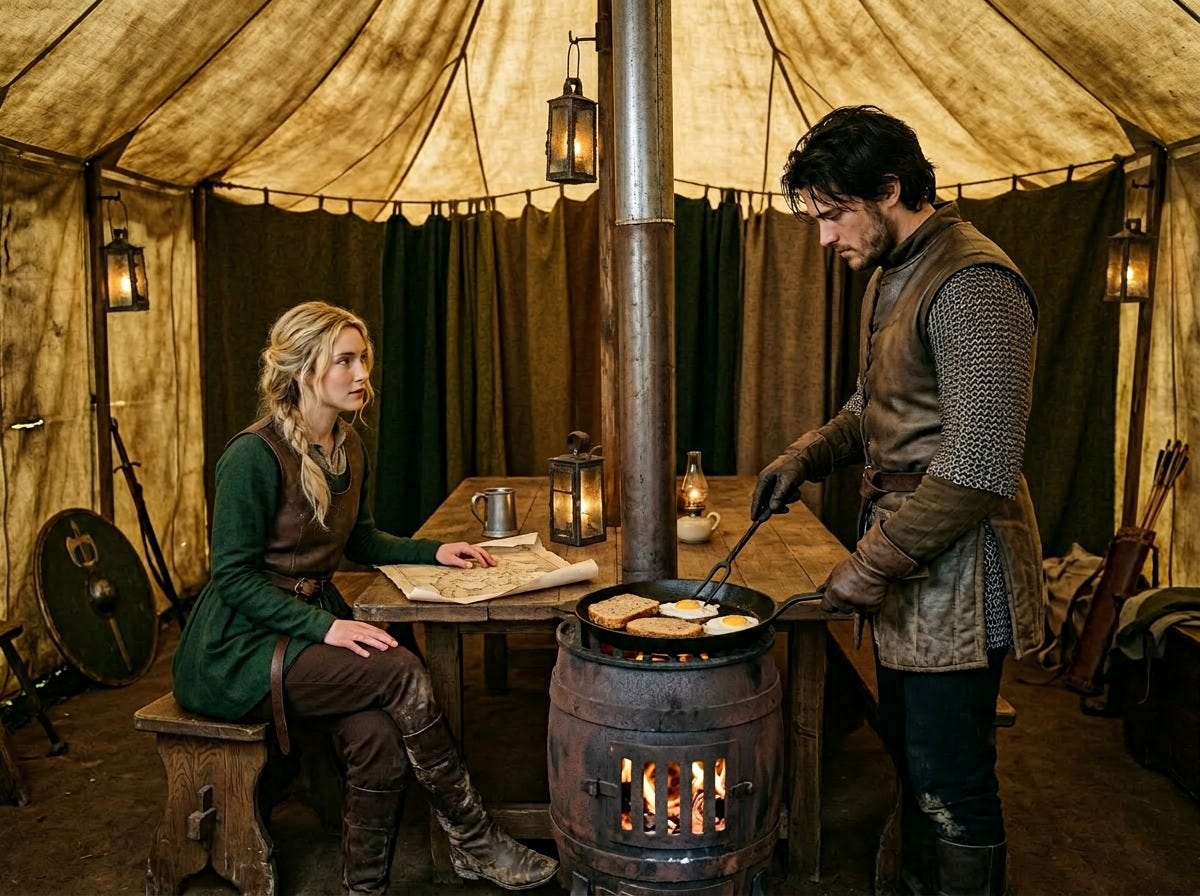
He almost smiled, turned his back to her for a moment, and then turned back with two plates of eggs over easy on toast. And then he surprised her when he dropped a slab of grilled ham on each plate.
“I’ll never be able to eat all this,” she said.
“Not to worry,” he said. “I’ll finish anything you don’t.”
He stoked the fire, added a log, and then let it settle before sitting across from her. For a while neither of them said anything, which ought to have been awkward and was not. The wind came down off the Dragonspires and pressed against the oilcloth walls and went away again.
“How long have you been here?” she asked.
“At the canyon? Two seasons. In the campaign, six years.”
“Six years,” she said. Not a judgment. A measure.
“It goes slowly,” he said. “Land doesn’t come back quickly. You push a mile, you hold it, you push another.” He turned the cup in his hands. “It’s not glorious work.”
“No,” she said. “But it’s the right work.”
He looked at her then — the kind of looking that wasn’t casual. Almost taking stock.
It made her drop her eyes to her plate.
Why did she both fear and welcome him looking at her?
“Tell me about Psalter’s Point,” he said.
“I know almost nothing about it,” she admitted. “My mother says they are hardy people. That they live at the edge of the frozen world.” She paused. “I know they are Wentworths, and I know they have fighting men, and I know that if they have any of the same feeling about the family name that I have, they will come.”
“And if they don’t?”
“Then I will have ridden a long way in bad weather for nothing,” she said. “But I don’t think they won’t.”
“You sound very certain of people you’ve never met.”
“I sound certain of what it feels like to want your name back,” she said quietly.
He was still for a moment. Then he nodded, once, and looked back at the fire.
She watched him. The firelight moved across the angles of his face. The way he held his cup with both hands. The way he went quiet—occupied, his gaze going somewhere the firelight didn’t reach. For a moment he looked like a man who could see someone she couldn’t.
“Did you lose—someone?” she asked. She hadn’t meant to ask it.
He looked at her.
“I’m sorry,” she said. “That was—”
“No,” he said. “It’s—” He stopped. Started again. “There was someone. When I was young. It was nothing—” He turned the cup once in his hands. “I’ve never quite—”
He didn’t finish.
She understood. She understood so precisely and completely that it frightened her, and she looked down at her own cup and said, carefully, “Yes. I know what that is like.”
The fire spoke for a while in their place.
“The owl,” she said eventually, needing to move the conversation somewhere safer. “At Wyndmere. Was that your choice or Christine’s contrivance?”
“Mine,” he said, with a slight weariness that suggested Christine’s contrivance had been considerable. “Though the field was narrowed for me considerably.”
She laughed — a real one, not a managed one — and she saw it land on him, saw something in his face open briefly before he collected it.
Strange.
“The swan was not my first choice either,” she said.
“What was your first choice?”
“Not to go at all.”
“I completely understand,” he said. “I almost didn’t.”
“Really?”
“Yep. But I’m glad I did.”
Scarlet was glad too. But she didn’t say so. But “me too” had been right on the tip of her tongue.
He looked up from his cup at her and held her in his eyes, and for the first time, she didn’t look away. He did.
“Tell me about your books,” she said.
“Nothing special,” he said. “I didn’t learn to read until later in life. After I joined the Knight Celestial. It was required, and difficult. My master told me children learn it easier than adults and that I was foolish for waiting so long. But the fact was, I didn’t have an opportunity sooner.”
There was something almost familiar in the look on his face. Wistful, if she had to name it.
“What are they? The books.”
“There’s a story about Kiranoise politics, given to me by Chenguer, with both Bravian and Kirano words. It’s really meant as a language primer.”
“Oooh,” she said. “Thats fascinating. What else?”
“A book of Corvaire poetry, which seems to mostly be focused on oceans and beaches. The third is a journal.”
“What kind of journal?”
“I’m writing about the war,” he said.
“That’s— That’s actually kind of amazing,” she said.
“I kind of started it as letters to my dad.”
“Has he read any of it?”
“Oh, no,” Philip said. “No, he passed before I started writing. But I have the last letter he wrote me.”
He held up his hand and showed her a ring, where a wedding ring should go, but on the other hand. “My father’s ring,” he said. “It doesn’t quite fit me “
He twisted it with his thumb.
That motion made Scarlet shiver and she couldn’t figure out why.
“So,” he said, breaking her thought process. “I take it you do not want to get married?”
“What?”
“This confounded idea of solving a land dispute by us getting married. You’re not for it, right?”
How is it possible that the first person who actually asked her about her opinion was the very man she was expected to marry. He was asking her thoughts. He was asking her opinion.
“Well of course I want to get married. Some day. To some one. But it would be preferable to me if I knew him. Loved him. Wanted to be with him.”
“I am really glad to hear you say that,” he said. “It’s a relief.”
She felt herself almost frown.
“I mean, who would want to get married to someone you don’t love?”
“Not me,” she said.
“Me neither.”
They both stared at the fire for far too long. Then he got up and added a log before sitting back down.
“Of course if I did love her,” he said, looking up to meet her eyes and holding them, almost gently. “I would want to marry her.”
“You would?”
“I’d do it tomorrow if it pleased her.”
“Is that why? To please her?”
“What other thing is there that matters besides making someone else happy?” he asked, now staring into the fire.
Scarlet said nothing for a long time. She didn’t trust her voice. And he wasn’t keen to say anything either.’
Finally she said, “My mother says that love is a beautiful thing. On the one hand. But on the other hand, she thinks it’s perfectly fine to go without it and just follow the queen’s suggestion.”
“So I have your mother’s permission already.”
She looked up at him, horrified at first, but then saw merriment in his eyes.
And they laughed together.
A shout from the doorway grabbed their attention.
“Captain?” It was Chenguer, stepping through the flap.
“What is it?”
“A rider.”
“Alone?”
“Yes.”
“And?”
“He’s carrying the Wentworth colors.”
Scarlet exchanged glances with Philip.
“Does your father know you are here?”
“Does he know? By now, surely.”
“What have you done, Scarlet?”
“I might have left without permission.” She refused to look at him.
“Come,” he said.
She followed him outside where it was cooler than she had expected. Apparently she had warmed up while inside the lodge.
They watched together as Sir Benedict, riding alone, approached.
He came to a halt ten feet from her, dismounted, approached, and knelt.
“My lady,” he said. “I beg your forgiveness, but your father insisted.”
“I’m not going back, Benedict.”
“I’m not here to bring you back, my lady. I’m here to escort you. I am instructed by the Duke himself to obey you in all things except one.”
“Which is?”
“I am not to leave your side.”
Scarlet caught her breath. She bowed her head and closed her eyes, saying nothing for a moment.
Finally, she whispered, “Thank you, Papa.”
She meant it only for herself, but she felt Philip slipped his hand over hers, squeezing slightly.
She did not pull away.
He dropped his hand momentarily. It had been brief, but it had been an undeserved kindness.
“Looks like we’ve found our escort,” he said. “But you’ll both stay the night, won’t you?”
She looked up at him and nodded.
Stephen B. Anthony is the author of Transmigrant, an epic science fiction thriller, available on both Amazon and Audible. The first seven chapters are available on this website for free.
Ughhhh I want them to end up together!
I really like that they aren’t hostile toward each other