

Scarlet has ridden east alone into contested territory, heading for Psalter's Point and the Wentworth cousins she has never met. Benedict is following on her father's orders.
The Urukesh came out of the tree line moments before dawn, which was when they came most often—in the Twilight, when their better eyes had the advantage over humans.
Philip heard them before he saw them—the deep, resonant clash of polearm hafts struck together in rhythm, a sound like a heartbeat amplified to something terrible. He was already moving before the watch bell rang, sword clear of its scabbard by the time the first pale shapes resolved out of the morning mist.
They were big. They were always big. Taller than men by half a head, their rams’ horns sweeping back from their skulls like crowns earned in violence, their skin the color of birch bark in winter, marked with the same dark striations. They moved with the efficiency of a people who had been fighting this border for three generations and had stopped being angry about it. This was just work to them.
But the same was true for the humans under Philip’s command.
“Left flank,” said Chenguer. He had arrived two days ago with a grin on his face that stayed there until just moments ago. Now his look was fierce—fiercer than ever. He had more to fight for now. A woman, the beginnings of a family of his own. He had a soldier’s build, a soldier’s eyes, and the stillness of a man who had been in tight spots before and intended to survive this one.
“I see them,” Philip said.
There was no more time for words after that.
The first Urukesh reached them in a dead run, polearm leveled, the broad blade at its tip catching the pale dawn light. Philip sidestepped, let the blade pass close enough to feel the wind of it, and brought his sword down across the haft—not to cut through, which was impossible, but to redirect, to send the Urukesh stumbling past him and off balance. The tip of the polearm dipped, caught a rock, and sent the creature sprawling. Philip brought his sword down and through the creature’s back as it went by.
The second didn’t give him time to feel good about the first.
He caught the descending haft on crossed forearms, staggered under the weight of it—they were always stronger than you expected, even when you expected it—and drove his forehead into the Urukesh’s broad nose. The creature recoiled. Philip’s sword found the gap beneath its arm.
Behind him, he heard Chenguer working—the controlled, economical sound of a man who fought without wasted motion. A grunt of effort. The crack of something breaking. A body hitting the ground.
Then: “Down!”
Philip dropped without thinking.
The polearm that would have taken his head swept through the air where he’d been standing. He felt it pass. He came back up inside the Urukesh’s reach—too close for the halberd now, which was the point—and drove his sword hilt into the creature’s jaw. It staggered. He finished it.
“My thanks,” he said.
“Thank me after,” Chenguer said, breathing hard.
There were more coming. There were always more coming.
They fell back together toward the garrison wall—a measured retreat. Philip took the left. Chenguer took the right. Between them, they held a gap of perhaps eight feet, and anything that tried to come through that gap paid for the attempt in blood.
An Urukesh with a longer reach than the others got its polearm past Philip’s guard and caught him across the ribs—not the blade, mercifully, but the haft, swung like a quarterstaff. The impact drove the air from his lungs and sent him sideways. His knee hit the ground.
The follow-up strike never landed.
Chenguer was there, blade turned, catching the descending polearm on the flat and heaving it wide. The Urukesh turned toward this new threat and Philip, still breathless, drove his sword through the gap Chenguer had made.
He got back to his feet.
“Even,” he said.
“Not yet,” Chenguer said, and there was something almost like amusement in it.
They were down to the last four now. They pulled back, reassessing. This was the dangerous moment. A retreating Urukesh was not a defeated one. They were regrouping, reading the ground, looking for the angle that paid.
Philip watched their eyes. He’d learned to watch their eyes.
The one on the far left moved first—a feint, designed to draw him—and he didn’t take it. He held his ground, let Chenguer advance on the right where the real threat was coming, and when the two remaining center Urukesh committed to their charge he was already moving laterally, cutting across their line rather than meeting it head on.
It was untidy after that. It was always untidy at the end.
When it was over, Philip stood breathing hard in the trampled mud, sword lowered, the morning mist beginning to burn off around them. Chenguer stood six feet away, hands on his knees, head down, catching his breath with the focused discipline of a man who refused to collapse even when his body suggested it.
The garrison was holding. The wall was intact. The dead on the ground were not theirs.
Philip looked at the man beside him.
“You okay?” he said.
Chenguer straightened. “Never better.”
“You fight like you’ve done this before.”
“Once or twice,” Chenguer said, laughing.
Philip almost smiled.
He was about to speak again when the watch called down from the wall—not the alarm, not the battle cry, just the ordinary call of a man reporting something unremarkable.
“Rider at the gate, Sir Philip. Single horse. Traveling alone.”
Philip turned.
And she rode out of the mist into the morning light like a myth realized in Philip’s own time.
All she did was sit in the saddle.
But she moved in a way that words could never adequately describe.
“Who in the gods is that?” Chenguer asked.
“Lady Wentworth—the younger,” Philip said.
Chenguer looked at her, then back at Philip, then back at her. He raised an eyebrow.
Philip sighed. “I recognize her from Christine’s masquerade ball.”
Chenguer shook his head. The explanation had explained nothing.
“What in the devil is she doing out here?”
“Exactly.”
“I think I’ll leave you to it,” Chenguer said, heading to the garrison fire.
The canyon had found her before she had found it.
The road had been narrowing for the better part of an hour, the pines pressing in from either side until the sky above was little more than a pale ribbon between the treetops. Then the trees fell away altogether, and the Dragonspires rose before her in their full indifference—black rock and old snow and the cold breath of altitude rolling down to meet Thistledown’s nose. The mare snorted and tossed her head.
Scarlet steadied her with a word.
The garrison was visible before the canyon mouth itself—a low timber palisade, a watchtower, the pale smoke of cook-fires. Men moved along the wall. A banner she did not yet recognize snapped in the mountain wind.
She had known this was coming since that night in Harrowgate.
It was the stillness that caught her first.
In the midst of the garrison’s quiet industry—men moving, horses being led, wood being split—one figure stood apart. He had his back half-turned to the road, looking up at the canyon wall. Then he turned to look at her.
His right hand was at his side, fingers moving—slow, absent, the small turning motion of a man who does not know his own hands.
He was spinning a ring.
Scarlet slowed her pace. Her breath shifted—the way a flame shifts when a door opens somewhere in a house. She looked at the ring, at the turning, at the unconscious rhythm of it, and felt something rise in her chest and settle there without explaining itself.
Philip admired the way she rode.
She moved as one with the animal—not an aristocrat on a gentle pony for show. Her blonde hair streamed behind her in the canyon wind. She held her reins with the loose authority of someone who had been in the saddle since before she could read, and she was reading the field before she had fully entered it—her eyes moving across the bodies, the wall, the men on the wall, back to the bodies.
He saw the scabbard on the horse’s flank. A sword—he’d thought arming sword at first glance, but no. A saber. Curved, single-edged, the right weapon for a mounted fighter. Women of rank carried daggers if they carried anything at all—a blade small enough to forget was there. This was not a decoration. It was a fighting weapon.
She slowed upon seeing the field, littered with bodies. All Urukesh, nine of them. She seemed less than impressed.
He watched her approach and saw the moment of indecision pass—the squaring of her shoulders before she nudged her mount directly toward him.
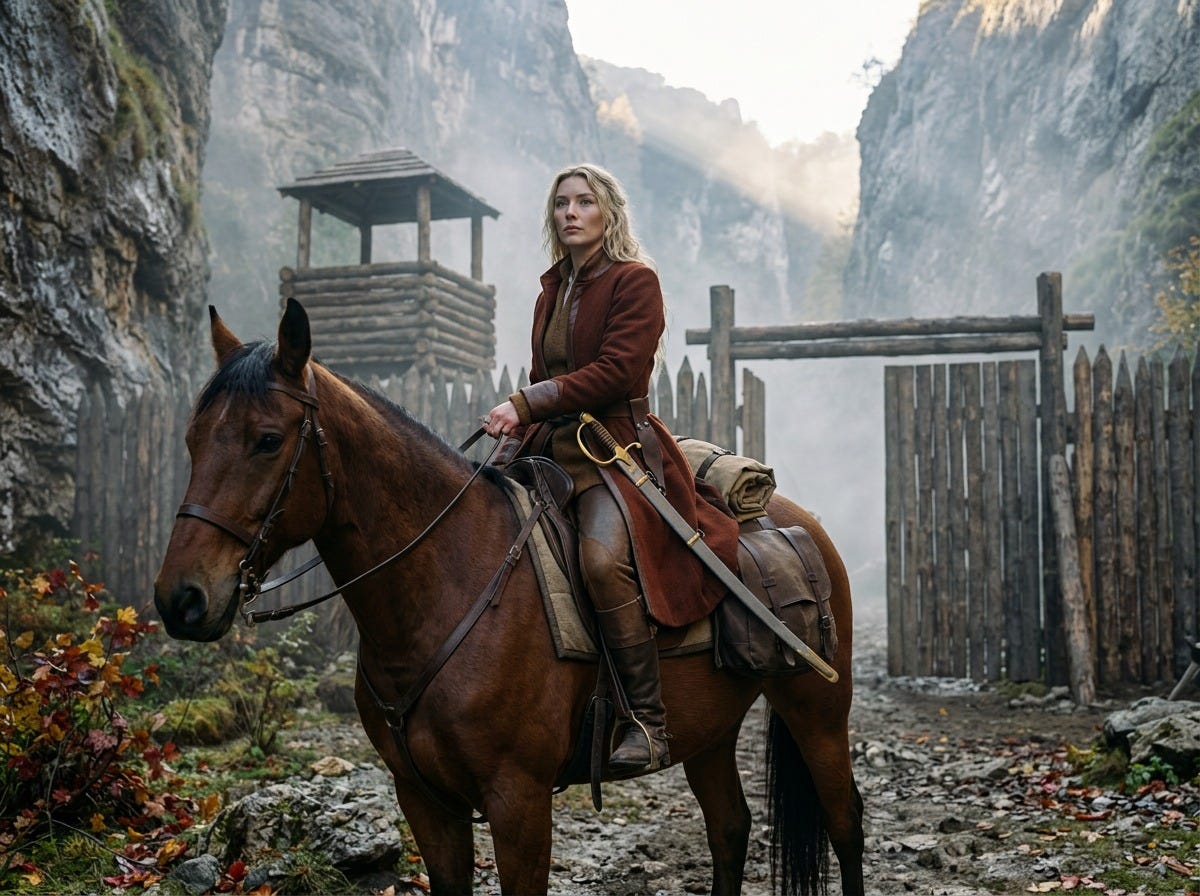
He had expected a great many things in Tallfellow Canyon. He had not expected Lady Scarlet Wentworth riding toward his garrison alone with her bags packed.
“My lady.” He stepped forward as she drew rein, and he did not miss the way she noted the distance he chose—close enough for conversation, placed precisely in the center of the road. Not a greeting. A fact.
“Sir Philip.” Her voice was level.
“You’ll forgive me,” he said, “if I observe that you are alone, it is three days’ ride from Kestrelmont, and that road—” he nodded toward the canyon mouth “—goes nowhere a lady of your station has any reasonable cause to go.”
“My station,” she said, “is Wentworth. That road goes through Wentworth land.”
“Formerly Wentworth land.”
“It is Wentworth land by title.” A pause. “Which you are currently in the process of returning.”
He looked at her steadily. “Which I am currently in the process of fighting for. There is a distinction.”
“Then we are both of us fighting for the same thing,” she said. “And I would ask you to let me pass.”
“I would ask you,” he said, “to tell me where you are going and why you are going there alone.”
She looked at him for a long moment, deciding how much he was worth telling. But instead of answering, she asked a question.
“There has been a battle?”
“There is a battle nearly daily, my lady.”
She eyed the corpses. “Have you tried talking to them?”
“You think a five-minute conversation is going to solve over a half century of war?”
“Do you even know their language?” she asked.
His mouth worked, but nothing came out.
“So you don’t. Do you even know what the dispute is about?”
“My job is to take back the land, not bicker about why it needs to happen.”
“Well, we agree on that point. It does need to happen. But why are they trying to take it? Has anyone asked recently? Or are we just going to keep killing each other indefinitely?”
“You’ve a lot of nerve—”
“I want you to look at each and every man here. Look at them. In their faces. See them for who they are,” she said. “Brothers, fathers, nephews, children. Every time an Urukesh cuts one of them down, we lose part of who we are. And nobody is asking why, after all this time, it keeps happening?”
Philip ignored her question. At least outwardly. But he knew she was partly right, striking at a chord he’d been afraid to play after six years in this feud. “Where are you going?” he asked.
She eyed him. Started to speak and then stopped. Then after a moment: “I am going to Psalter’s Point. There are Wentworths there. Fighting men. I mean to ask them for their service.”
“The Point,” he said. “In Harvest. With Blight coming.”
“I am aware of the season.”
“Are you aware,” he said quietly, “that the Urukesh patrol the eastern pass? That I have lost two scouts in the last season?”
She did not answer immediately. He took that for honesty, at least.
“I cannot let you go through alone,” he said.
The word let was a mistake. He knew it the moment it left his mouth, because he watched her sit up straighter and become, if anything, more still.
“You cannot let me,” she repeated.
“My lady—”
“I am a Wentworth,” she said. “You are fighting for my family’s land under my Queen’s authority. I am grateful for that. I am sincerely, genuinely grateful. But I am not under your command, Sir Philip, and I am not asking your permission.”
“No,” he agreed. “You are not.”
She waited.
“But I am asking,” he said, “that you wait until morning. My second knows this terrain. I’ll send him with you.”
“Chenguer?”
“You know him?”
“I’ll not take him with me.”
“Why not?”
“Because if I die out here and he dies with me, it will kill my best friend, too. That’s three deaths. Two too many.”
“One is too many,” he said. “In any case, I have other men. But even beyond that—I’d like to understand your plan. Your purpose.”
“What’s to understand?”
“If I knew that answer already, I wouldn’t be asking, would I?”
It was her turn to look surprised.
“Stay here,” he said. “Until I can find someone to accompany you. Give me one night.”
She looked at him, looked down the road into the unknown, and then back at him.
“It’s not even half past seven. You would have me waste a day here, knowing the season?”
“I’d have you take precautions so you can make your destination. I’m only asking for one night.”
“One night?” she asked.
He nodded. “One night.”
She looked at him a moment longer, and then turned Thistledown toward the garrison without another word.
Philip stood in the road after she had passed him.
Then, without thinking, his fingers found the ring again.
He stood there in the cold mountain air, turning it slowly. He could not account for it—not the familiarity, not the pull of it, not the sense that her presence was not new to him in some way he had no framework for. He had seen her once, at a masquerade, across a room. That was all it was. That was the whole of it.
He turned the ring and did not convince himself.
Stephen B. Anthony is the author of Transmigrant, an epic science fiction thriller, available on both Amazon and Audible. The first seven chapters are available on this website for free.
Always impressed when a writer can make a fight scene both understandable & compelling. Really like the two men working together & getting more of Chenguer
The battle scene in the beginning was beautifully written