

Quail eggs and hearthwater and a map with imprecise lines. Philip told her about the girl he never quite got over. Scarlet told him she knew what that was like. The fire spoke for them.
Benedict had arrived on a heavier horse, laden with far more provisions than Scarlet had thought to bring. In retrospect, she realized that’s what she should have done rather than bringing her riding horse. This wasn’t going to be a leisurely ride.
Among the provisions was a cask of Carathel red, and he’d cracked it open for the evening. It paired well with the rabbit stew, which was now a pleasant memory. Scarlet held her second glass in both hands and watched the fire.
Chenguer had built it well, a soldier’s fire, efficient and bright, throwing good heat against the night air. The four of them sat on logs in a rough circle and for a time no one spoke, which suited her.
It was Benedict who asked about the trebuchet attack earlier in the day.
“Peat, resin, and tar,” Philip said. “The mixture clings. Ordinary water makes it worse.”
“How did you extinguish it?”
“We didn’t. We denied it purchase.” He turned his cup slowly in his hands. “Mud and sand on the palisade. The fire had nothing to grip. Once it consumed its own fuel, it was spent.”
Benedict considered this with the quiet appreciation of a man who had spent his life solving physical problems. “Simple.”
“The best solutions usually are.”
“And the machine itself?” Benedict looked to Chenguer.
The warrior’s expression was one of mild satisfaction. “We dragged it to the edge of the ridge and dropped it into the ravine. Its operators had already gone.”
“Fled?”
“Or finished. They may have had a fixed number of projectiles and used them all.” Chenguer shrugged. “Either way, they did not stay to discuss it.”
Benedict smiled at that. Scarlet watched him across the fire, the familiar lines of his face, older now, the grey threading deeper into his beard. He caught her looking and raised his cup slightly. She raised hers in return.
“You handled it well,” Benedict said to Philip.
“We were fortunate. No casualties.”
“Fortune favors the prepared,” Scarlet said.
Philip looked at her. “Is that your father’s saying?”
“My swordmaster’s.” She glanced at Benedict, who had developed a sudden interest in his wine.
The fire crackled. An ember broke loose and drifted upward.
“Swordmaster? You have a saber. Do you know how to use it?” Philip asked her.
“She can best most men,” Benedict said, with feeling.
“He taught me,” Scarlet said, first looking at Benedict and then turning her attention to Philip. “In exchange for mincemeat pies.”
“The best currency,” Chenguer said gravely, and she laughed, caught off guard by his perfect deadpan. Philip chuckled, his blue eyes capturing the firelight. He looked at Benedict.
“How long?”
“Since she was fourteen,” he said. “So, about nine years.”
Philip looked back at her then, revising his thoughts about her. “You surprise me,” he said.
She turned away from him, a grin she couldn’t quite suppress finding its way to her face.
The conversation moved between the serious and the inconsequential. Chenguer described the terrain of the ridge with a soldier’s precision. Benedict asked questions about supply lines and Philip answered them plainly, without pretense. Scarlet listened and said little, but she was building a picture from small pieces. The way Philip tracked every entrance to the clearing without appearing to. The way Chenguer deferred to him on tactics and Philip deferred to Chenguer on terrain. A partnership, not just a command structure.
The second glass became a third, finished slowly, and at some point she realized she was tired in the deep way that follows fear finally released.
Philip noticed. He noticed things, she was coming to understand, in the way that quiet people do.
“Come,” he said. “I’ll show you where you can sleep.”
She followed him.
“You already showed me,” she protested.
“I know, but this way I can make sure you have everything you need.”
When they stepped into the lodge, it seemed smaller than it had been during the day. Maybe it was the darkness outside making the space feel more enclosed.
He led the way, lamp in hand. Just at the entrance he lit a tallow candle and passed it to her, then he moved to the stove and filled it to the brim with three fresh logs.
“You’ll be warm enough,” he said.
He pulled back the hanging wall to his private room and lit the single lamp hanging from the wall near the shelf with his books and papers.
“It isn’t much,” he said.
“It’s lovely, and better than I’ll have for a long while.”
He stood near the hanging curtain and she stood near the bed and the space between them was not large. Neither of them moved.
“There are extra blankets in the chest,” he said. “The nights have been cold.”
“Thank you.”
He nodded. She nodded. Neither moved.
“Philip,” she said, and then stopped, because she hadn’t known she was going to say his name and had nothing to follow it with.
He waited.
“Thank you,” she said again. It wasn’t what she had meant to say. Or perhaps it was, only carrying more weight than the words could hold.
He held her gaze for a moment—not quite a smile, not quite something else. “I recommend keeping the flap up for a few minutes just to let the heat in. But close it when you’re ready for privacy.” He paused. “Sleep well, Scarlet.”
He turned and ducked through the flap. She stood listening to his footsteps move away and did not move for a long moment after they had gone.
She meant to sleep.
She lay down, pulled the blanket up, closed her eyes. The sounds of the garrison settled around her, the distant exchange of sentries, the fire dying down outside, the small noises of a camp at rest.
She was tired and should have slept. She did not.
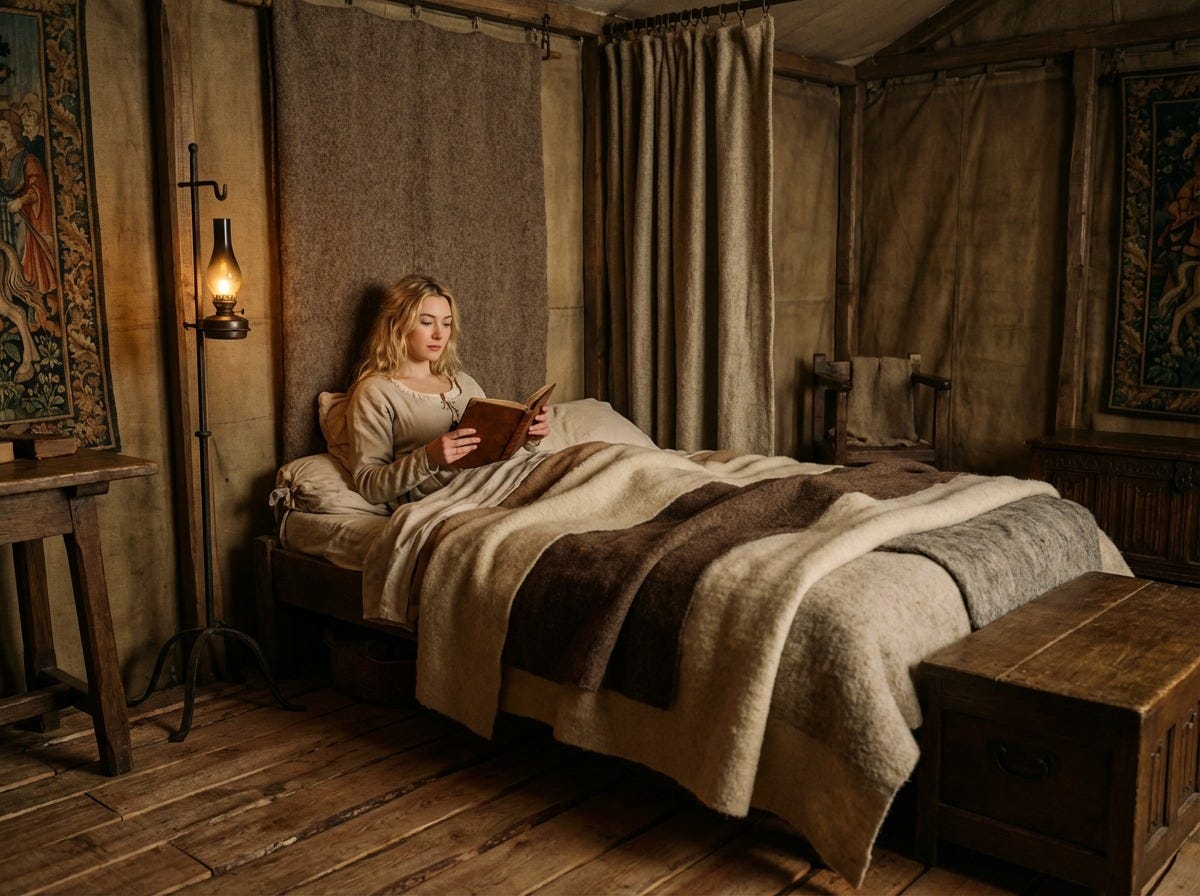
The wool blanket held him in it. Only faintly. The wool carried its usual warmth, lanolin and sun and the faint dry sweetness of cedar, but beneath it was something else. A subtler note. Skin and heat, worn into the fibers over time. Just the trace of a man who had lived in it. A sort of gentle musk, which should have annoyed her, but annoyingly did not annoy her.
After a while she sat up, opened the chest, and grabbed a fresh blanket. It smelled fresher than the one that had already been spread upon her arrival. She tossed his blanket back into the trunk and tried again.
She shivered a few minutes later. Maybe one blanket wasn’t enough. She reached back into the chest and pulled his blanket on top of her, enjoying the warmth and weight, the musky scent, the traces of smoke from long nights by the fire, and leather, or possibly iron. It was almost like her father in that pleasant manly way. But also different.
Still, sleep did not come.
She lifted the curtain again. But the bunks were empty. Curious, she stepped closer to the lodge entrance and opened it, the cool night air rousing her.
She stopped and withdrew when she saw that Benedict and Philip still sat at the fire. She took one step backward and listened through the flap.
“…halfway through Harvest already. Blight is no picnic in the Dragonspire Foothills. You’ll want to move quickly. Even with no delays, you’ll be pushing it to get back here before Frostfall.”
“What should we expect once it hits?” Benedict asked.
“By Frostfall much of it will be impassable,” Philip said. “Snow neck deep in places. The horses won’t make it through, much less you.”
“It is possible?”
“It is,” Philip said. “You can be back here before it gets bad, but if you’re still in it by the first week of Frostfall, it’ll be all over for you. So if you get delayed, your best bet is to stay in Psalter’s Point until mid-Myst. Maybe even stay until the first week of Plantings.”
They didn’t speak for a while, which caused Scarlet to peek through the curtain. She watched Philip add a log to the fire. Benedict poured another glass of wine for each of them.
“There are many dangers,” Philip said as he sat down. “No place for a woman.”
“She’s not just any woman.”
“I can see that. I wish I could spare some of my men, but we’re barely holding on here.”
“We’ll come back with more men.”
“How many, realistically?”
“I have no idea. But some will come,” Benedict said.
“Can she convince them?” Philip asked.
“You really haven’t tangled with her yet, have you?”
“Kind of afraid to,” Philip said.
“Wise man.”
Scarlet smiled and withdrew, leaving them to it, and being careful not to make the floorboards creak too much, she returned inside. She checked the stove and found a spot for another stick of wood, tossed it in, and closed the stove.
She climbed back under the blankets, luxuriating in the warmth, and stared at his journal. Dark leather. Worn at the corners. She had no business reading it.
She read it anyway.
He wrote the way he spoke, plainly, without ornament. Early entries were purely tactical: supply calculations, patrol schedules, observations on Urukesh movement patterns that were precise enough to be unsettling. He had understood their engineering months before anyone else apparently had.
Scarlet didn’t read every page going back through more than five years, but she occasionally found entries with real humor in them.
Corporal Maren has been feeding grain to a pheasant, having made it his pet after it wandered into camp three weeks ago. He has named it Brigadier. It has begun attending morning formation. I have decided not to address this.
She thumbed through a few pages and found another entry.
There has been a sickness moving through the camp. Fever, mostly. Two men have reported seeing things that aren’t there. Dawes swore he saw Corvin at the tree line on the 17th. Corvin has been in the ground three days.
But as she moved deeper into the ledger the entries changed.
Father would have known what to do here. He always knew. I find myself reaching for a conversation I cannot have.
She stopped. Read it again. Then she moved to the next entry, idly moving her index finger back and forth along her lips.
I have been here long enough that I have stopped counting the days the way you count them when you are still close enough to home to be missed. Now I count by what remains to be done. I mostly don’t even know what day it is.
She turned pages slowly.
There are men here who have wives. Children. They talk about them at night the way men talk about water when they are thirsty. I have nothing to say in those conversations. At those times I feel utterly alone.
The final entry was recent.
There was a swan, white silk, a mask of pale feathers, and something about the way she moved was both different and familiar at the same time. I danced with her once.
I do not know why I have written that down.
It later turned out this was the girl the queen wanted me to consider marrying.
But she doesn’t want me. And yet—
She held very still. He had not finished the sentence. She sat with those two words for a long time before she closed the journal and set it back exactly as she had found it. She lay down in the dark, pulled the blankets up, and rested the back of her hand on her forehead, pondering.
Outside, somewhere near the perimeter, a sentry called the hour.
He doesn’t want me either.
She watched the lantern light tell stories as it played in the shadows.
She didn’t think of his eyes. Not at all. Not even a little.
But when she slept, she dreamt of a deep, endless sea, its waters impossibly blue, carrying her farther than she had ever been.
Stephen B. Anthony is the author of Transmigrant, an epic science fiction thriller, available on both Amazon and Audible. The first seven chapters are available on this website for free.
I look forward to this every night!!