

Scarlet should have slept. Instead she read his journal and found an unfinished sentence about a swan. She dreamt of a deep blue sea.
Benedict was quiet because Scarlet was.
The departure from Tallfellow Canyon had been odd—hushed in a way he couldn’t account for. She was riding toward the goal she had set for herself, driven by her own belief in the rightness of the act, and yet she rode like a woman leaving something behind. It put him off-balance in a way he didn’t have words for.
He wondered if Sir Philip had said something to upset her. But she didn’t seem angry. It was more—forlorn? As if a small private grief had taken up residence just behind her eyes.
But it might also have been the overcast weather. Her spirits broke open along with the clouds when the sun came out around ten in the morning.
“Did you converse with Philip after I went to bed?” she asked.
“A bit,” Benedict said. “He had some advice and warnings for me.”
“What did you make of him?”
“He’s pragmatic, but he might underestimate you.”
“I might have done the same.”
“How do you mean?”
“Not all soldiers are the same. Chenguer, for example, seems to be a hopeless romantic. You knew he had proposed to Lady Lapointe?”
“Yes, I had heard that rumor.”
“It’s just that you get in your head a picture of who people are supposed to be, and when they turn out differently, it’s a surprise sometimes.”
“That’s what makes people people. The element of surprise. We’re all different. Not all soldiers are violent by nature. Not all noble ladies are demure by nature.”
“That’s for sure,” Scarlet said. “Just like not all Urukesh are backward savages by nature. They are as individual as we are.”
“You think?”
“Of course they are. They are just people.”
“I’m rather surprised that we are two hours in and have seen no one.”
“I get the sense,” Scarlet said, “that they have seen us.”
“Likely true,” Benedict said.
He stopped his horse and Scarlet reined in beside him.
“What is it?”
“Shhh—” he said.
Then she heard it herself. The snap of a twig. Somewhere off to her left. Distant.
Her eyes scanned the forest left of the road, but there was so much underbrush she could see no movement at all.
It was a perfect ambush spot.
They waited silently for what seemed like minutes.
The forest returned by degrees. First the distant birds, then nearer ones, testing the quiet, finally a squirrel that complained from somewhere above. Scarlet knew that sometimes squirrels warned of humans—but just as often, of other creatures.
Then she heard the sharp exhale of wind through a creature’s nostrils. The proximity startled her.
The creature made the same sound a second time, and then she heard crashing in the underbrush and a small elk emerged into the roadway, attempting to cross the road. It reached the halfway point, stopped, and looked back at them.
The snap of a bowstring startled her.
She caught the motion from the corner of her eye—Benedict’s bow tilting forward—then looked back at the creature, trailing blood.
It ran to the far edge of the road, took two bounds into the forest, and then smashed into a tree before falling over and out of sight.
Benedict sat on his mount, unmoving, watching the forest where the animal had fallen.
“Good shot,” she said.
“Thank you, my lady.”
It had been a clean strike. She could tell by the way the animal had run—strong for a few strides, then failing all at once. No thrashing, no prolonged suffering.
The sound of it crashing through the brush still lingered. Loud enough to carry.
They were no longer quiet travelers on an empty road.
“I guess I should keep my bow strung,” she said.
“It wouldn’t be a bad idea,” he said.
She inclined her head toward the animal.
“We’ll wait,” he whispered. “You give a wounded animal a chance to lie down and die, not chase it. It builds bad blood flavor if you chase it. And it’s more work.”
Scarlet nodded. She kept her eyes on the woods and promised herself to string her bow at the next opportunity. She was decently competent with it—nothing like she was with her saber—but they couldn’t rely on Benedict alone for the next four weeks.
After fifteen minutes, Benedict rode to where the animal left the path, dismounted, stepped a few feet into the woods, and gave a whistle and motion for her to join him.
She dismounted and watched as he uncoiled a rope from a saddle loop, made a slipknot, and then went back into the woods. A minute later he returned with the end of the rope, which he looped around the saddle horn of his horse. Then, directing his mount, they dragged the elk out of the woods.
He began by cutting along the backbone, peeling the skin off the backstraps. They would not be able to take the entire animal.
While he did so, Scarlet strung her bow by hooking the recurve behind her ankle, bending her body forward, and slipping the bowstring over the nock. She stretched it three or four times to make sure the string was well-seated in its grooves.
Benedict had just finished removing the backstraps when six Urukesh appeared at the bend in the road, about two hundred yards distance. Scarlet saw them first.
“Benedict—” she said.
He raised his eyes.
“We have company.”
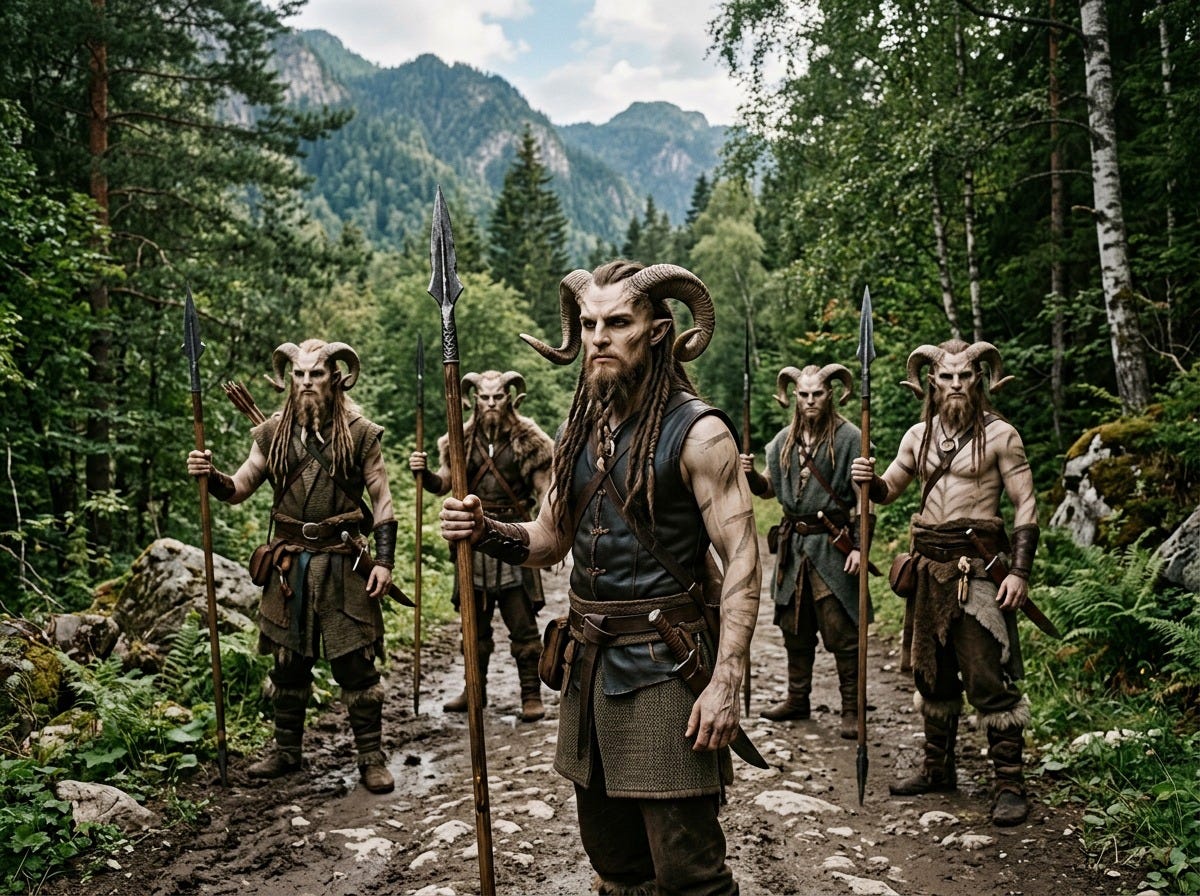
Benedict wiped his knife on the elk’s flank, slipped it back into its sheath and then mounted his horse. He nocked an arrow, but kept the bow along the horse’s flank so that it wouldn’t be visible at distance.
“I’ll talk to them,” she said.
“You’ll what?”
“I know their language.”
“How?”
“It used to be common knowledge.”
“You sure?”
“I made a decision a while ago,” she said. “That I would start with talking first when it came to the Urukesh. I’m not going to abandon that the first time I see them.”
“If it’s all the same to you, I’ll keep my bow ready.”
“Oh, we’ll be ready,” she said, hand on her saber. “But we’ll talk first. Understood?”
“As you wish, my lady.”
When they were forty yards away, they stopped their approach and spread out in a semi-circle. They were armed with spears, but were unarmored. Not warriors currently planning for a fight, then, or at least not announcing one.
“Who are you on Urukesh land?” one of the Uruks asked in Bravian.
She was certain that they were still on Wentworth land, but arguing otherwise didn’t seem productive.
“Vashet na Urukesh. Vashet na keth Urukesh. Seth Wentworth.”
He looked surprised, and answered in Urukesh.
“You know the tongue of my people. How did you come to know Urukesh?”
“It wasn’t that long ago our peoples could speak both languages. For some of us, that still matters.”
“You should not be on this land.”
She held his gaze for a moment, then looked about.
“This land was my family’s land a century ago,” she said. “It is disputed land now. We should both be careful to not make claims without conceding the possibility of error.”
He smiled at her, showing large white teeth, his grin growing wider, and then he laughed, filling the valley.
“If you’d said that in Bravian,” he said, “I’d have taken it as an insult. Saying it in Urukesh though? That was honourable.”
“Then I would honour you a second time,” she said. “We have taken this elk cleanly and will use a portion of it for the road ahead. But we offer to share what two riders cannot use before it turns.”
“Answer first: Where does the road take you?”
“We are passing through to Psalter’s Point.”
“I don’t know of this place,” he said.
“Far to the east. Over three weeks ride.”
“What do you expect to find in this place?”
“Family,” she said.
He eyed her, then glanced at Benedict.
“If your guardian will place his arrow in his quiver, we will wait until you complete your work and leave you unmolested. We accept your barter for passage.”
Scarlet turned her head slightly. “He wants you to put your arrow away and will trade what we do not take in exchange for letting us pass.”
Benedict watched her back, still holding his bow. He didn’t move.
“Do it,” she hissed.
“As you wish, my lady.”
She caught the motion at the edge of her vision. Benedict raised the bow slowly, tilting it toward the sky. Crossed his left hand, plucked the arrow, dropped it into the quiver, and let the bow settle along the horse’s flank, where he clipped it in place.
Upon Benedict doing this, the Urukesh withdrew, but not before their leader said, “Good travels, lady.”
“Thank you,” Scarlet said.
Benedict slipped from his horse and continued working the carcass. Scarlet stayed mounted, hand on her saber hilt, watching the Urukesh, who now spoke in low murmurs about sixty yards away, paying little heed to them.
It took about fifteen minutes for Benedict to gather the meat. He took the backstraps, tenderloins, and one rear quarter. It was as much as they could use before it spoiled. Had there been more time or better circumstances, he would have smoked or salted more of the kill, and he lamented leaving it.
“That’s about all we can take,” he said.
The Urukesh, observing them mount up, approached again.
“We thank you for the exchange,” the Uruk said in his native tongue.
“As do we,” Scarlet replied in Urukesh. “May I know your name, sir?”
“If you tell me yours.”
“I am Scarlet.”
“Scarlet and nothing more? No honorific?”
“What’s the point of titles to people who do not share a common society? Can’t we just be who we are?”
“We could, but then you would not know you have spoken to Krang Haddagan.”
Scarlet’s eyes went wide for just a moment. Krang was the Urukesh word for king. He was their king, or tribal chief.
“Even between great societies,” he said, “there should be a show of respect.”
“Very well, and I do not disagree,” she said. “I am Scarlet. I am the daughter of the Duke of Wentworth.”
“The man who claims these lands?”
“The same,” she said.
“Many have died,” Krang Haddagan said. “For many years.”
“On both sides,” she said.
“Agreed, but we did not start this war.”
This land had been disputed for seventy years. Small at first, then growing across the decades. The truth of how it began was buried under so many seasons of grievance that no one living could say with certainty who struck the first blow—and Scarlet suspected that was not an accident.
Then, in accented Bravian, he said, “Your father’s men also did not start this war, nor your grandfather’s. Something else did. We know this. Your people do not seem to.”
Scarlet tilted her head, speaking in Bravian. “To what do you refer, Krang Haddagan?”
A shadow crossed his face. “We have found our dead on this road. What was taken from them—we have no word for it in Urukesh. Nor, I think, in Bravian.”
Scarlet raised an eyebrow. “Whatever the cause, I would have it end,” she said.
“Would you?” He switched back to Urukesh. “Then all you need to do is give up your claim to lands that do not belong to you and call off your war dogs.”
She watched him coolly.
“I shan’t argue with you here and now about who has what ancestral rights. But know this, Krang Haddagan—the truth is out there somewhere, and I will find it. My goal will be the restoration of the truth, wherever that leads.”
He held that for a moment.
“Good travels, Scarlet of Wentworth.” He paused. “Be careful on the eastern roads after dark. There are things in this land that feed. Things neither Human nor Urukesh.”
Then he turned and was gone—not walking, not running, just suddenly no longer there in the way that very large men sometimes aren’t.
“He says there are dangers on this road that aren’t Human or Urukesh,” Scarlet said.
“What kind of dangers?” Benedict asked.
“Something unnatural,” she said. “I fear.”
“Then we put steel to it, whatever it is,” he said.
Stephen B. Anthony is the author of Transmigrant, an epic science fiction thriller, available on both Amazon and Audible. The first seven chapters are available on this website for free.
Such a chilling interaction