

Philip Beckwith was seized on a dark road, drained by creatures that wore the bodies of men.
Scarlet stood at the back of the Psalter’s Point community theater—open to the sky, the late afternoon sun illuminating the gallery—and counted heads.
Twenty-three. Maybe twenty-five if you counted generously.
Chelsea was in the front row, sitting very straight, Lucy tucked under one arm. She had insisted Lucy needed her own chair, and Scarlet had not argued the point. The dolly sat propped against the armrest with a dignity that suggested she took civic matters seriously.
Scarlet had not expected a crowd, not truly. Word traveled slowly in a town that worked from before dawn until after dark. She had posted notices. She had asked Marcus to spread the word from the inn. She had spoken to Thomas and Nan Willow, who had promised to come and to bring whoever would listen.
She waited.
By quarter past six, the trickle had become something more. Forty people. Then sixty. She could hear the low murmur of conversation filling the space as neighbors found neighbors and settled into seats with the slightly suspicious air of people who had come to see what all the fuss was about.
She walked up the steps to the stage and crossed to the podium.
“Let me start by introducing myself,” she said. “My name is Scarlet Wentworth. My father is Caspian Wentworth, the Duke of Kestrelmont. We have heard that this town is home to cousins we have not seen in two generations, and I have ridden twenty-eight days to find you.”
She paused.
“So let me ask—by standing—who here is a Wentworth?”
Nobody moved.
Then, slowly, Marcus rose from a seat near the middle of the room. He had changed from his innkeeper’s apron into a decent grey coat, and he stood with the careful dignity of a man who had been waiting a long time to stand.
A moment later, two men rose—father and son, from the look of them. Then a woman near the back. Then two more.
Soon there were nine people on their feet, scattered across the audience like lights coming on in a town at dusk.
“Hello,” Scarlet said, and meant it. “I am your cousin. Would you come and sit up here with me? Just on the edge of the stage?”
They came slowly, hesitatingly, but they came—all except Marcus, who caught her eye and gave a small nod toward his seat, as if to say he was more useful where he was. She let him stay.
More people were still filing in along the walls. The side doors had been propped open and she could see faces in the doorway.
“This town was first settled by Wentworths,” she said. “I want to tell you a story about this family—some of which you may find difficult to believe, but it is all true.”
She told them. The false accusation against her great-grandfather, his death, the forged signet ring and the theft of the title. She was careful with the name Ashcroft, leaving it out of the story where she could. She told of the burned papers, the ring found in a locked box in Stormrest, the petition to the monarch, the hearing before the queen—and then she stopped herself.
“I was twelve,” she said. “Twelve years old, standing in front of the queen, making the case for my family’s name. And I was terrified.” She paused. “I did not let them see that.”
There was a murmur from the crowd, and she saw something shift—not agreement yet, but attention.
“The title was restored. The bill of attainder was struck. And here I am.”
Chelsea chose this moment to hold Lucy up and wave her arm in Scarlet’s direction by way of greeting. Scarlet gave her a small nod.
A man near the back stood. He was broad-shouldered, with the weathered face of someone who worked outdoors.
“Some say you’re here to ask peaceful people to fight in a war for you.”
“Yes,” Scarlet said. “I am here to ask that.”
“Why would we?” he said.
Several murmurs rose in agreement.
“What is your name, sir?” she asked.
“Bered Cartwright—my lady.” The last two words arrived a beat late, as if he had only just remembered them.
“Mr. Cartwright. What do you know about the Cartwrights in Stormrest?”
He shook his head. “Don’t rightly know, my lady.”
“Catherine Cartwright works for my father at Kestrelmont. She keeps his books.”
“I’m an accountant,” Bered said, surprised despite himself.
“That’s interesting,” Scarlet said, and smiled at him. “But let me address your real question. I could make a fine speech about duty and Bravian honor, and every one of you would nod along in private and do nothing about it in public. I know that. So I won’t insult you with that speech.”
A few people laughed, quietly.
“You are asking—what is in this for me? Why should I care about a distant lord who has not graced this town with his presence in three generations?”
“Indeed, my lady,” Bered said, and sat down.
“The answer,” Scarlet said, “is that you shouldn’t.”
That brought silence.
“You shouldn’t care about people who have not cared about you. You were left out here at the edge of the world, and you built something anyway. You have made this town with your own blood and work and stubbornness, without asking anyone for help. You just did what needed doing.”
A couple of people began to clap. Others joined them.
“My mother told me you were the hardiest people in all of Bravia,” she said. “The strongest. The most capable. I’ll be honest with you—I didn’t believe her. I thought I’d come find a small fishing village of people who couldn’t care less.”
The room went cool.
“I was wrong,” she said, before it curdled. “I was completely wrong. I came and found a place thriving, filled with good people doing hard things with very little room to do them. Children who have to climb the mountain to find space to run. Gardens crammed into stone.” She thought of Thomas Willow’s little patch of earth between the rocks. “People who have not given up, but who deserve better ground.”
Nods, now. Real ones.
Another man stood. “You’re still asking us to fight the Urukesh. We respect the Urukesh. Nobody here wants that fight.”
“Vashet na keth Urukesh gratha,” Scarlet said.
Silence.
“Who knows what that means?” she asked.
A woman in the second row lifted her hand.
“Would you stand and tell everyone?”
The woman rose and turned to the crowd with the expression of someone who had not anticipated public speaking this evening. “I think—I believe the young lady has said she respects the Urukesh people.”
“I said I love them,” Scarlet said gently. “As I love all peoples. The Urukesh, the Oroquai, the Aelvaeni, and we humans. In much of the world, all four races live together. We have our disputes, but mostly we are neighbors.”
“Then why?” the man said.
“Because the Urukesh occupy Wentworth land. Not their ancestral land—our land. Two million acres of good ground that has passed out of our hands over eighty years. We want no land that was ever rightfully theirs. We want only to restore the original borders. No more and no less.”
From his seat in the middle of the room, Marcus raised his hand.
Scarlet had been expecting him. “Marcus.”
He stood. He looked different here than he did behind the front desk of the Rusty Anchor—straighter, somehow. As if this was the room he had actually been built for.
“My lady,” he said, “are you willing to consider giving back Urukesh ancestral lands that were taken from them—not by your family, but by the crown?”
“Tell me what you know,” Scarlet said.
He blinked. “I’m sorry?”
“I said tell me what you know. I’m listening.”
He stood a little straighter still. “I spent the better part of my career in Stormrest studying the original Wentworth land grants. Not just the duchy itself—the borders as they were established, what was ceded, what was traded, and what was simply taken.” He paused. “Nobody has wanted to hear any of it for a very long time.”
“I want to hear it,” Scarlet said. “I gave you my word on that two days ago, and I meant it. But I’d like to hear the rest of it after this is over, if you’ll stay.”
“I’ll stay,” he said, and sat back down. The crowd watched him as if seeing him for the first time.
The room was over capacity now. Men stood along the walls with their arms folded, watching.
“The Wentworth duchy has been legally restored,” she said. “But its land is in the hands of others—and it’s quite possible we hold land taken wrongly as well. If we do, I will restore it. That is my intention. But I need your help to do any of it.”
“You still haven’t said why we should!” a man near the back called out.
“Because there is land,” she said. “Two million acres.”
“What does winning land for you put in our hands?”
“Hear me now.” She let the room settle. “The Wentworth family is going to restore both a landed gentry and a landed yeomanry. If you are a Wentworth by blood, and you serve honorably in my service for three years, you will be granted one thousand acres as a freehold—heritable title, held by your children and their children, so long as your line exists. More land than you can see from the top of the ridge. More land than this entire town covers. Good land. Farmable land.”
A man near the wall closed his eyes when she said it, as if he was already standing on it.
“All of us?” said one of the Wentworths on the stage edge.
“Every Wentworth is entitled to both the protection and privilege of the duchy. I don’t care if you’ve never set foot in Stormrest. You are family.”
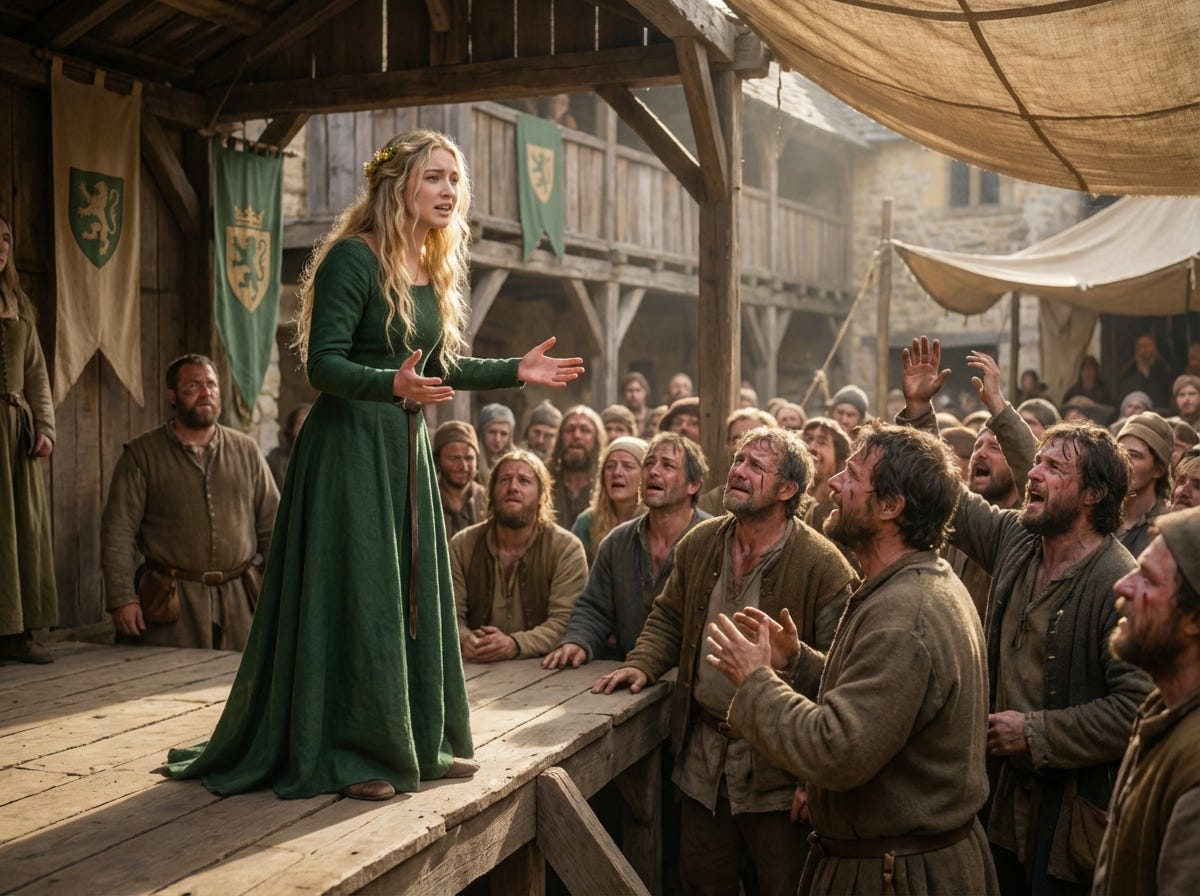
The murmurs became something louder. She heard the number passed back through the room—a thousand acres, a thousand—like a tide going out and coming back changed.
“What about the rest of us?” someone called. “Not everyone here is a Wentworth.”
“There is land enough for all,” Scarlet said. “Any adult who serves in my army for not less than three years, and does so honorably, will be granted a heritable land trust of one hundred acres. Man or woman, regardless of birth. A farm to work. A farm that will feed your family and your children’s families. Not as tenants. Not as renters. As owners of the land. You don’t fight for me. You fight for your own futures.”
“Women?” someone said, and the word carried the particular weight of a question that expected to be told no.
Scarlet stepped back from the podium. She drew her saber from its scabbard and it caught the light.
“I am a fighter in my own army,” she said. “I am not asking you to do something I will not do myself. I will do it alone if I must. But we will succeed if we do it together. Any woman willing to take up the sword and train with us is entitled to the same as any man.”
There were objections, as she had known there would be—from men and women both.
“Every man and woman chooses for themselves,” she said, raising her voice over them. “And answers to no one but the gods for it.”
The room was loud now, not with anger but with the noise of people who had come in with small hopes and were now recalculating.
In the front row, Chelsea held Lucy up so the dolly could see the stage.
The Rusty Anchor was quiet when they returned. Marcus had stayed behind to help fold chairs, and Chelsea had gone straight upstairs with Lucy under one arm and the serious expression of a child who had absorbed a great deal and needed time to process it.
Scarlet was halfway across the lobby when Lance reached for her arm, turning her toward him.
“You were remarkable this evening,” he said.
“I did pretty well, didn’t I?” Scarlet said.
“You’ve surprised me since the beginning,” he said. “Every time I think I have you measured, you exceed the measure.”
She turned her head away and studied the wall for a moment.
“Scarlet?”
“Yes?”
“Marry me.”
“What?”
“Not for politics. Not for leverage. But because I have grown very fond of you. I think we can be great together. I know you will make me a better person.” He paused. “I love you, Scarlet. Marry me?”
She heard it—the thing he hadn’t said: and I know that I can help you attain who you can really be. The sentence he had left out. She wasn’t sure if that was better or worse.
She turned away from him, took four steps, and stopped.
Stephen B. Anthony is the author of Transmigrant, an epic science fiction thriller, available on both Amazon and Audible. The first seven chapters are available on this website for free.
Scarlet is such a wonderful character!! But that ending! She better say no!