

Christine came for morning tea and left with the knowledge that Chenguer's jade pendant means something. Scarlet has decided it is time to settle matters.
The Duke roared, slamming his helmet onto the workbench hard enough to rattle the tools and split the grain straight across the wood.
“What in the name of the gods have you done?”
Benedict did not answer at once. His gaze remained lowered.
“You’ve let her ride out,” the Duke went on, voice rising, “alone—into Urukesh territory—chasing some half-formed notion of honor?”
“Sire,” Benedict said, steady, “on my first day in your service, you commanded me to obey her.”
The Duke rounded on him. “It should bloody well go without saying that you obey me first. Your duty is to this house—to its safety. Don’t dress this up as obedience when it’s failure.”
Benedict stayed silent.
“What have you got to say for yourself?” the Duke demanded.
“My lord,” Benedict said, lifting his eyes, but keeping his head slightly bowed, “I did not do it because she commanded it.”
The Duke stilled.
“I did it,” Benedict continued, “because she is right.”
Silence fell—sharp and immediate.
“She is right,” he repeated. “This is a Wentworth matter. It must be answered by a Wentworth. She knows it. I know it. And if you hang me for letting her go, then I will hang knowing I chose correctly.”
The Duke stared at him for a long moment.
“So certain are you?” he asked.
“Yes, my lord.”
A breath passed between them.
“Damn it,” the Duke muttered. “In my family, doing the right thing sometimes gets you killed. My grandfather. My nephew. It can’t happen again.”
Benedict nodded, but remained silent.
“That’s my daughter for gods’ sake!”
Benedict understood the anguish. He had buried a son of his own. And he loved Scarlet in his way—but not as a father does.
“She’s a fine woman, sire. You should be proud.”
“Proud? She’s the best thing I’ve ever done! Of course I’m proud. That’s got nothing to do with it. I’m frightened for her. I’m worried.”
“Me too, sire.”
He turned away, then back again, decision settling over him like armor.
“You should never have let her go alone. Not into that.”
Benedict did not argue.
“Get your gear,” the Duke said.
“I am already prepared.”
“Then why are you still standing here?”
Benedict met his gaze. “She commanded me to remain.”
The Duke didn’t hesitate this time.
“Then I countermand it,” he snapped. “Go. Find her. Do not return without her.”
A beat.
“And Benedict—”
“Yes, my lord.”
“When you find her… you will still obey her. Except you shall never leave her. Understood?”
Benedict inclined his head. “As you command.”
Less than a minute later, he was mounted and riding east, the road already cooling under nightfall. She had to have known the Duke would send him. She had wanted a head start.
And she had earned it.
Benedict headed east, following her path.
Scarlet Esmerelda Wentworth departed Kestrelmont of Stormest, Bravia on the 3rd Windsday of Harvest in the year 2144, in the 14th year of the reign of Queen Delphine Beatrix Arctois, who was, herself born some 35 years after her own grandfather had the Duke of Wentworth hanged for a treason he did not commit. That event, 79 years in the past, triggered the chain of events that caused Scarlet to leave that Harvest day.
But Scarlet knew only parts of the chain. What she knew was that the queen intended to wrong her by arranging her marriage to a man she did not know, and her own mother, the New Duchess, seemed to be perfectly fine with the idea.
Scarlet wasn’t going to stand for it.
But she was going to have to fix it with few resources and only her own willpower. No dresses, no buttered scones, no teacups, no servants at her beck-and-call. She was on her own.
The Wentworths had not always been wealthy, though even now they were not among the houses with substantial estate income. The first dozen years of her life had been a proving ground that no lady of comparable station had ever been asked to endure.
But, plenty of women had endured worse. The difference was that Scarlet had then been handed a title and expected to forget it.
She rode at no hurry. The trip to Psalter’s Point would take about four weeks of travel, a little more than half a season.
Benedict had demanded to accompany her and bring a dozen good men beside. But she had refused, despite him arguing with her an hour.
“Just tell my dad I ordered you to do it.”
“He’ll not forgive me, my lady.”
She knew that Benedict had still been watching her from the shadows when she had cast her last glance back at the estate.
She arrived at the village Harrowgate the first evening, still within the Wentworth duchy, still populated by humans. The Urukesh had never breached the Tyr River which formed the eastern edge of the village.
Scarlet reined in at the Whitewater Inn, dismounted, and walked Thistledown into the adjoined stable.
“Evening,” she said to the stable boy.
“Even, miss,” he said. “It’s two farthing for the night. Need a brush down?”
She put two pence in the boy’s hand. “Take good care of him.”
“Aye, miss,” he said, his eyes shining as bright as the two pennies. “Thank you! I’ll carry your bags once I put him away.”
“No need,” Scarlet said, shouldering the bags herself. “Will there be a different boy in the morning?”
“Karl will be here in the morning.”
“Can I trust you to give him a penny?”
“Yes, miss.”
Scarlet gave him a third. “Just want to make sure he has breakfast.”
“Yes, miss,” he said, tipping his cap to her. “Oats, okay?”
“Perfect.”
The Whitewater Inn had the particular smell of a place that had been warmed by a fire every night for a hundred years, with a hint of tallow and wet wool, and the overlaid scent of mutton roasting low over coals. The ceiling beams were low and smoke-blackened. The floor was wide-plank oak, worn pale in the paths between the door, the bar, and the stairs leading to the private rooms above.
A handful of travelers sat apart from one another the way travelers do, each minding his own business with practiced indifference. Four locals—barflies sitting in the same chairs they always sat as a matter of tradition.
It was better than she’d expected and worse than she’d have liked. Clean floors, a decent fire, and no one who looked at her longer than was polite, except one chap at the bar who she quickly labeled in her mind as a letcher. Good enough.
“Help ya, miss?” asked the barkeep.
“Dinner and a room.”
He looked her over appraisingly, made a quick decision, and said, “Two shillings.”
Scarlet caught the brief glance between two barflies.
“The going rate,” she said, “is five pence. That’s what I’ll pay.”
“Oh,” said the barkeep, slightly flustered. “It being Windsday, I thought maybe you were staying four nights.”
Scarlet smirked. She wasn’t buying it.
“Just the one,” she said, dropping the coins on the bar. “But I’m not paying for the damage if Leering Leonard over here decides to go hands on.” She tapped her saber with her fingernails, making an audible sound.
“There’ll be no trouble here,” the barkeep said.
“Key?”
He slid it over to her. “Table four’s yours. What you want to drink with supper?”
“Got rainwater?”
“We got the finest water from the Tyr river that you can buy.”
“I’ll take a glass of Thyl red then,” she said, smiling.
“Fair enough.”
After storing her things in her room and double-checking the door lock, Scarlet made her way to table four, which already had a small soft loaf of bread, with a side of herb butter on a cutting board. A glass of red wine was at hand. Less than a minute after she sat, the barkeep arrived with a bowl of mutton stew with a gold glistening broth that looked delicious and did not disappoint.
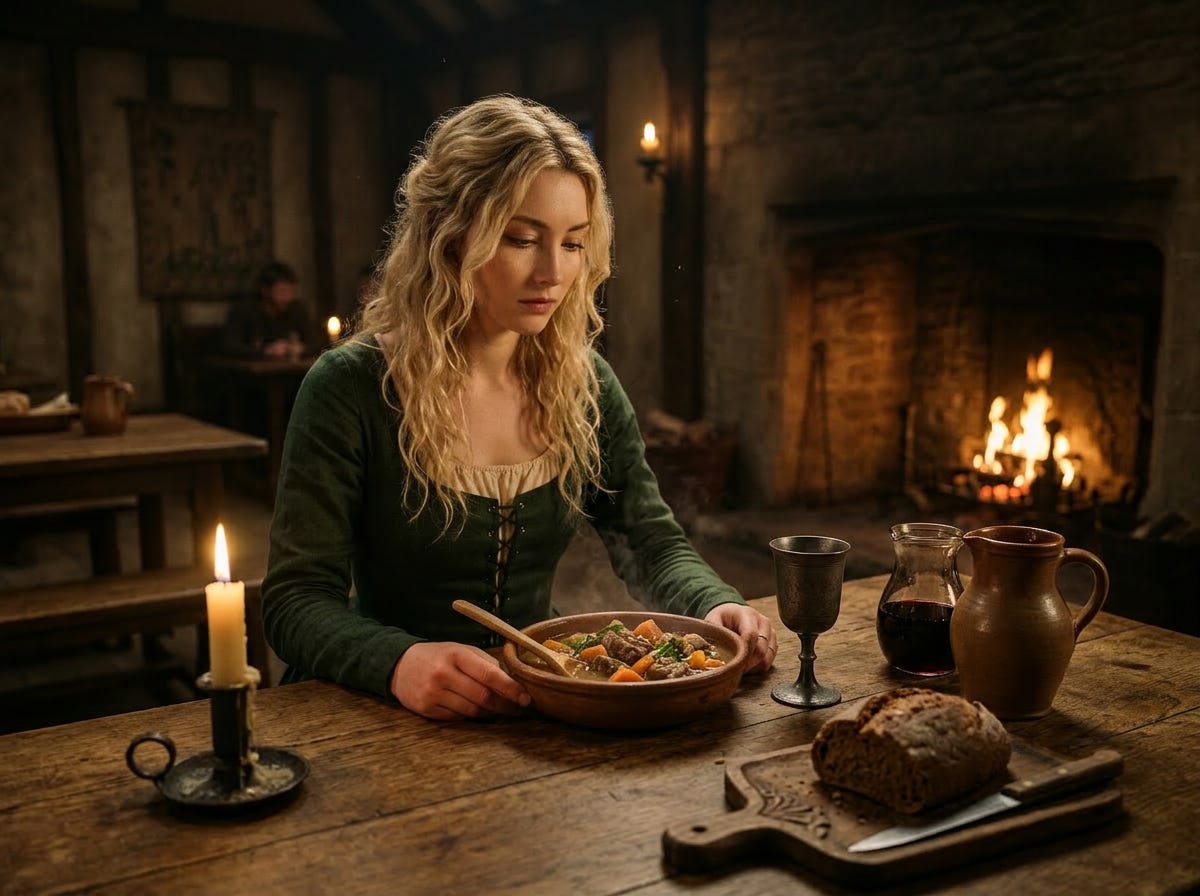
She wondered how long it would be before she wished for a meal this good again.
Scarlet looked around the main room. These were her people. Within her father’s demesne. Two grizzled men arguing about the price of pork, a foursome betting farthings at cards, a single gentleman reading a book by candlelight and sipping the same wine she had on her table, two nervous women in their forties talking about their upcoming visit to see the gardens in Stormrest. Her people. Mostly unhurried, just living their lives. There was something simple about it that she missed from her youth.
This, she thought, ought to be the purpose of the nobility. To ensure that these lives continued unmolested.
“Young lady?”
Scarlet’s mind snapped to the present.
“Would you like to join us?” One of the two women, both smiling at her. “No need for another woman to sit alone.”
Scarlet was taken aback slightly. “Oh, are you sure? I wouldn’t want to intrude.”
“Come, come. We are just chatting.”
“Okay,” Scarlet said. She picked up her things and moved them to one of the two empty spots, joining them.
“I’m Charlotte,” said the first woman. “This is Patty. We’re going to Stormrest for the first time.”
“Really?” Scarlet asked.
“We’re hoping to get a look at the queen’s son,” Patty confessed.
“He’s worth a look,” Scarlet smirked.
“Oh, you’ve seen him then?” Charlotte asked.
“Once or twice,” Scarlet said, realizing it might have been a mistake.
“I see you’re carrying a sword,” Patty said. “Are you traveling alone? Young girl like you? Abba protect you.”
A reference to the goddess of fate.
“I am,” Scarlet said. “But I brought the sword because I’m not leaving it up to Abba.”
Patty chuckled. “As long as the blade’s longer than a man’s arm, you might be alright.”
“Have you seen the gardens?” Charlotte asked.
Scarlet had. Many times. So many times that she’d begun to take them for granted which she realized had been a mistake. She nodded. “They are beautiful. I especially like the floating carnations.”
“Floating?” Charlotte asked, wide-eyed. “Didja hear that, Patty?”
Patty nodded.
“Where have you ladies come from?”
“Faerlong Dell,” Charlotte said. “Recently returned to it. I’m re-settling my grandparents’ place that had been taken over by the goat-men.”
“Disgusting creatures,” Patty nearly spat. “They eat horses.”
Scarlet tried to keep the annoyance off her face. In her great grandfather’s time, before the war, the Urukesh had lived openly within Stormrest and humans had lived openly in Urukesh cities. They had once been friendly peoples. But decades of war had a way of making people reduce their opponents to caricatures.
“So, the village has been re-opened recently?”
“About a year ago,” Patty said. “The Knights Celestial are responsible for that.”
“Philip Beckwith,” Charlotte said, dreamily. “If I was twenty years younger…”
Philip. Beckwith.
She shivered, remembering the way he looked at her without apology.
Dangit.
She hadn’t given it any thought until now. To get to Psalter’s Point, she was probably going to have to go through a garrison. What if he was there?
“You okay?” Charlotte asked.
“Me?” Scarlet said. “Yeah, I’m fine.”
“He’s also worth a look,” Patty said.
“No idea who that is,” Scarlet lied.
Scarlet enjoyed the rest of the conversation, but her mind kept drifting back to the man the queen wanted her to marry.
Elegant.
She tried to be angry.
But she wasn’t.
That night she was restless in her borrowed bed. Sleep would not come easily.
The room was warm enough, the bed softer than she deserved, and yet her thoughts would not settle. Every time she closed her eyes, the road ahead stretched longer, darker—no longer a matter of defiance, but of consequence. Psalter’s Point was not just distance. It was decision.
She had spoken boldly at home, certain in her refusal. Certain in herself.
But certainty was easier in a hall filled with servants and familiar walls.
Out here, it felt thinner.
Scarlet turned onto her side, staring at the faint line of candlelight beneath the door.
If she failed, she would not simply return. She would be brought back. Even now, she was sure that her father had sent someone, possibly several someones, to find her. Perhaps Benedict himself had already taken the trail, obeying his master’s command.
She pushed the thought away. There would be no retreat. Only forward—or capture.
Stephen B. Anthony is the author of Transmigrant, an epic science fiction thriller, available on both Amazon and Audible. The first seven chapters are available on this website for free.
I absolutely love the scene you set in the inn. So rich and inviting! And I really want that meal she ate 🤤